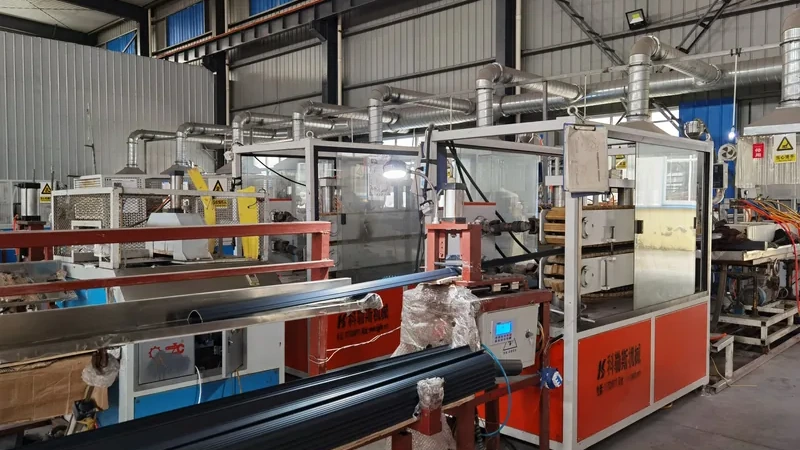
Polymer extrusion is the continuous process behind most of the plastic sections you see around you — window seals, cable channels, edge trims, light covers, tubing and industrial guides. Because output is continuous, the process rewards stable control and punishes optimistic drawings. This guide explains what polymer extrusion actually is, how a production line works end to end, which tolerances and materials are realistic, and how to evaluate a profile extrusion supplier before tooling money is committed.
- Polymer extrusion is a continuous process: melted plastic is forced through a die head, calibrated, cooled and cut to length.
- Profile widths from 5 to 600 mm are commercially routine; ±0.05 mm on a profile cross-section is achievable, but always subject to material and section geometry.
- Co-extrusion runs up to 3 layers in one pass, pairing a rigid carrier with a soft functional element such as a sealing lip.
- Most defects trace back to four variables: melt temperature, die head flow balance, vacuum calibration and haul-off stability.
- First-article approval is not long-run stability; dimensional checks must continue at intervals through the production run.
- Standards such as EN 12608 and ASTM D638 define what to test, so ask for traceable results instead of adjectives.
What Is Polymer Extrusion?
Polymer extrusion is a continuous manufacturing process in which thermoplastic granules are melted, pressurized by a rotating screw and forced through a die head that shapes the melt into a constant cross-section. The emerging profile is calibrated, cooled, pulled and cut to length. Because the output is endless until cut, geometry — not length — is what the tooling defines.
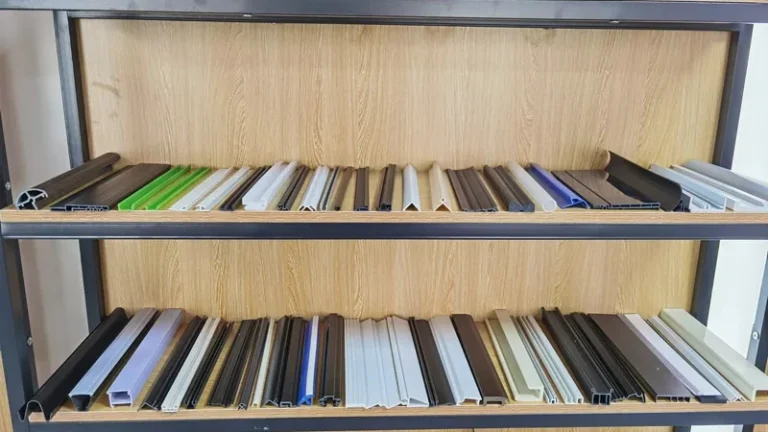
The term covers a family of formats: solid and hollow profiles, tubes and pipes, sheet, and custom sections developed to a customer drawing. Modern profile extrusion shops run anything from a 5 mm sealing strip to a 600 mm industrial channel on the same class of equipment, with single-layer and multi-layer tooling. For a broader walk-through of the process family, see this plastic extrusion molding overview.
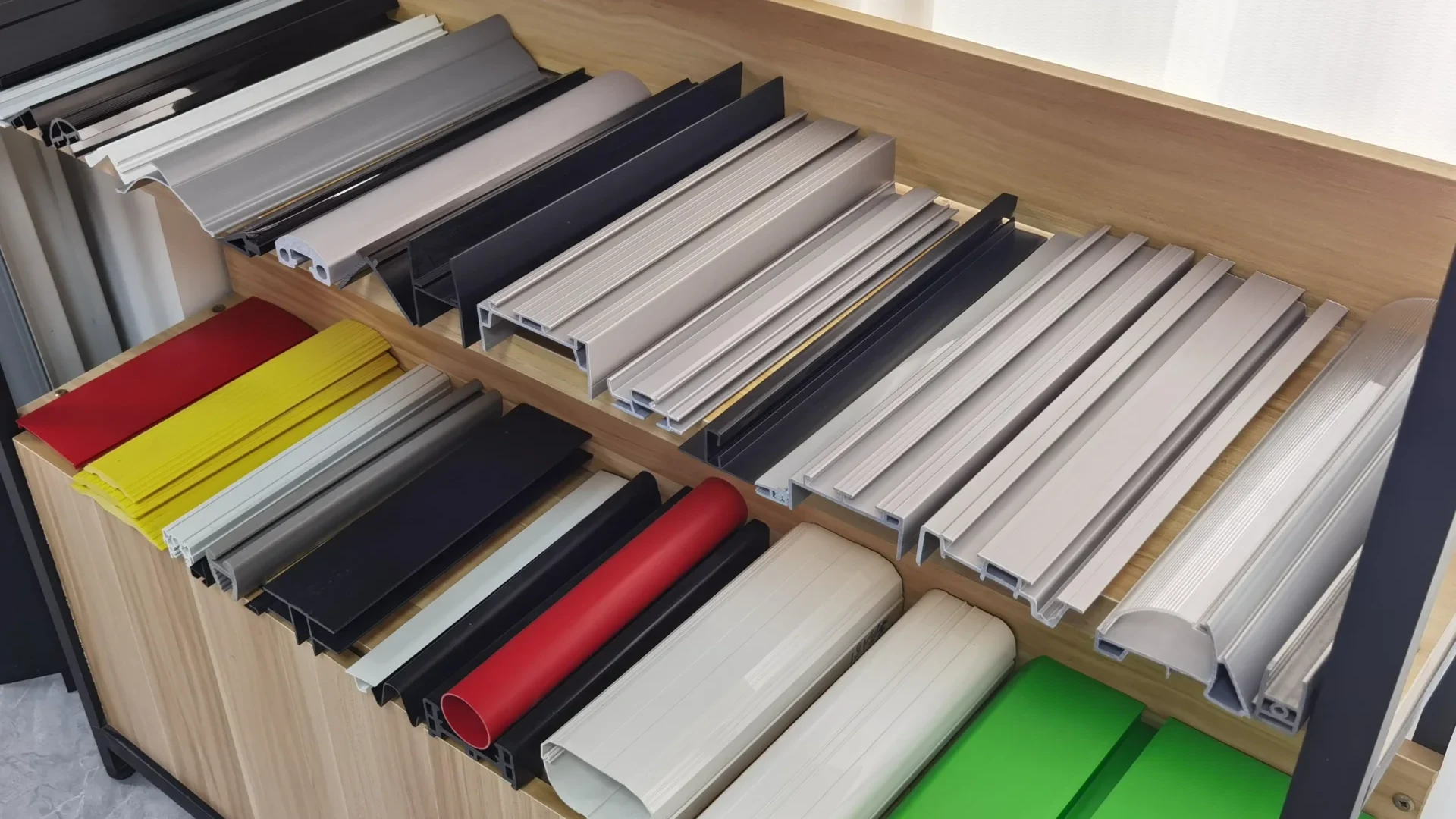
Compared with injection molding, which produces discrete parts in a closed tool, extrusion produces a continuous section whose length is decided by cutting rather than by the mold. That makes it the natural process for seals, channels, guides, trims and tubes measured in meters, and it changes the quality conversation: instead of inspecting part after part, you manage a stable line and check the profile at planned intervals.
How Does an Extrusion Line Actually Work?
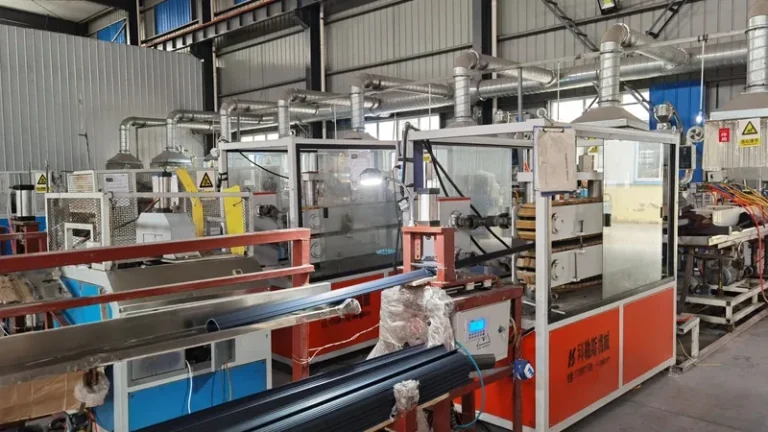
Every line runs the same fixed sequence: material preparation, screw melting, die head shaping, vacuum calibration, water cooling, haul-off and cutting. Each stage sets up the next — melt quality limits what the die head can do, and calibration quality limits what the haul-off can hold.
Feeding and melting. Granules — dried first for moisture-sensitive resins such as PC, PA and ABS — enter the barrel, where a rotating screw conveys, melts and homogenizes them. Melt temperature windows vary by material, roughly 180–230 °C for PVC and PP and 220–280 °C for ABS and PC, and staying inside the window matters more than hitting an exact number. A screen pack filters contamination before the melt reaches the tooling.
Die head and flow balancing. The die head is where the cross-section is actually created. Melt must leave every point of the die lip at the same speed; where it does not, the profile emerges thick in fast zones and thin in slow ones. Die design therefore combines flow simulation with deliberate trial corrections on the tooling, which is why a new section usually needs a few tool trials before it runs clean.
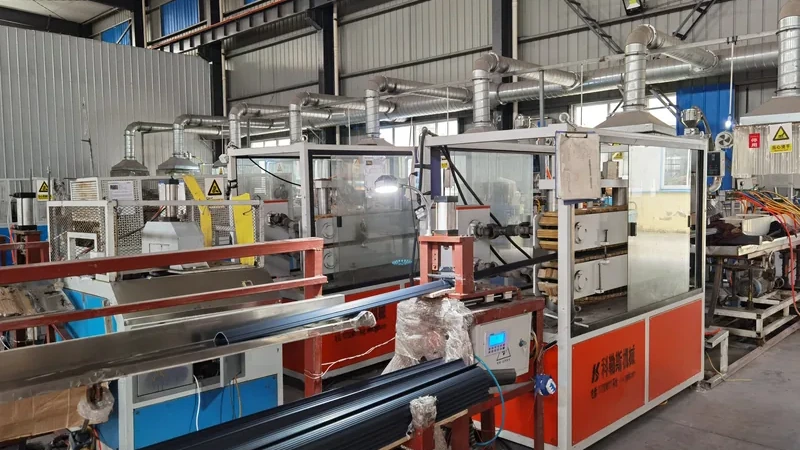
Calibration and cooling. Immediately after the die, the hot profile passes through a vacuum calibrator that fixes its outer geometry while water cools it from the outside in. Cooling length scales with wall thickness and line speed; thick sections need substantially more tank than thin ones, and unequal cooling is a classic cause of bowing.
Haul-off, cutting and in-line operations. A dual-belt haul-off grips the profile without marking it and pulls at constant speed — the single biggest factor in repeatability along the length. Downstream, saws or guillotines cut to length, and in-line punching, embossing or printing can add holes, texture or marking without a separate handling step.
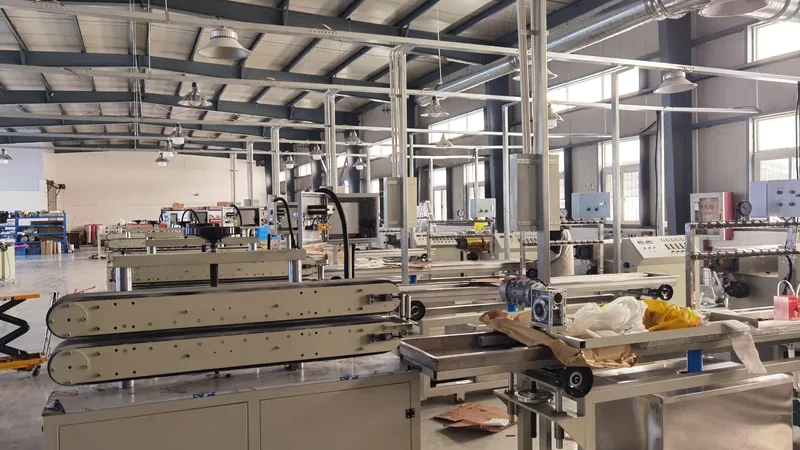
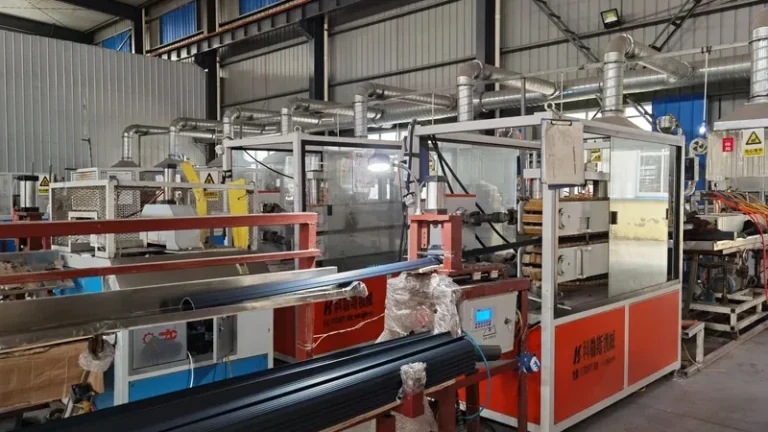
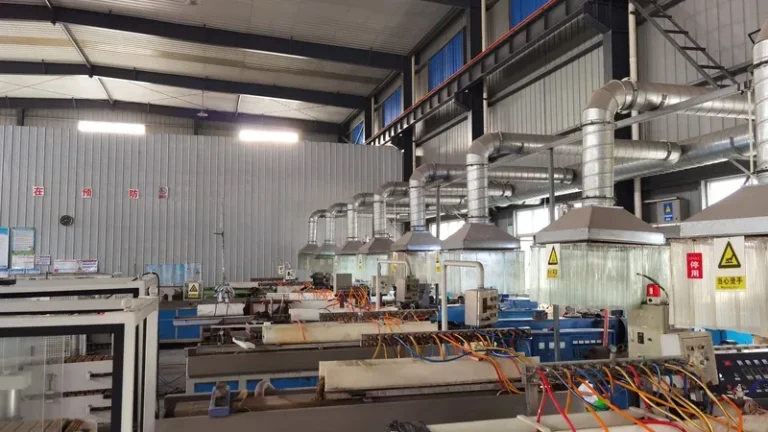
ZetarVac runs 7+ automated extrusion lines with a maximum profile width of 600 mm, and the lines support in-line punching, embossing and printing. For a buyer, that means holes, branding and surface texture can be added during extrusion itself, protecting both dimensional accuracy and unit cost.
Which Materials Are Used in Profile Extrusion?
Nearly every structural thermoplastic can be extruded. The working palette in profile extrusion includes PVC, ABS, HDPE, LDPE, PP, PC, PMMA, PA6/PA66, POM, TPE, TPU and TPV, plus blends such as PC/ABS and ASA for outdoor service. Selection is driven by stiffness, service temperature, weathering and contact requirements — not by what the die head can cut.
| Material | Typical extruded products | What to verify on the datasheet |
|---|---|---|
| PVC (rigid) | Window and door profiles, decorative trims, pipes, sealing strips | EN 12608 class, impact resistance, heat reversion |
| ABS | Automotive and industrial profiles, decorative parts | Heat resistance, surface finish |
| HDPE | Pipes, edge trims, guide rails, wear strips | Density class, stress-crack resistance |
| PP | Profiles, pipes, functional parts | Melt flow index, low-temperature impact |
| PC / PMMA | Transparent pipes, light covers, clear profiles | Light transmission, Vicat softening point1 |
| PA6 / PA66 | Industrial profiles, wear parts, mechanical parts | Moisture effect on dimensions |
| POM | Precision profiles, guide rails | Dimensional stability in service |
| TPE / TPU / TPV | Sealing strips, gaskets, hoses, conveyor belts, protective sleeves | Shore hardness, compression set |
| ASA / PC/ABS | Outdoor profiles, industrial and automotive sections | UV stability, weathering data |
For pipe products, wall thickness is not chosen freely: ASTM D2241 dimensions PVC pressure pipe by standard dimension ratio2, and ISO 4427 sets material and dimensional requirements for PE water-supply pipe. On a datasheet, temperature capability is usually expressed as a Vicat softening point rather than a single maximum service temperature, because creep under load moves the real limit downward.
Co-extrusion3 extends the palette further: two or three materials are pushed through one die head in a single pass, so a rigid carrier can carry a soft sealing lip, a wear surface or a decorative skin. Compatibility is the gate — the layers must bond to each other and process at compatible melt temperatures. The tooling side is explained in more detail in this co-extrusion die head article.
Co-extrusion combinations actually running in production at ZetarVac include PP+TPV, PP+TPE, PVC+TPU, ABS+TPU and TPV+CPVC, with up to 3 layers in a single pass. If a drawing needs a rigid section plus a soft functional element, the useful question for a supplier is whether that pairing is already proven on the line.
How Tight Can Extrusion Tolerances Really Be?
On a well-set line, ±0.05 mm is achievable on critical cross-section dimensions, subject to material and section geometry. Wide walls, long unsupported legs, glass-filled compounds and regrind all push the realistic band outward. Judge each dimension on its own geometry rather than applying one blanket tolerance across the drawing.
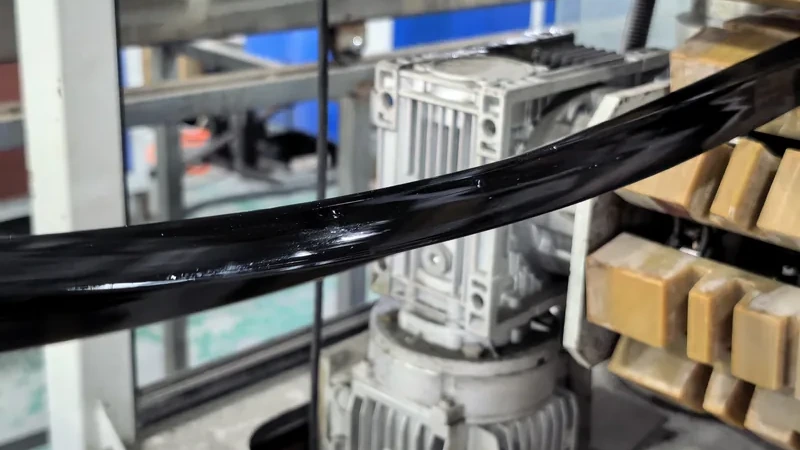
The physics behind the limits is die swell4, the elastic expansion of the melt as it exits the die lip. Because the melt grows slightly after leaving the tooling, the final size is a function of die design and controlled draw-down, not of the die opening alone. Add asymmetric cooling, which bows non-uniform sections, and post-cooling shrinkage, which continues for hours after the cut, and it becomes clear why uniform wall thickness and generous internal radii are worth more than any tolerance negotiation.
"Tolerances are free — you can call out ±0.05 mm on every dimension of the drawing."False
Tight bands on every dimension fight each other during calibration and force slower line speeds with more scrap. The cost returns either in the unit price or in a tolerance disclaimer that surfaces after tooling is already cut.
"Critical dimensions deserve tight bands; everything else should stay practical."True
Identify the two or three dimensions that make the profile function — a seal lip, a clip leg, a slide width — and tolerance those tightly. Let the rest carry general bands so the line can run at an economic speed.
For transparent profiles in PC and PMMA the same logic applies, with one extra constraint: polish quality in the die head and calibrator determines surface finish, and any scratch in the flow path shows on the finished part. Clear sections therefore reward suppliers who maintain dedicated polished tooling.
What Causes Most Extrusion Defects?
Four process variables explain most defects: melt temperature, die head flow balance, vacuum calibration and haul-off speed stability. Surface defects such as melt fracture, die lines and gels usually point to melt problems, while dimensional drift and wave usually point to calibration or pulling problems.
Melt fracture and poor surface. Excessive shear at the die lip, degraded regrind or a melt temperature above the material window produces rough or sharkskin surfaces. The fix is thermal and rheological, not cosmetic: lower line speed, adjust melt temperature or re-balance the die.
Warping and bowing. Uneven wall thickness or asymmetric cooling makes one side shrink more than the other. The profile leaves the cooling tank already curved, and no downstream straightening reliably fixes a geometry problem.
Dimensional drift along the length. Melt temperature creep, haul-off belt slip and vacuum loss in the calibrator each move dimensions slowly. This is why a stable line is monitored rather than assumed — a drift caught inside tolerance is a process alarm, not yet a scrap event.
Bubbles, voids and gels. Moisture in hygroscopic resins flashes into steam bubbles at the die, while contamination and degraded material show up as gels. Both are material-handling failures, which is why drying parameters belong on the process sheet.
A systematic walk through these failure modes, with causes and fixes mapped to line variables, is in this extrusion defects troubleshooting guide.
"Once the first article is approved, the profile will hold those dimensions for the whole run."False
A first article is a snapshot from a freshly tuned line at one moment in time. Melt temperature drift, haul-off slip and vacuum loss all move dimensions gradually, so an approved start does not protect hour six of a shift.
"Dimensional stability has to be verified at intervals across the whole run."True
Ask how the line is monitored: scheduled cross-section checks, tracked measurements on critical dimensions and defined reaction limits. A supplier who can show interval-based records is demonstrating a process, not just a good morning.
One further production reality: regrind ratio and material lot changes both shift melt behavior. A process sheet that fixes drying parameters, regrind ratio and temperature profile is what keeps the second shift identical to the first.
How Should You Evaluate a Profile Extrusion Supplier?
When the buyer is ready to compare suppliers, the evaluation should be about process evidence, not brochure adjectives. The four points below are deliberately short enough to use in a first technical call.
Standards traceability. For rigid PVC building profiles, EN 12608 specifies the profile geometry, impact resistance and heat reversion requirements that PVC-U window and door profiles must meet, so a qualified supplier quotes test results against it rather than describing color and finish. For mechanical claims, ASTM D638 is the default tensile test cited for extruded profiles, and ISO 1163 provides the designation system for PVC-U extrusion materials — datasheet numbers should be traceable to defined specimens and test conditions.
Co-extrusion evidence. Ask which material pairings actually run in production, not which ones are theoretically possible. A line that runs PP+TPV every week will qualify an automotive seat-rail strip faster than one experimenting with the combination on your tooling.
In-line capability. Punching, embossing and printing on the line remove a handling step, and every removed handling step removes a tolerance risk and a cost line.
Capacity and batch flexibility. Prototyping, small batches and volume production should run on the same process family, so a qualified prototype does not need re-qualification when volumes grow.
The plant runs 45+ production lines in total, with reference monthly capacity of roughly 300–500 tonnes across the extrusion lines, and supports prototyping as well as small and large batches. In practice this means a buyer can start with a prototype run and scale to volume without changing process families.
None of these points requires a site visit to verify; all of them can be settled in a technical call with drawings on screen.
"The lowest quoted price per meter is the cheapest option overall."False
Quotes that look low often exclude tooling corrections, secondary operations or a realistic tolerance regime. Those costs come back later as change orders, or as scrap your incoming inspection discovers.
"Compare supplier quotes on identical scope before comparing prices."True
Put the same drawing, the same tolerance notes and the same secondary operations in front of each supplier. When the scope is identical, the price difference tells you something real about the process behind it.
FAQ
Is polymer extrusion viable for small quantities?
Extrusion economics come from continuous running, so very short runs are rarely its natural territory — but prototyping and small batches are supported across the industry, typically with simpler single-cavity tooling and slower line speeds. The plant supports prototyping, small batch and large batch production on the same equipment family, which matters when a product is expected to scale.
What does a custom profile die actually cost?
Die cost follows section complexity, cavity count, material and expected volume, so a meaningful answer needs the drawing first. A structured breakdown of what drives custom profile extrusion cost — tooling, material, secondary operations and volume — is in this cost breakdown article.
What information does a supplier need to quote a profile?
At minimum: a cross-section drawing with tolerances, material or target properties, order quantities, cut lengths, color and the service environment. Standards the part must meet belong in the first conversation, not in a dispute later.
Can tight tolerances hold on transparent profiles?
Yes, within the same limits as opaque sections. For PC and PMMA clear profiles, ±0.05 mm class accuracy on critical dimensions is achievable subject to geometry, and polished tooling is what keeps the surface free of flow marks.
How do I move from a drawing to a production decision?
The fastest step is a technical review: share your drawings and ask the three questions that decide feasibility — material pairing, achievable tolerance on your section geometry, and calibration strategy. To evaluate your profile against real line capability and talk to an engineer, start with the China plastic extrusion manufacturer page or the service overview.
-
Vicat softening temperature: The temperature at which a loaded needle penetrates a thermoplastic specimen to a defined depth, used as a heat-resistance indicator. ↩
-
SDR: Standard Dimension Ratio, the ratio of a pipe’s outside diameter to its wall thickness, used to dimension pressure-rated plastic pipe. ↩
-
Co-extrusion: Extruding two or more polymer layers through a single die head in one pass, combining different material functions in one profile. ↩
-
Die swell: The expansion of melted polymer as it exits the die, caused by elastic recovery of the molecular chains. ↩