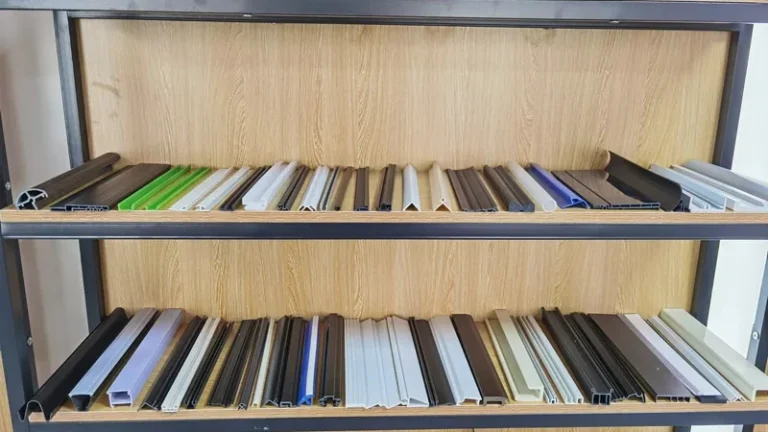
Extrusion is the workhorse behind a surprising share of the plastic parts around you: window frames, cable channels, sealing strips, pipe runs, guide rails and edge trims all begin life as continuous extruded sections. When buyers first ask what extrusion actually is, they usually get either a textbook definition or a sales pitch. This guide takes a middle path — a working engineering explanation of the process, the tolerances and materials you can realistically specify, and the checks that separate a stable production run from a costly one.
- Extrusion is a continuous process: melted plastic is forced through a die head into a constant cross-section, then calibrated, cooled and cut to length.
- Cross-section tolerance depends on material and section geometry; ±0.05 mm on the profile cross-section is achievable but must be qualified per drawing.
- Co-extrusion of up to 3 layers lets one profile combine rigid structure with a soft sealing lip or low-friction surface in a single pass.
- Material choice drives everything: PVC for construction sections, PP and ABS for industrial and automotive parts, TPE, TPV and TPU for flexible function.
- First-article approval alone does not prove a stable run; dimensional data over continuous length is what matters at volume.
- When evaluating suppliers, look for line count, in-line secondary operations and documented process parameters — not just a quoted price.
What Is Extrusion in the Manufacturing Process?
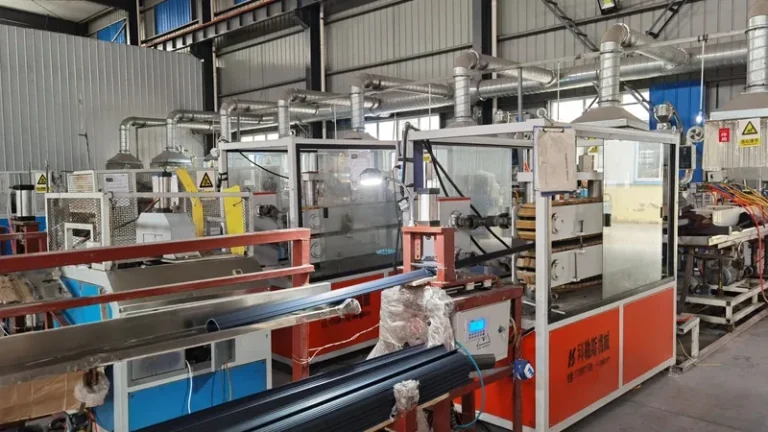
Extrusion is a continuous manufacturing process in which plastic pellets are melted by shear and heat inside a rotating screw and barrel, then forced through a shaped die head to form a part with a constant cross-section. The emerging section — a profile, tube, pipe or sheet — is sized, cooled and cut to length without ever stopping the line.
In practice, an extrusion line never makes one discrete part at a time; it makes metres of section per minute, and the part only becomes discrete at the cutter. That single difference shapes every downstream decision: how tolerances are controlled, how packaging is quoted, and why sample quantities are priced differently from volume orders.
Melt temperatures are material-specific engineering ranges rather than fixed numbers. Rigid PVC typically processes around 170–200 °C, polypropylene and ABS roughly 200–250 °C, and engineering polymers such as PA6 or POM higher still, depending on machine and section geometry. What matters to a buyer is not the exact number but whether the supplier can document a stable process window for your resin — the subject of our profile extrusion process parameters guide.
How an Extrusion Line Turns Pellets Into an Extruded Profile
Knowing each stage helps you ask sharper questions during supplier selection, because nearly every profile defect traces back to one of them — our common extrusion defects and troubleshooting guide maps the symptoms.
Feeding and melting: Dried pellets enter the screw and barrel, where rotation generates most of the heat through shear. A breaker plate and screen pack filter contaminants before the melt reaches the die.
The die head: This is where the cross-section is born. The die head must distribute melt evenly across the section; unbalanced flow reappears downstream as warpage, uneven walls or bow. For custom sections, profile extrusion die design is the largest single engineering investment, which is why non-standard sections are developed from customer drawings rather than selected from a catalogue.
Calibration and cooling: The hot section enters a vacuum calibrator or sizing sleeve that fixes the outer geometry while water tanks remove heat. Under- or over-cooling here causes post-exit distortion that no later straightening fully removes.
Haul-off and cutting: The haul-off1 pulls the section at a constant, controlled speed; speed variation shows up directly as thickness and length variation. An in-line cutter then divides continuous output into order lengths.
In-line secondary operations: Punching, embossing and printing can run on the line itself, so holes, markings and surface textures are added without a second handling step.
A line is a balanced system: change the haul-off speed and you change cooling time; change the die and you may need a different calibrator. That is why quotations for a new extruded profile include tooling lead time — the die and calibration tooling must be proven on the actual production line.
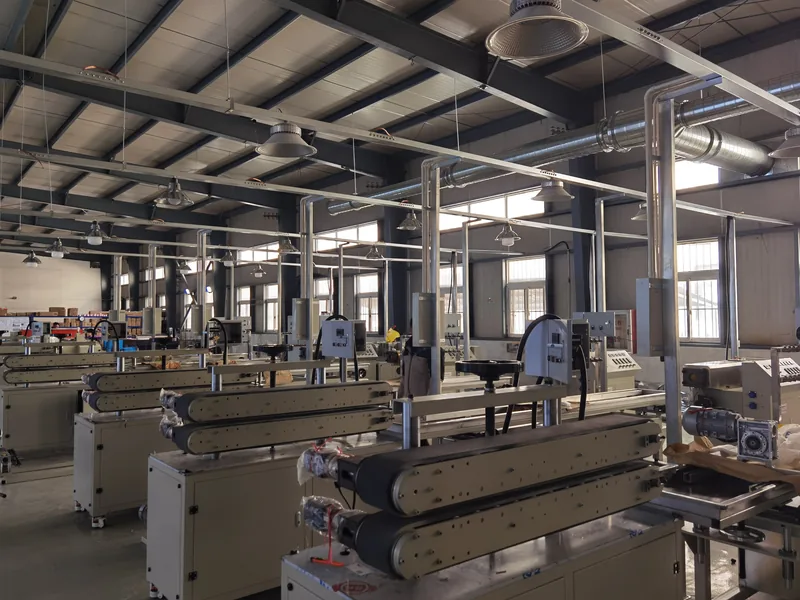
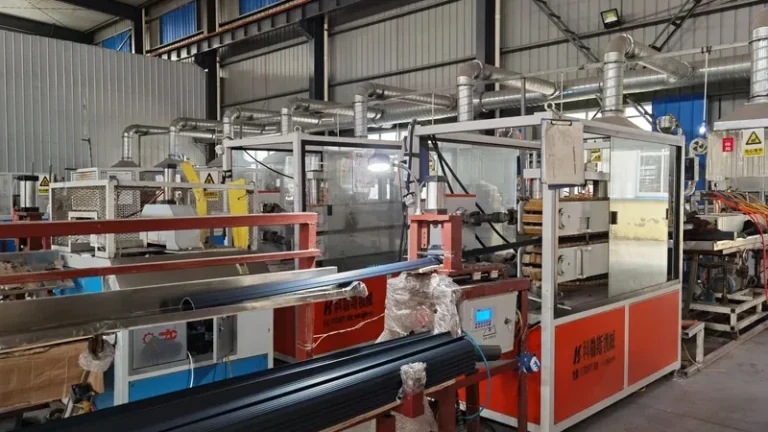
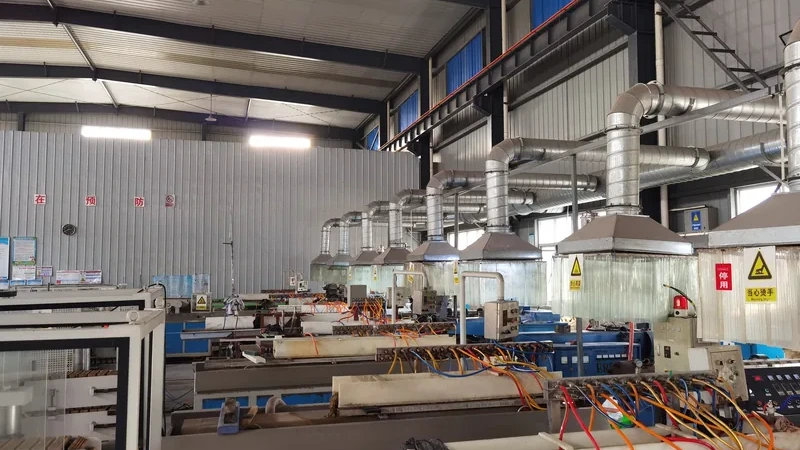
ZetarVac runs 7+ automated extrusion lines with a maximum profile width of 600 mm, and punching, embossing and printing are available as in-line operations. For buyers, that means hole patterns, branding and texture can be built into the same pass instead of planned as separate secondary processes.
Which Materials Suit Profile Extrusion Best?
Almost every major thermoplastic can be extruded; the practical question is which resin matches your section’s function, environment and cost target. Material choice determines the melt window, calibration behaviour and achievable tolerance, so it should be fixed before tooling is cut.
| Material | Typical extruded products | Why it is specified |
|---|---|---|
| PVC | Window and door profiles, decorative trims, pipes, sealing strips | Cost-efficient, weatherable, construction-proven |
| ABS | Automotive and industrial profiles, decorative parts | Rigid, good impact behaviour, easy finishing |
| HDPE | Pipes, edge trims, guide rails, wear strips | Low friction, abrasion and chemical resistance |
| LDPE | Film, flexible tubing, soft profiles | Flexibility at low cost |
| PP | Profiles, pipes, functional parts | Fatigue and chemical resistance, low density |
| PC / PMMA | Transparent pipes, light covers, clear profiles | Optical clarity and light transmission |
| PA6 / PA66 | Industrial profiles, wear parts, mechanical parts | High strength and wear resistance |
| POM | Precision profiles, guide rails, mechanical parts | Dimensional stability, low friction |
| TPE / TPU / TPV | Sealing strips, gaskets, hoses, conveyor belts, protective sleeves | Elastic recovery and soft-touch function |
| ASA | Outdoor and building profiles | UV and colour stability without painting |
| PP/GF | High-strength industrial profiles | Glass reinforcement for stiffness |
Where heat is involved, ask for the Vicat softening temperature2 of the specific compound rather than for the generic resin family. Softening behaviour varies with formulation, and it is a more useful screening indicator for profile service temperature than a datasheet melting point.
For a broader view of how extrusion sits among plastic forming processes, our plastic extrusion molding hub covers the wider manufacturing context.
What Tolerances Can You Hold on an Extruded Profile?
Achievable tolerance depends on the material and the section geometry, not on the drawing alone. On the profile cross-section, ±0.05 mm is a realistic capability for well-behaved sections, while thick, unbalanced or heavily filled sections need more generous limits.
Standards give both sides a shared yardstick. EN 12608 specifies the profile geometry, impact resistance after ageing and heat reversion limits that PVC-U window and door profiles must satisfy3, which is why established PVC profile suppliers quote against it rather than against an internal company standard. Mechanical properties are verified the same way: tensile behaviour of the extruded material is characterised to ASTM D6384, the default tensile test cited for extruded profiles, so both parties measure the same property with the same method.
"If the first article passes inspection, the profile will hold that tolerance for the whole production run."False
First-article approval only proves the tooling and process settings were correct at that moment. Die wear, screw and barrel wear and melt temperature drift all move dimensions over kilometres of output, so a passing first article without run data says nothing about month three.
"Tolerance should be confirmed by measurement over a continuous production run, not at the first article alone."True
Sampling dimensions at defined intervals across a continuous run shows whether the process is centred and stable. A supplier who can present this data during evaluation is offering evidence instead of a promise.
For functional fits — a profile that must slide into a channel, or a sealing lip that must compress against a panel — put tight tolerance on the functional surfaces and generous tolerance on the rest. Blanket tight limits across every dimension raise tooling cost and slow qualification without improving the part.
When Does Co-Extrusion Beat Single-Layer Extrusion?
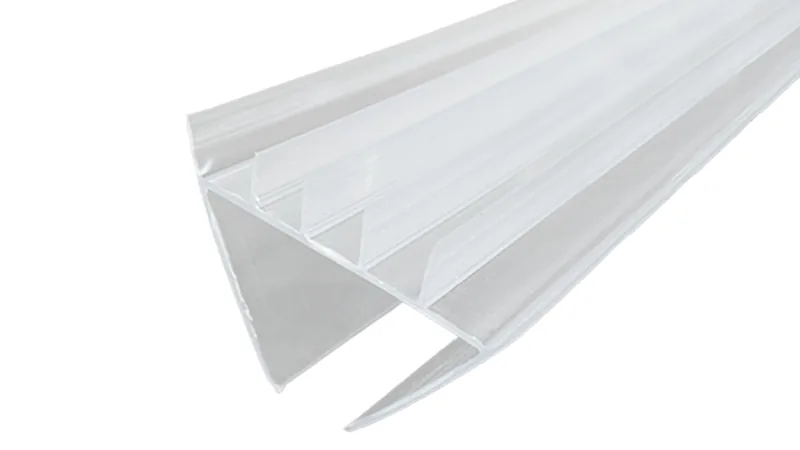
Co-extrusion5 earns its place when a single resin cannot deliver two contradictory properties — rigid structure plus a flexible sealing lip, or a weatherable skin over a structural core. The combinations actually run in production include PP+TPV, PP+TPE, PVC+TPU, ABS+TPU and TPV+CPVC, with up to 3 layers in a single pass.
Two de-identified cases show the logic. An automotive seat slide rail strip is co-extruded in PP+TPV: the PP carries structural load, while the TPV layer provides dust exclusion, guiding, wear resistance and low friction through a flexible sealing lip. A household robot vacuum squeegee strip pairs ABS with TPU — ABS supplies the rigid support, TPU the flexible wiping contact and wear resistance. In both cases no single resin could do both jobs, and joining two separate parts would add assembly cost and a failure point.
"Co-extrusion is only worth specifying for decorative two-colour profiles."False
The main industrial value of multi-layer extrusion is functional: a soft sealing lip on a rigid core, or a wear surface exactly where it is needed. Treating it as decoration means missing single-part solutions for sealing and wear problems that otherwise need assembly.
"Co-extrusion pays for itself when one profile must combine rigid and elastic functions in a single part."True
A rigid-plus-flexible section removes assembly steps, eliminates joints that can leak or rattle, and lets each material do what it does best. The trade-off is more complex tooling, so annual volume must justify the die investment.
For less demanding sections, single-layer extrusion remains the right answer: simpler tooling, faster qualification and lower cost. Double and triple layer capability exists to solve problems, not to complicate quotations.
How Should You Evaluate an Extrusion Supplier?
Evaluate the system, not the sample. Between an approved drawing and a stable production run sit checkpoints that are worth walking through with any candidate supplier.
Process window documentation: Ask at which melt temperature, line speed and vacuum settings the process was validated. A supplier who runs by feel cannot reproduce your part after a line change.
Dimensional monitoring over length: Cross-section dimensions should be sampled across the run, not once at start-up.
Material traceability: The compound lot used for qualification should be recorded and repeatable.
Packaging for continuous sections: Long profiles fail in transit more often than on the line; bundling, coiling or rigid packing should match the stiffness of the section.
ZetarVac operates 45+ production lines across the plant, with reference monthly capacity of roughly 300–500 tonnes on the extrusion lines, and supports prototyping, small batch and large batch production. That range matters when your programme moves from sample lengths to annual volumes without changing suppliers.
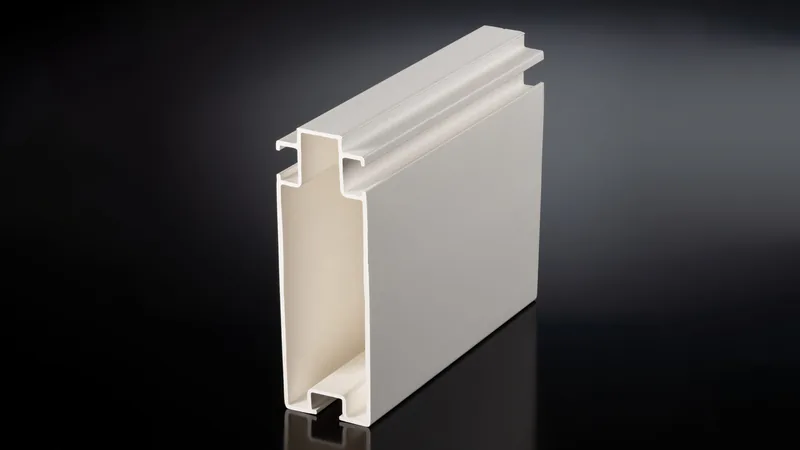
Also ask how a new section is qualified: how many metres are run before first-article sign-off, exactly what is measured, and who approves process changes afterwards. The answers reveal more about a supplier than any brochure, and our service overview shows how these checkpoints map to one integrated workflow.
FAQ
What products are made with plastic extrusion?
Continuous sections with a constant cross-section: window and door profiles, pipes and tubes, sealing strips, edge trims, guide rails, wear strips, cable channels, light covers and custom industrial sections developed to customer drawings.
Is extrusion only suitable for high volumes?
Not necessarily. The process favours volume because output is continuous, but prototyping and small batches are supported as well. The tooling investment is the main volume decision, not line availability.
What tolerance should I put on my drawing?
Start from function: tight limits on fitting or sealing surfaces, standard limits elsewhere. On the cross-section, ±0.05 mm is achievable subject to material and section geometry, and your supplier should confirm the achievable value per drawing before tooling is cut.
How is extruded profile quality tested?
Typical checks include cross-section measurement over the run, tensile testing to ASTM D638, and, for PVC-U construction profiles, conformance to EN 12608 covering geometry, impact resistance and heat reversion. Heat resistance is often screened with the Vicat softening temperature.
How do I start an extrusion project with a supplier?
Bring the cross-section drawing, target material or properties, required lengths and annual volume. To compare capabilities before committing, send your drawings through our China plastic extrusion manufacturer page and talk to an engineer about your section.
-
Haul-off: The caterpillar or belt unit that pulls the extruded section away from the die at a constant, controlled speed; its stability directly governs wall thickness and length accuracy. ↩
-
Vicat softening temperature: The temperature at which a loaded needle penetrates a thermoplastic specimen to a defined depth, defined in ISO 306; used as a comparative indicator of heat resistance. ↩
-
EN 12608: The European standard for unplasticized PVC (PVC-U) profiles for windows and doors, covering profile geometry, impact resistance after ageing and heat reversion limits. ↩
-
ASTM D638: The standard test method for tensile properties of plastics, the default tensile test cited for extruded profiles. ↩
-
Co-extrusion: An extrusion arrangement in which two or more melts are combined within a single die to form a multi-layer profile, typically up to three layers. ↩