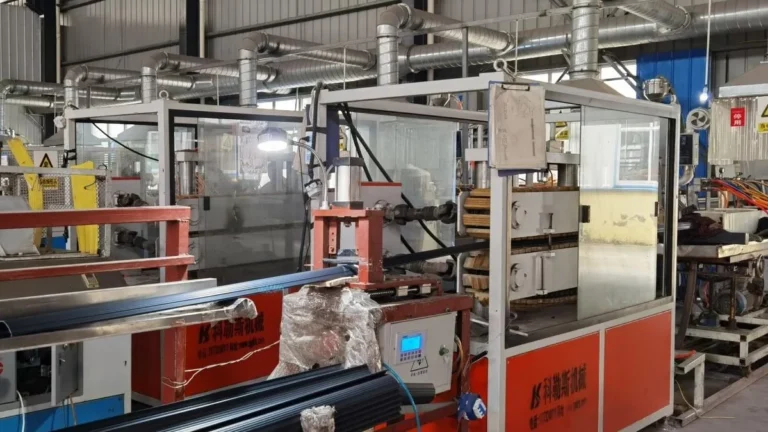
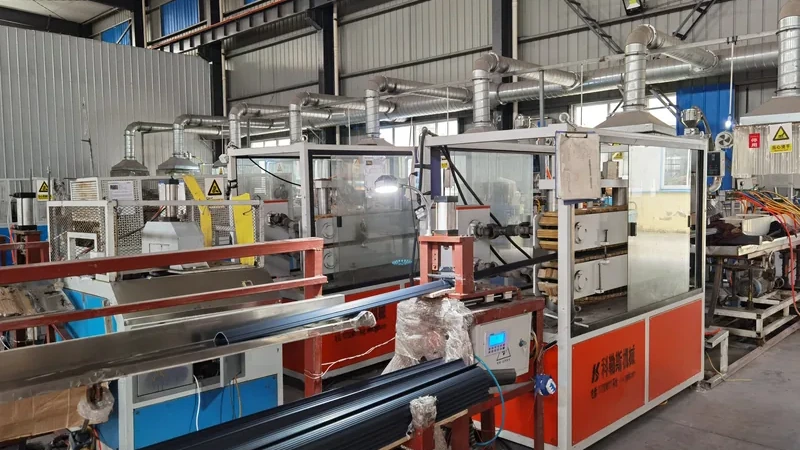
A plastic profile never leaves a factory as the output of one machine. It is the product of an extrusion line: a chain of integrated equipment that melts, shapes, sizes, cools, cuts, and handles the material in one continuous pass. For a buyer comparing suppliers, knowing what actually sits along that chain is the fastest way to judge whether a quoted section is realistic, which tolerances are achievable, and where quality problems tend to start. This guide walks through the components, the process sequence, material and die options, and the checks that matter when you are evaluating a profile supplier.
- An extrusion line is not one machine but a sequence of stages — extruder, die head, calibration, cooling, haul-off, and cutting — that must run at matched speeds.
- Final dimensional accuracy is decided downstream as much as at the die: vacuum sizing, cooling length, and pull speed fix the profile cross-section.
- Co-extrusion up to three layers lets one line combine rigid and soft materials in a single pass, for example a rigid PP body with a flexible TPV sealing lip.
- Modern profile lines cover section widths from 5 to 600 mm, with dimensional tolerance down to ±0.05 mm depending on material and section geometry.
- Standards such as EN 12608 and ASTM D1784 define what a profile compound must demonstrate, so agree on the applicable standard before tooling starts.
What Is an Extrusion Line?
An extrusion line is a connected set of machines that converts plastic resin into a continuous finished profile: the extruder melts and pressurizes the material, the die head shapes it, and downstream units calibrate, cool, pull, and cut the product to length. Because every stage runs continuously at matched speeds, the line as a whole — not any single machine — determines output quality.
In profile extrusion, the term covers both the melt-preparation stage at the front end and everything that happens after the material leaves the extrusion die. A line configured for a rigid PVC window profile looks different from one running a soft TPE gasket, but the functional blocks are identical. What changes is the die design, the calibration method, the cooling length, and the temperature profile along the barrel. This line-level view also complements the material-side overview of plastic extrusion molding, which explains the technology from the compound outward.
The continuous nature of the process is its greatest strength and its main risk. Output per hour is high, unit cost is low, and sections are highly repeatable — but a disturbance at any stage propagates down the whole line within seconds. That is why experienced profile extrusion shops invest in stable temperature control, closed-loop haul-off drives, and in-line measurement instead of relying on end-of-line inspection alone.
What Are the Main Components of an Extrusion Line?
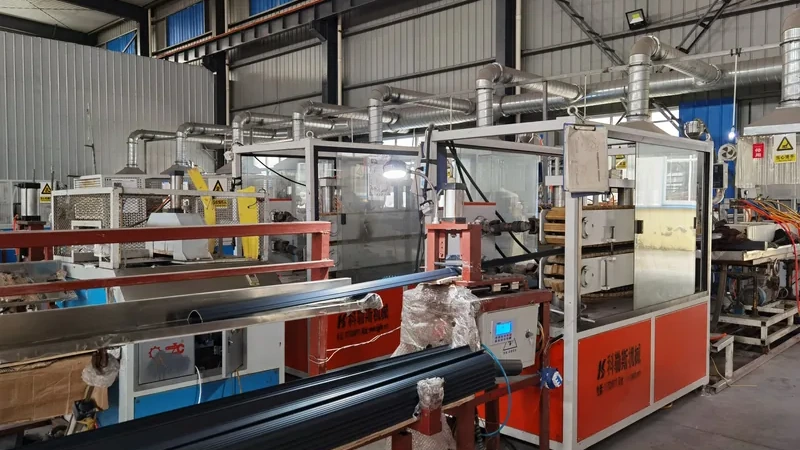
Six functional blocks make up a typical line: the extruder, the die head1, the calibration and vacuum sizing stage, the cooling trough, the haul-off2, and the cutting or coiling station. In-line secondary operations such as punching, embossing, or printing can be added between cooling and cutting.
Extruder and die head. The extruder feeds, melts, and homogenizes the resin; single-screw machines dominate profile work. Melt temperature depends on the material: rigid PVC is commonly processed around 170–200 °C, while polyolefins such as PP run hotter, often in the 200–250 °C range, with exact settings material- and machine-specific. The die head distributes this melt into the target section, and its flow-channel design determines wall-thickness balance and how much die swell the calibrator must absorb.
Calibration and vacuum sizing. The hot extrudate enters a calibrator, usually a water-cooled steel sleeve or plate set, where vacuum of roughly 0.4–0.8 bar pulls the outer surface against the sizing surfaces. This stage fixes the external dimensions while the core is still soft, so calibrator position and vacuum level are among the most sensitive settings on the line.
Cooling, haul-off, and cutting. Immersion and spray troughs remove the remaining heat until the section is dimensionally stable. The haul-off grips the profile with belt or caterpillar pads and draws it at a precisely controlled speed; on many die designs, the ratio between melt output and pull speed sets wall thickness. A traveling saw or shear then cuts to length without deforming the still-warm section.

These blocks are only as good as their synchronization. If the haul-off accelerates while the section is still soft, the profile stretches and thins; if calibration vacuum is too high, delicate sections distort or drag. Commissioning a new profile is largely the work of finding the stable window where all stages agree.
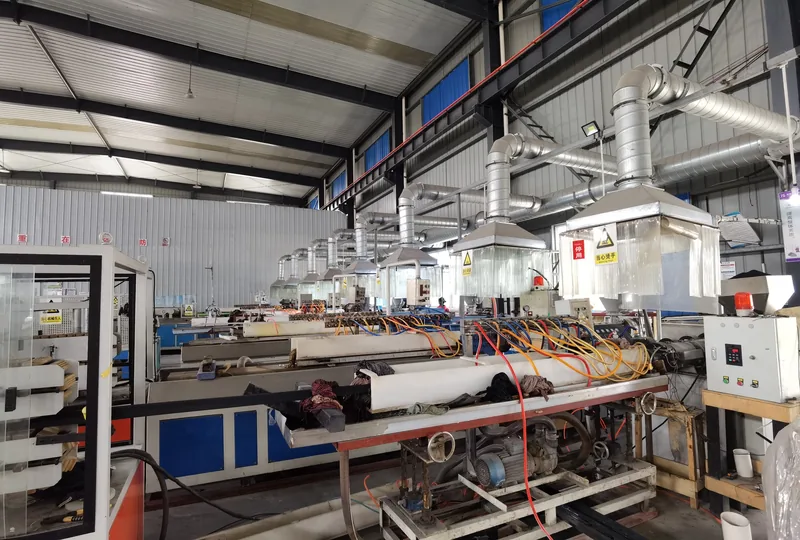
ZetarVac runs more than seven automated extrusion lines with a maximum profile width of 600 mm, and punching, embossing, and printing are available as in-line operations on the line. For your project, that means slots, markings, or textured surfaces can be added while the profile is still on the line, rather than in a separate downstream step with its own tolerancing stack.
A common misconception about where tolerance is actually created deserves a direct correction, because it changes how you should read any supplier’s capability sheet.
"If the die is machined accurately, the finished profile will hold tolerance on its own."False
The die only shapes semi-molten material; final dimensions are fixed later, in calibration and cooling, while the section is still shrinking. Ignore the downstream sizing train and even a perfect die head will deliver out-of-tolerance product.
"Calibration and haul-off settings are as decisive as die quality."True
Vacuum level, cooling length, and pull speed govern how the extrudate solidifies and shrinks after leaving the die. A supplier who tunes these stages together with the die head is the one who can hold tight cross-section tolerances in volume production.
How Does a Profile Extrusion Line Work, Step by Step?
In steady operation, pellets are conveyed and melted, forced through the die, calibrated under vacuum, cooled below their softening range, pulled at a controlled speed, and cut to length — typically within a minute from die exit to discharge. The controlling variable throughout is the match between melt output and pull speed.
Feeding and melting. Dried pellets enter the feed throat and are conveyed by the rotating screw. Shear heat and barrel heaters bring the melt to target temperature, and stable melt pressure pumps the die continuously. Moisture-sensitive materials such as PA6, PA66, and POM must be dried beforehand, or bubbles and surface defects follow.
Shaping at the die. The melt is distributed through the die’s flow channels into the section geometry. The die designer compensates for die swell — elastic recovery that makes the extrudate larger than the die opening, often by tens of percent depending on material and section — and for uneven flow between thick and thin walls. Getting this balance wrong shows up immediately as warp or wall-thickness variation.
Calibration and cooling. The extrudate is guided into the calibrator, where vacuum and chilled water set the outer geometry, then travels through cooling until the core solidifies. A section that leaves calibration off-size rarely recovers downstream, so wall thickness and overall dimensions are checked here first.
Cutting and discharge. A flying saw or shear cuts the continuous product to length, and parts are transferred to an output table or coiler. Cutting quality matters more than buyers expect: burrs, melted cut faces, or length variation all originate at this last station.
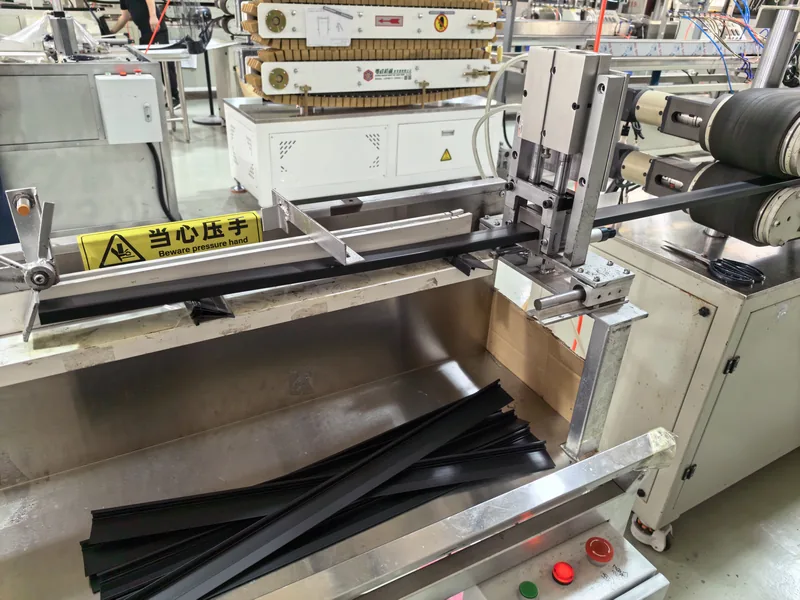
Because the process never pauses, defect modes have characteristic signatures: gloss bands point to melt temperature or die-land condition, wavy edges to haul-off slippage, and sink or warp to uneven cooling. Reading these signatures correctly saves hours of trial and error; the most common failure modes and their fixes are cataloged in this guide to common extrusion defects and troubleshooting.
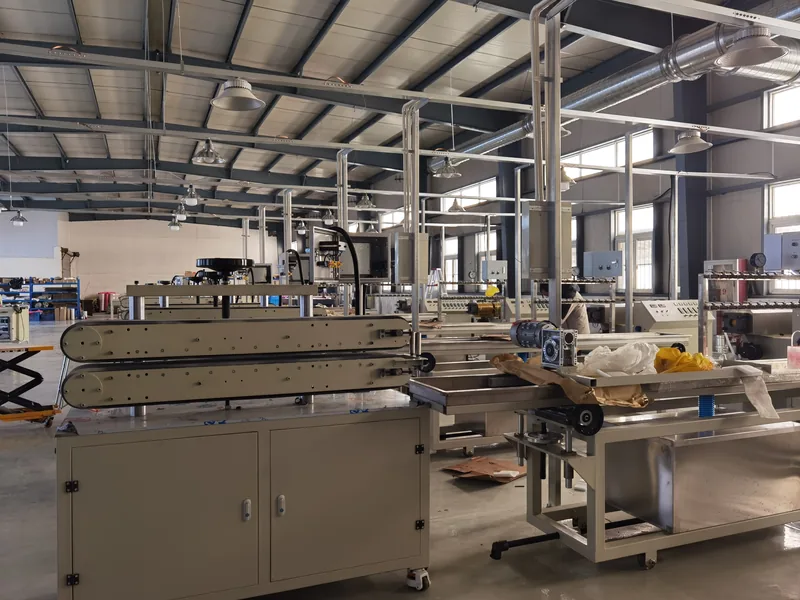
Materials and Die Configurations on a Profile Extrusion Line
Material choice drives die design, calibration strategy, and achievable tolerance. The table below summarizes the materials commonly extruded into profiles and what each demands from the tooling.
| Material | Typical extruded products | Die and sizing considerations |
|---|---|---|
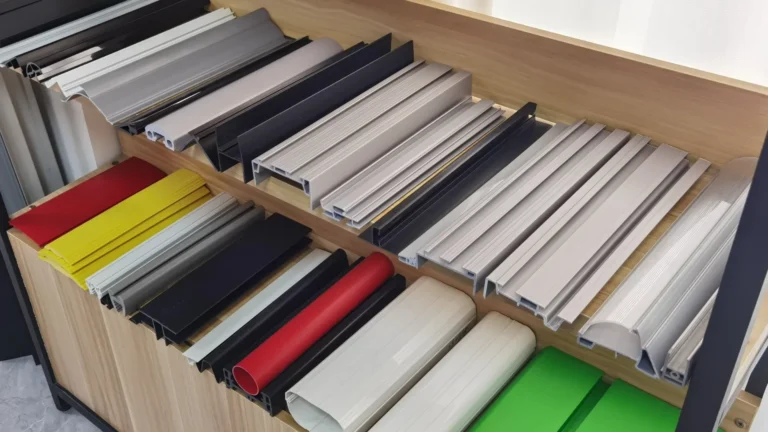
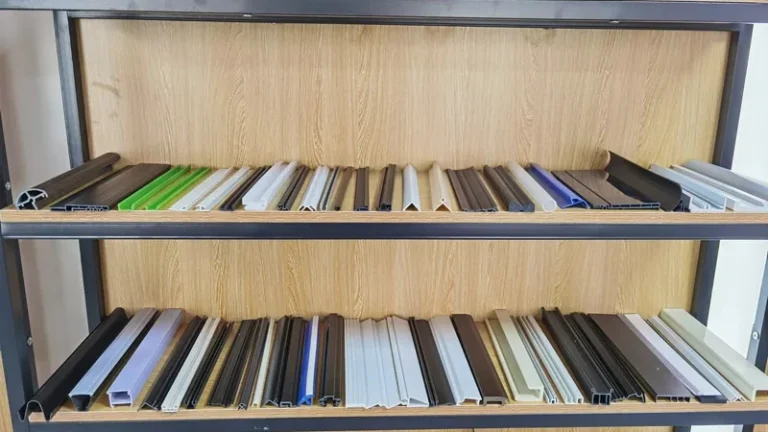
| PVC | Window and door profiles, decorative trims, pipes, sealing strips | Heat stability limits melt temperature; rigid grades are specified through compound classification |
| ABS | Automotive and industrial profiles, decorative parts | Good surface finish; moderate shrinkage eases calibration |
| HDPE | Pipes, edge trims, guide rails, wear strips | Higher shrinkage demands longer calibration and cooling |
| PP | Profiles, pipes, functional parts | Often the rigid base layer in PP+TPV or PP+TPE co-extrusion |
| PC, PMMA | Transparent pipes, light covers, clear profiles | Optical clarity requires polished die lands and thorough drying |
| TPE, TPU, TPV | Sealing strips, hoses, protective sleeves, gaskets | Soft, low-stiffness melts need support and gentle handling during sizing |
| PA6, PA66, POM | Wear parts, guide rails, precision mechanical parts | Hygroscopic or high-temperature grades need drying and tight barrel control |
| ASA, PC/ABS, PP/GF | Outdoor profiles, automotive sections, high-strength industrial profiles | Glass-filled compounds increase die wear and require hardened tooling |
Standards give buyers a common language for these choices. EN 12608 is the European standard that specifies PVC-U3 profiles for windows and doors, covering profile geometry, impact resistance, and heat reversion after exposure. ASTM D1784 classifies rigid PVC and CPVC compounds by cell class, so a compound called out on a drawing can be verified against defined property ranges rather than a trade name. For heat resistance, ISO 306 defines the Vicat softening temperature test4, a practical screening indicator for how a profile behaves as service temperature climbs.
Multi-material sections extend the design space further. In a co-extrusion pass5, up to three layers can be combined: PP with TPV, PP with TPE, PVC with TPU, ABS with TPU, or TPV with CPVC. A seat slide-rail strip in PP+TPV pairs a structural rail surface with a flexible sealing lip that excludes dust, guides the seat, and runs with low friction. A robot vacuum squeegee strip in ABS+TPU puts a rigid ABS body behind a wear-resistant TPU wiping edge.
The die head for such sections is more complex and commissioning takes longer, but the alternative is assembling two separate parts with a joint that can fail. The mechanics of these combined dies are covered in detail in this article on co-extrusion die heads and multi-layer profiles.
Co-extrusion up to three layers is in regular production at ZetarVac, with combinations including PP+TPV, PP+TPE, PVC+TPU, ABS+TPU, and TPV+CPVC actually running on the lines. If your application needs a rigid structure and a soft functional surface in one continuous section, this is a proven route rather than an experimental one.
What Tolerances and Quality Checks Should You Expect?
On a well-maintained profile extrusion line, dimensional tolerance down to ±0.05 mm on the profile cross-section is achievable, but only for favorable materials and geometries; wide, thin-walled, or soft sections carry wider realistic bands. Ask for a tolerance proposal tied to your drawing, not a blanket number.
Which tolerance is realistic depends on the material’s shrinkage behavior, the wall-thickness uniformity of the section, and the length of the calibration and cooling train. A compact solid section in ABS is far more forgiving than a thin hollow section in PP with a soft co-extruded lip, and honest suppliers will say so before quoting.
Verification should be defined before tooling starts. Cross-section dimensions are checked with profile projectors or in-line laser gauges, wall thickness with ultrasonic probes or sectioned samples, and straightness on a surface plate. Mechanical properties come from standardized testing: ASTM D638 is the default tensile test cited for extruded profiles, specifying how tensile strength and elongation at break are measured. For outdoor profiles in ASA or weatherable PVC, ISO 4892 defines exposure to laboratory light sources and is the standard basis for judging weathering resistance.
One judgment call catches many first-time buyers of extruded profiles, so it deserves an explicit answer.
"Once the first article passes inspection, the profile will stay in tolerance for the whole run."False
A first article is a snapshot taken under freshly tuned, closely watched conditions. Over a long run, melt temperature drift, calibrator wear, and material lot changes shift dimensions, so one passing sample proves very little about process stability.
"Dimensional trend data from the run matters more than a single passing sample."True
Ask how dimensions are monitored during production: laser gauging frequency, sampling plans, and control charts. A supplier who can show drift data from a comparable profile extrusion job is demonstrating a controlled process rather than a lucky setup.
Stability also depends on matching the program to the right production base. A supplier organized for volume output will monitor and react differently from a shop running occasional short jobs, so state realistic annual and per-batch volumes early in the conversation.
ZetarVac holds a minimum achievable dimensional tolerance of ±0.05 mm on the profile cross-section, subject to material and section geometry, and supports prototyping alongside small and large batch production. Reference monthly capacity across the extrusion lines is about 300–500 tonnes, so a program can move from trial volumes to steady supply on the same equipment base.
How Do You Evaluate a Supplier’s Extrusion Line Capability?
Line configuration. Count the lines, note the maximum section width, the number of co-extrusion layers, and whether in-line punching, embossing, or printing exist. The plant runs more than 45 production lines in total across processes; the relevant question is how many of them are dedicated to profile extrusion and which widths and material families they cover.
Material depth. A supplier who routinely runs PVC, ABS, HDPE, PP, PC, PMMA, PA6/PA66, POM, TPE, TPU, TPV, PC/ABS, ASA, and glass-filled PP has already solved the drying, temperature, and sizing problems your material will raise. Ask which materials run on which lines, and for references in your own market segment.
Evidence, not promises. Comparable case sections say more than brochures: a transparent PVC electronic tube profile used for cable protection, insulation, and guiding, or a continuous PVC drainage channel profile suited to volume production with custom cross-sections, shows whether the shop has handled geometry and material classes like yours.
Process control. Ask what is measured on the line, how often, and how deviations are handled — whether first-article reports and periodic dimensional checks are standard deliverables or only available on request.
These checks take an hour of honest questions and can save weeks of tooling rework. They also give you a fair basis for comparing quotes that look similar on paper but differ sharply in what is actually included.
FAQ
How wide can an extruded profile be?
Production lines typically handle section widths from a few millimeters up to around 600 mm. Wider sections need larger calibration and cooling trains and more extruder output, so confirm your specific width against the supplier’s actual line data rather than a general brochure claim.
Can one extrusion line produce multi-material profiles?
Yes. With a co-extrusion die head, up to three layers can be combined in a single pass — for example a rigid PP body with a soft TPV sealing lip, or ABS with TPU for a flexible, wear-resistant contact edge. The layers melt-bond during forming, so no secondary joining is needed.
Does line speed affect profile quality?
Yes. Faster pull speed shortens cooling time and can push dimensions toward the edge of tolerance, especially on thick or soft sections. A realistic quote balances output rate against the cooling length available on the line instead of promising maximum speed on every section.
What should you prepare before requesting a profile quotation?
A section drawing with tolerances, the target material or an acceptable equivalent, the service environment, and expected annual and per-batch volumes. With those inputs, a supplier can judge die feasibility, propose a realistic tolerance band, and quote tooling accurately.
If you are comparing suppliers for a profile program, send your drawings and talk to an engineer about die design, material selection, and achievable tolerances. You can evaluate your section requirements with ZetarVac and get a technical read on your drawing before any tooling commitment.
-
Die head: The shaped tool at the front of the extruder that distributes molten plastic into the cross-section of the continuous product. ↩
-
Haul-off: The pulling unit on an extrusion line that grips the profile and draws it at a controlled speed through calibration and cooling. ↩
-
PVC-U: Unplasticized polyvinyl chloride, a rigid PVC compound without plasticizers, widely used for building profiles and pipes. ↩
-
Vicat softening temperature: The temperature at which a flat-ended needle penetrates a thermoplastic specimen to a defined depth, used as a heat-resistance indicator. ↩
-
Co-extrusion: An extrusion process in which two or three melt streams are combined in a single die to form a layered profile in one pass. ↩