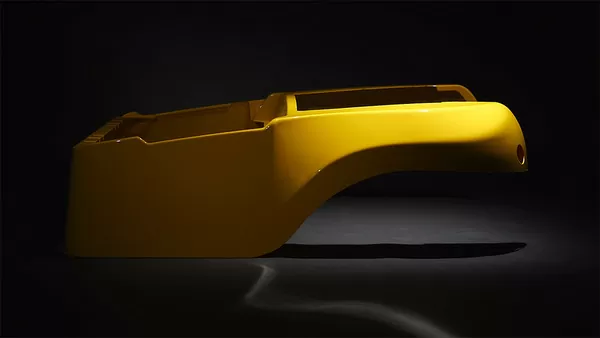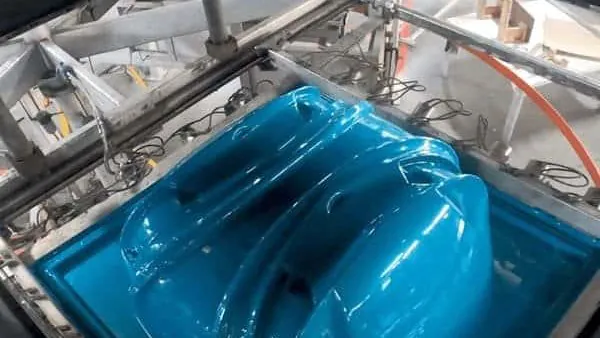
Vacuum forming earns its low-cost reputation in two places: the tool you pay for once, and the cycle you pay for on every part. Both savings come from the same physics — a heated plastic sheet is drawn over a single-sided mold by vacuum and atmospheric pressure, rather than injected into a closed steel cavity at high tonnage. This article shows where the money is actually saved, what the process gives up in return, and how to judge whether the economics hold for your part geometry and volumes.
- Tooling is the biggest cost lever: vacuum forming tools are single-sided, usually machined aluminum or cast composite, and cost a fraction of a closed-cavity production mold.
- Unit cost stays low because forming cycles run in minutes even for large parts, secondary operations stay contained, and sheet converts to near-net shape with limited scrap.
- The advantage is strongest for large parts, low-to-medium volumes, and one finished cosmetic face; it narrows for small, complex, tight-tolerance parts at high volumes.
- Thickness distribution, draw ratio, and corner radii are engineering trade-offs you manage in the design, not on the shop floor.
- Material selection drives both performance and price: ABS, PC, HDPE, PP, and PMMA sheet cover most enclosure, tray, guard, and display applications.
Why Vacuum Forming Tooling Costs Less
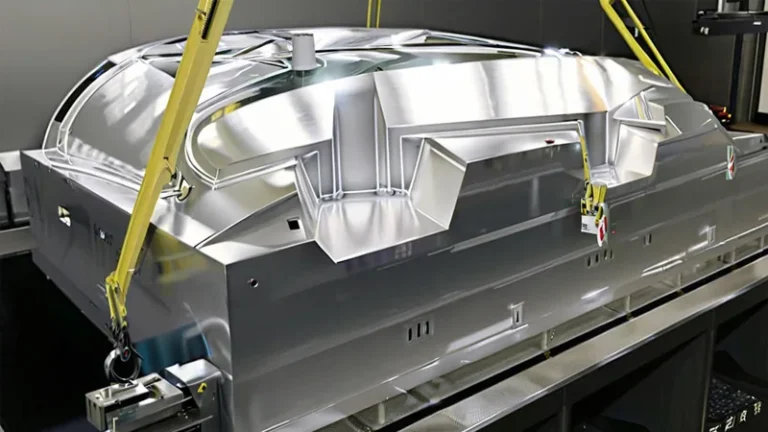
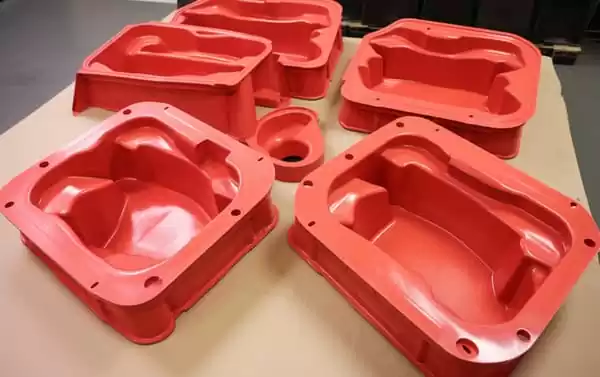
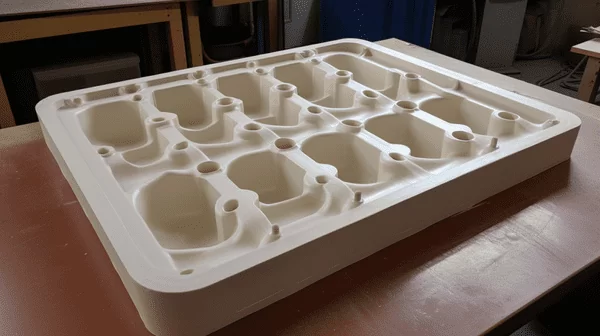
A production injection mold is a closed, high-pressure system: core and cavity machined from hardened steel, cooling channels drilled through both halves, ejector hardware, slides, and a gated runner system. A vacuum forming tool is nearly the opposite. It is a single surface — commonly machined aluminum or a cast and finished composite — that defines one face of the part while atmospheric pressure presses the softened sheet against it. Fewer machined features, softer tool stock, and no ejection hardware translate directly into fewer machining hours and lower tool material cost.
Lead time follows the same logic. Because the tool is structurally simple, a forming tool can often be cut and producing sample parts in days to weeks rather than months. That speed makes revisions cheaper to absorb as well: widening a radius, thickening a flange, or relocating mounting bosses means re-cutting one surface, not re-engineering a matched pair of steel halves. If the design will change after you see real parts — and on first-generation enclosures it usually does — iteration cost belongs in your total project budget, and the single-sided tool quietly wins there.
ZetarVac processes sheet from 0.5 to 15 mm and forms parts up to about 2,500 mm in length, trimmed on 5-axis CNC equipment that follows the forming tool. That combination means very large housings and covers can be produced from a single-surface tool instead of a scaled-up closed mold — which is exactly where the tooling saving is largest.
How Does Vacuum Forming Compare to Other Molding Processes?
Vacuum forming is more cost effective because it replaces an expensive closed mold with a single-sided tool and replaces high clamping tonnage with modest vacuum, so both the fixed cost and the per-part machine cost drop. The saving is largest for large parts at low-to-medium volumes and shrinks as complexity and volume grow.
Against injection molding, the tooling gap dominates at low and medium volumes: you can hold a formed part for a fraction of the up-front commitment, and the crossover point where amortized mold cost tips the balance typically sits beyond the lifetime volume of most equipment housings, machine covers, and tray programs. The mechanics of that head-to-head are covered in detail in our vacuum forming vs injection molding comparison. Against compression molding, the difference is more about geometry than price: compression suits thick, solid cross sections, while thermoforming wins on large, thin-walled surfaces with one finished face, a distinction we unpack in our thermoforming and compression molding comparison.
| Cost driver | Vacuum forming | Injection molding | Compression molding |
|---|---|---|---|
| Tooling cost | Low — single-sided aluminum or cast tool | High — hardened steel core, cavity, cooling | Medium — matched molds |
| Tooling lead time | Days to weeks | Weeks to months | Weeks |
| Economic volume range | Prototypes through large batches | High volume | Medium to high volume |
| Part size capability | Very large panels and enclosures | Limited by machine tonnage | Limited by press platen |
| Cycle time per part | Minutes for heavy-gauge sheet | Seconds for small parts | Minutes |
| Secondary operations | Trim, drilling, bonding | Usually none needed | Deflash and trim |

"Vacuum forming tooling costs about the same as a production injection mold."False
The two tools are built from different logic. A forming tool is one machined surface in soft stock, while an injection mold is a matched pair in hardened steel with cooling and ejection built in, so machining hours and material cost are not comparable. Budgeting them as equivalents inflates your project case and can push you away from the process that actually fits the volume.
"Forming tool cost scales with part size far more gently than closed-mold cost."True
A larger forming envelope means more surface to machine and a bigger machine, but the tool remains single-sided and free of ejection and cooling systems. For large enclosures and covers this is precisely the regime where the cost gap between processes is widest. Get quotes for both routes when the part is over a few hundred millimeters, and the difference will usually speak for itself.
Where the Unit-Cost Savings Actually Come From
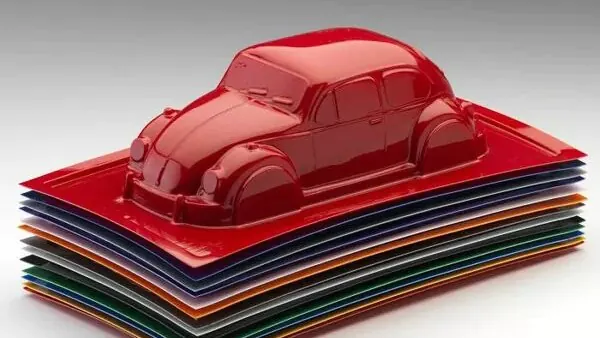
Material conversion is the first saving. Forming starts from pre-made plastic sheet that converts to near-net shape; the main waste is the trim skeleton, which on many programs can be recovered, keeping effective utilization high for a process handling parts this large. Cycle economics come next: a heavy-gauge1 forming cycle scales with sheet thickness and draw depth, and for typical enclosure-gauge sheet it runs on the order of a few minutes including heating, forming, and cooling. That is slower than a small injection-molded shot, but the part being produced is far larger, so measured against part surface area the machine cost per finished panel is usually favorable.
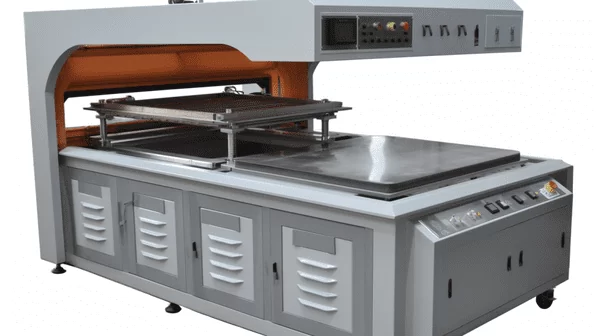
Machine economics matter too. Forming needs no high injection pressure and therefore no massive clamp tonnage, so the machines behind large formed parts are modest relative to what a closed-mold process would need for the same envelope. Secondary operations stay contained: after forming, most parts need one trimming pass and, where the design requires, drilled holes or bonded hardware.
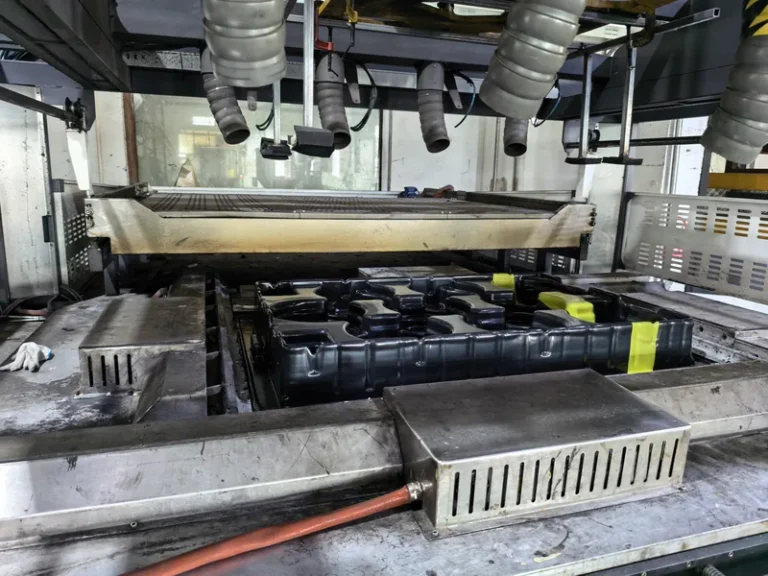
ZetarVac runs more than 20 vacuum forming machines within a plant of 45+ production lines, with reference monthly capacity of roughly 100,000 to 200,000 pieces. For a buyer, that mix matters: prototyping, small batches, and large batches all run on the same process base, so volumes can change without a requalification penalty.
What Engineering Trade-Offs Come With the Lower Cost?
The savings come with geometry rules: formed wall thickness varies across the part, deep draws thin the corners and can web, and only one surface is tool-defined. Managed in the design these are predictable; ignored, they become assembly-line rejects.
Thickness distribution is the main trade-off. As the sheet stretches over the tool, material pulled deepest thins the most; in a deep-drawn corner the local wall can fall to roughly half the starting gauge depending on draw ratio2, sheet temperature, and plug assistance. That is not a defect — it is the physics of the process — but it means strength must be placed where the sheet actually is, not where the nominal CAD wall sits.
Corners and drafts come second: generous radii, sensible draft angles, and the avoidance of knife-edge features prevent webbing and bridging between steep walls. Where two finished surfaces or hollow stiffness are needed, twin-sheet forming3 bonds two formed skins into one closed part, at the cost of a second tool and a slower cycle.
"Formed wall thickness stays uniform across the whole part."False
A formed sheet is a stretched sheet, and stretching is never even: corners, deep draws, and areas near the clamp frame all finish at different gauges. Treating the nominal sheet thickness as the finished wall invites under-designed corners and surprised stress calculations. The correct approach is to request a thickness map for the actual tool and design to it.
"Thickness variation is predictable and can be engineered around."True
For a given tool, material, and temperature window, the thinning pattern repeats run after run, which makes it a design input rather than a random risk. Ask the molder for expected minimum wall at your deepest section and validate stiffness and impact at that gauge. Parts designed this way pass qualification without drama.
When Does Vacuum Forming Stop Being the Cheapest Option?
The advantage narrows where a closed mold amortizes fast and its seconds-long cycle undercuts forming’s minutes-long one: high volumes of small, complex parts. It also narrows when both faces need cosmetic texture or tight tolerances are demanded on both sides.
Those boundaries are worth naming honestly, because buyers who miss them pay twice. If your program runs millions of palm-sized parts a year, injection molding will win the math and no tooling discount changes that. If the second surface must be textured or highly defined, pressure forming improves the non-vacuum face at some tooling cost and is the right upgrade when appearance drives the purchase. And if tolerances tighter than typical formed-part capability govern the fit, plan machining or redesign rather than hoping. Stating volume, envelope, material, and finish requirements early lets the crossover math decide, which is cheaper than discovering it after tooling.
What Should You Check Before Committing to a Vacuum Formed Part?
Check three things before the tool is cut: validated material properties, the thickness map you can accept, and the compliance requirements your market imposes. All three are cheap to verify on paper and expensive to fix after production starts.
Start with the material datasheet against the service environment: confirm the heat deflection temperature4 covers your maximum continuous service temperature with margin, and check impact and stiffness figures at the gauges you will actually use. Compliance comes next. UL 94 classifies the flammability of plastic materials, and it is the standard behind most formed equipment enclosures — a housing or guard destined for electrical equipment typically needs a specified flammability rating before the finished assembly can ship.5
On the mechanical side, ASTM D790 measures the flexural properties of plastics and is commonly used to validate that formed panels and enclosures hold their stiffness under design load. ISO 527-2 defines the tensile test run on thermoformed sheet, confirming that forming has not degraded the material the datasheet promised.
"A clean first article proves the production run will hold dimensions."False
Sheet temperature, vacuum, and cooling rate drift between cycles, so part number one can measure well while part fifty wanders on flange flatness or hole position. Approving the run on a single sample invites a slow drift that only surfaces at final assembly, where it is most expensive to correct.
"Dimensional stability is proven by sampling across multiple forming cycles."True
Measure critical dimensions — trimmed outline, hole positions, flange flatness — on parts pulled at defined intervals through the early run, and track them statistically before releasing full-rate production. This costs hours, not weeks, and it is the difference between a process that is certified and one that merely started well.
Material selection is the quietest cost lever of all. ZetarVac forms ABS, PC, HDPE, PP, PMMA, and PC/ABS sheet, among other materials, across enclosures, trays, guards, liners, and structural parts. Choosing the lowest-cost sheet that still meets your flammability, stiffness, and impact requirements is often the largest per-part saving available after tooling.
ZetarVac supports prototyping, small batch, and large batch production on the same forming and trimming base, so the material and gauge you validate on first articles carries straight into volume production. That continuity protects the cost case you built the project on.
FAQ
Why is vacuum forming cheaper than injection molding for large parts?
The closed mold and clamp tonnage needed for a large injection-molded part scale steeply with size, while a forming tool stays a single surface and the machine requirement stays modest. For big panels, housings, and covers, that difference dominates total project cost at most realistic volumes.
How large can a vacuum formed part be?
Forming excels at large envelopes. ZetarVac processes sheet from 0.5 to 15 mm and forms parts up to about 2,500 mm long, with the trimmed outline cut on 5-axis CNC equipment.
Does low tooling cost mean lower part quality?
No. Formed parts use the same engineering thermoplastics as closed-mold processes, and properties are validated on the sheet and the finished part. Quality depends on process control and inspection, not on tool price.
Can vacuum forming produce structural parts?
Yes. Heavy-gauge thermoforming handles thick structural sections, and higher-strength materials such as PP/GF and PA6/PA66 extend the process into load-bearing industrial and automotive components.
What volumes make vacuum forming the right choice?
There is no single crossover number, because it depends on part size, cycle time, and tooling quotes. As a working rule, prototypes, small batches, and large batches all run economically on the same tool, which is unusual among molding processes and suits equipment programs with uncertain volumes.
If you are mapping processes for an upcoming enclosure, tray, or cover program, explore the complete ZetarVac vacuum forming guide, or see how a China vacuum forming manufacturer structures projects from prototype through batch production before you shortlist suppliers for comparison.
-
Heavy-gauge thermoforming: The branch of thermoforming that works with thicker sheet — in industrial practice roughly 0.5 mm up to 15 mm — to produce rigid parts rather than thin-gauge packaging. ↩
-
Draw ratio: The relationship between formed part depth or area and the starting sheet dimensions; higher draw ratios mean more stretching and more thinning at corners. ↩
-
Twin-sheet forming: A thermoforming variant that forms two sheets and bonds them into a single hollow part, adding stiffness without a solid core. ↩
-
Heat deflection temperature (HDT): The temperature at which a plastic specimen deflects a defined amount under a specified flexural load, marking the practical service-temperature ceiling. ↩
-
UL 94: The flammability classification standard for plastic materials, rating burning behavior at levels such as V-0, V-1, V-2, and 5VA. ↩