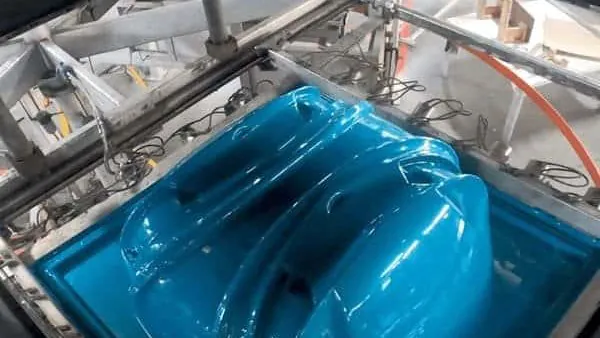
Lead time, not unit price, is where heavy-gauge thermoforming programs most often get into trouble. A formed enclosure, tray or cover can be quoted within days, yet the road from purchase order to parts on your dock runs through tool fabrication, forming trials, trim programming, packaging sign-off and a freight plan for parts that can be more than two metres long.
This guide breaks the schedule into its real phases, shows where each one typically slips, and lists the contract terms and logistics decisions that keep a program predictable. If you need the process basics first, the vacuum forming process overview explains how sheet is heated, formed and trimmed; everything below assumes you are already comparing suppliers and schedules.
- Tool fabrication and first-article qualification, not the forming cycle, dominate the lead time of a heavy-gauge thermoforming part.
- A realistic end-to-end schedule spans tooling build, trial loops, production release and ocean transit, and each phase has its own failure modes.
- Logistics risk starts with geometry: large formed parts consume container volume, nest imperfectly and dent at thin flanges, so packaging design belongs inside the schedule.
- A first-article approval is a point-in-time result; stable production needs an agreed control plan on sheet lots and dimensions.
- Shipping terms allocate cost, not risk; whoever books and manages the freight owns the risk and should be named in the plan.
- Milestone buffers, pre-shipment inspection and packaging sign-off protect delivery dates far better than last-minute air freight.
What Actually Drives Lead Time in Heavy-Gauge Thermoforming?
Tooling dominates. For a new heavy-gauge part, the forming tool and its trim fixtures take several weeks to build, and every trial loop that follows adds calendar time. The forming cycle itself, measured in minutes per part, is almost never the bottleneck.
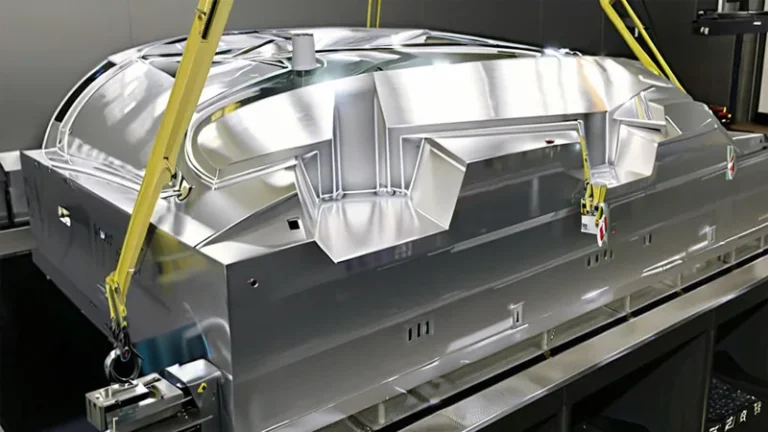
Break the schedule into components and the picture sharpens. A forming tool for heavy-gauge work is machined from aluminum or cast from a composite, then hand-finished so that draft angles, radii and web lines behave under vacuum. Tool lead times commonly run two to six weeks depending on part size and cavity count, and that range assumes the 3D model arrives DFM-clean; unresolved draft or radius questions at kickoff translate directly into weeks. The DFM checklist for thermoformed parts and molds lists what should be settled before a tool is cut.
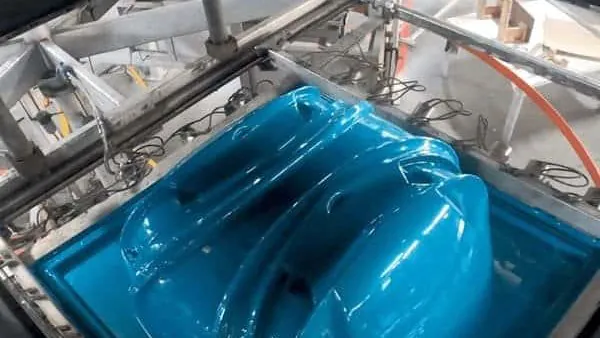
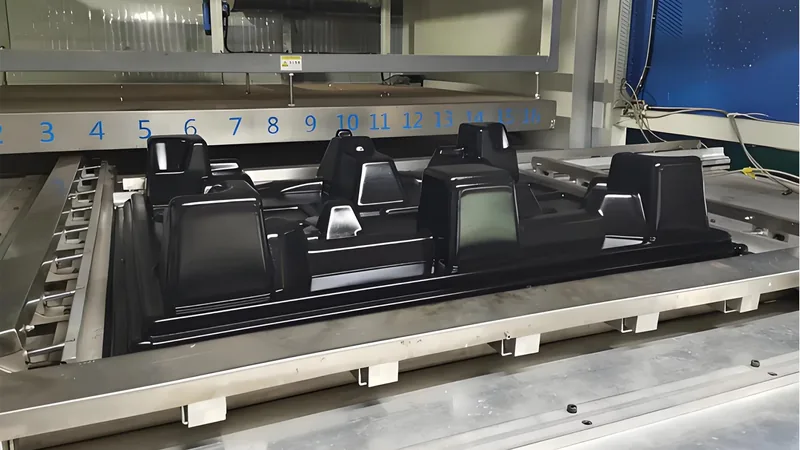
Once the tool exists, forming trials begin. Sheet temperature, vacuum dwell and forming depth are tuned until wall distribution sits inside the drawing, and each correction loop costs days, not hours. Trimming adds its own queue: formed parts are trimmed on 5-axis CNC equipment whose outline follows the forming tool, so trim programs, fixtures and datum strategy must be verified together with the tool, not after it.
Material supply sits upstream of all of this. Sheet for heavy-gauge work runs from 0.5 to 15 mm, and while common gauges of ABS, HDPE and PP are widely stocked, specialty gauges, UV-stable ASA, PC/ABS blends and other engineering grades may need production or import time. Confirming sheet availability at kickoff, before the tool design freeze, prevents a finished tool from waiting on material.
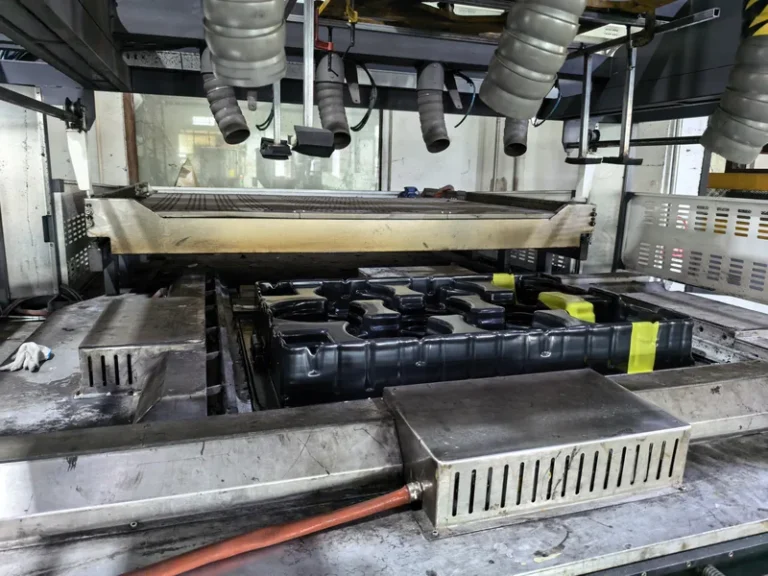
ZetarVac runs 20+ vacuum forming and thermoforming machines that process sheet from 0.5 to 15 mm with a maximum forming length of about 2,500 mm. Machine spread matters to schedule: when one forming tool needs adjustment mid-program, work can be reallocated across machines instead of queueing behind a single press.
How Long Should Tooling and First Articles Really Take?
Plan on roughly three to eight weeks from tool design freeze to an approved first article for a single-cavity heavy-gauge part, with large or multi-cavity tools sitting at the top of that range. The real number depends on tool material, part size and how many trial loops the geometry demands.
The first article is more than a presentable sample. It should be dimensionally mapped against the drawing, and for structural parts the material properties should be verified on formed samples: ISO 527-2 specifies the tensile test method used to confirm that thermoformed sheet keeps the mechanical properties the design assumes, and it is the standard test run on real wall sections before release.1 Thin, oriented areas of a formed part are exactly where a datasheet value and a formed-part value diverge.
For electrical equipment enclosures, add flammability qualification to the same window: UL 94 defines the flammability ratings a plastic material must demonstrate, and many equipment housings need documented compliance for the resin and the formed part before shipment.2 Scheduling that qualification during tooling instead of after first article is one of the cheapest weeks a program can save.
"Once the first article passes inspection, the production lead time is locked in."False
A first article validates geometry on one machine, one sheet lot and one shift. Sheet lots change, ambient conditions drift and setup variation moves formed dimensions, so without an agreed control plan a production run can stall in requalification. The consequence is a schedule that quietly restarts after launch.
"A first article is a point-in-time result, so production stability needs a control plan."True
Agreeing on inspection frequency, critical dimensions, sheet lot records and trim fixture checks before launch keeps parts inside tolerance across the run. Treating the control plan as part of the lead time protects the delivery date instead of gambling it.
Ask a prospective supplier to describe, in writing, what happens between first-article approval and production release. A clear answer at the procurement stage, covering interval checks, lot traceability and defined escalation, is a better schedule indicator than any promised ship date.
What Does a Realistic End-to-End Schedule Look Like?
The table below is an engineering planning frame, not a quotation. Ranges depend on material, part geometry, machine availability and destination, so treat them as sanity checks on any supplier timeline you receive.
| Phase | Typical duration | What commonly slips |
|---|---|---|
| DFM review and tool design freeze | 1–2 weeks | late drawing changes, unresolved draft and radii |
| Forming tool fabrication | 2–6 weeks | hand-fitting rework, cavity and texture complexity |
| Forming trials and first article | 1–3 weeks | wall-distribution corrections, trim fixture re-cuts |
| Production run | 1–3 weeks for typical volumes | sheet lot supply, machine availability |
| Finishing, inspection, packing | 3–10 days | packaging redesign after a damage review |
| Ocean transit | 3–6 weeks to most destinations | vessel rollovers, port congestion |
Reference material from the SPE Thermoforming Division describes the same phase logic of tool, trial, trim and ship, and it is a useful cross-check when a supplier timeline looks compressed.
ZetarVac operates 45+ production lines across the plant, with a reference monthly capacity of about 100,000–200,000 pieces, and supports prototyping, small batch and large batch production. That mix changes how lead time scales: a pilot build and a full production release follow the same phase structure but occupy very different fractions of available capacity.
Watch the boundary between production and transit. Partial shipments can protect an urgent launch, but they split container utilization and multiply documentation, so a program shipped in three batches pays three times in freight administration. If phased delivery is likely, plan it around the packaging design instead of deciding at loading time.
Which Logistics Risks Are Specific to Formed Parts?
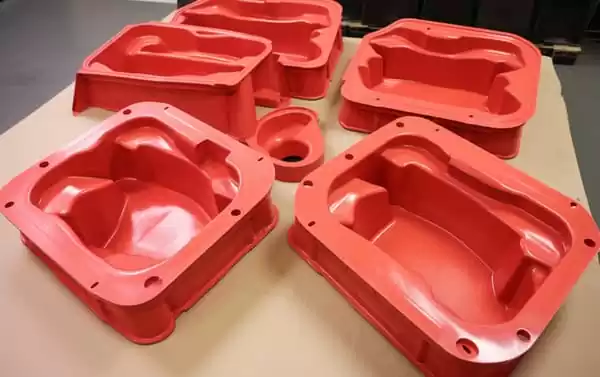
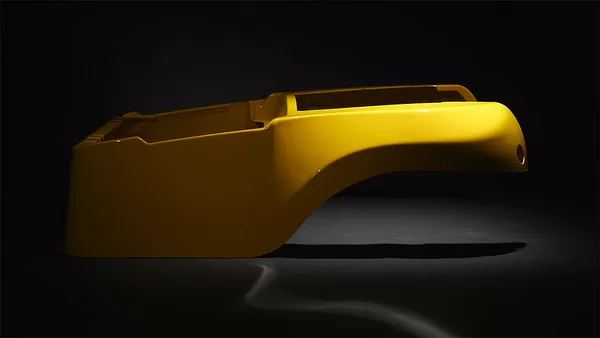
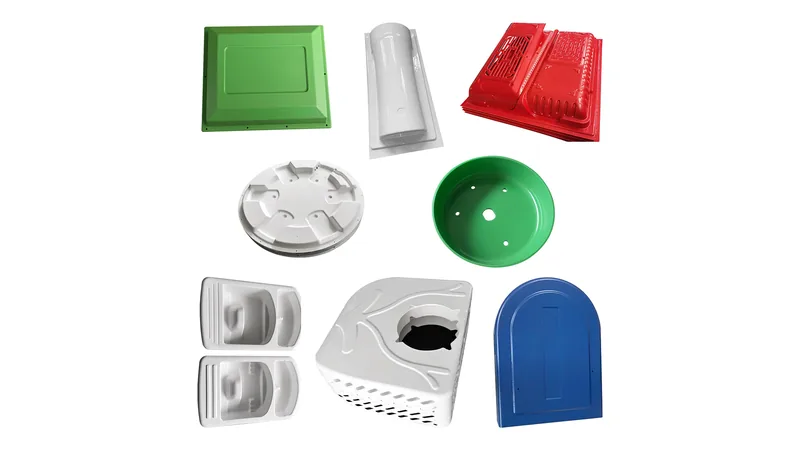
Geometry is the defining risk. Heavy-gauge parts are voluminous, often formed up to about 2,500 mm long; they nest imperfectly, and their thin flanges and return walls dent under point loads. Freight cost, packing design and container utilization are therefore engineering decisions, not administration.
Three failure patterns recur. First, dimensional weight: a pallet of formed covers can fill a container long before it approaches weight limits, so the freight budget is driven by volume, and nesting depth decided at the design stage moves the whole economics of shipping. Second, stacking strength: a panel that stacks forty high in a forming jig may crush at six layers on the ocean, so stack height must be tested with the actual packaging. Third, environment: a container cycles through heat and humidity that can bow large flat panels or mark cosmetic surfaces, so bagging, desiccants and edge protection belong on the packing specification.
Documentation is a quiet schedule killer. Wooden crates and jigs for heavy parts must meet heat-treatment rules, packing lists need accurate weights and dimensions for container planning, and cosmetic surfaces benefit from a signed surface standard that defines acceptable marks. A dispute settled at destination costs a full shipping cycle.
Mode choice follows from part value and urgency, not habit. LCL freight exposes large formed panels to extra handling at consolidation terminals, so many buyers of cosmetic parts pay for a dedicated container even at moderate volumes. The decision belongs in the quotation stage, where packaging depth, handling count and part value can be weighed together.
Pre-shipment inspection closes the loop. Agree on the sampling plan and the acceptance limit before production, typically expressed as an AQL,3 and define what happens when a batch fails: rework, re-sort or re-shipment, with responsibility stated. Inspection agreed after production has finished is not inspection; it is negotiation.
"Choosing FOB shipping terms transfers the delivery risk to the freight forwarder."False
Under FOB terms the buyer owns the goods and the risk from the moment they are loaded on board at origin. A forwarder executes the transport but absorbs no schedule risk from port congestion or a missed vessel. The buyer still owns the consequences of a late container.
"FOB shifts cost control to the buyer, so the buyer must manage the freight risk."True
Naming the forwarder, booking space early for outsized formed parts and insuring against the actual failure modes keeps FOB workable. Whoever books the shipment should own a written contingency plan, not just a rate.
How Do You Write Terms and Milestones That Contain the Risk?
Most schedule pain in thermoforming traces back to terms copied from a standard template instead of being engineered. Four clauses earn their place in every formed-parts contract.
Milestone payments should mirror the phase table: tooling sign-off, first-article approval and production release are natural payment gates because each marks a point where the schedule can still be corrected cheaply. Packaging deserves its own approval gate, since a signed packaging trial before mass packing prevents the classic failure of a full container arriving with crushed flanges.
Pre-shipment inspection rights, with the sampling plan named in the contract, keep quality conversations on data. And the Incoterms clause4 should name who books freight for outsized parts, because a 2.5-metre formed panel is not a commodity any forwarder picks up casually.
Formed parts at ZetarVac are trimmed on a 5-axis CNC centre whose outline follows the forming tool. For lead time this means trim programming and fixture verification sit inside the tooling phase, so the schedule a buyer receives should already contain them rather than discovering them at first article.
Keep a buffer where it counts. A one-week buffer after first-article approval and a second before the production release date absorbs most trial-loop surprises without moving the promised ship date. Blanket orders with call-off quantities shift repeat orders from the full tooling-inclusive schedule to a production-and-transit schedule, which is usually the single largest lead time reduction available after the first program.
"Air freight is a reliable fallback if a thermoforming shipment slips."False
Formed parts up to 2.5 metres long are dimensional-weight cargo, so air freight on production quantities can cost more than the parts themselves. Oversized air handling adds its own booking and ground-handling delays. Air freight rescues samples and emergency kits, not containers.
"Schedule protection comes from milestone buffers and packaging sign-off, not last-minute air freight."True
Buffers placed after trials and before release absorb the realistic slip causes at low cost, and a packaging trial prevents damage claims that no freight mode can undo. Reserve air freight for documented, sample-level emergencies and price it in advance.
None of these clauses require adversarial negotiation; they require a supplier who has thought through the same phase logic you just read and will put it in writing.
FAQ
How far in advance should I order heavy-gauge thermoformed parts?
For a new part, plan eight to fourteen weeks from purchase order to dock, covering tooling, trials, production and ocean transit. Repeat orders against an existing tool typically run four to eight weeks depending on volume and destination. Ask each supplier to quote the phases separately so you can see where the time goes.
What can I do on my side to shorten the schedule?
Arrive with a DFM-clean model, named critical dimensions and a material specification that states acceptable alternatives. Decide packaging constraints early, because packing geometry changes stacking depth and therefore container count. Buyers who freeze drawings before tool design avoid the most expensive slips in the schedule.
Who should book the freight for large formed parts?
Whoever is best positioned to manage the risk. Under FOB the buyer books and carries the risk from loading; under supplier-managed terms the supplier books but should still be held to an agreed packaging specification and a named contingency plan. Either way, write the plan before the tool is cut.
Can I change sheet suppliers after the tool is qualified?
Usually yes, but a new sheet lot or resin source is a change, not a swap. Wall distribution, texture transfer and shrink behaviour can shift with the new material, so budget a short requalification loop with dimensional checks before committing production volumes.
Can a supplier guarantee an exact arrival date?
No credible supplier guarantees a vessel arrival date, because transit sits outside factory control. What a supplier can guarantee is internal milestones: tool completion, first-article date, production release and handover to the named forwarder. Judge quotes on the precision of those internal dates.
When you are ready to compare schedules, send your drawings with target quantities and destination port, and review your drawings with the ZetarVac team for a phase-by-phase lead time assessment, or talk to an engineer about packaging, inspection and shipping terms before you commit to a tool.
-
ISO 527-2: The standard tensile test method for rigid and semi-rigid plastics, used to verify that thermoformed sheet and formed parts retain the mechanical properties the design assumes. ↩
-
UL 94: The flammability classification standard for plastic materials, commonly required for equipment enclosures and housings. ↩
-
AQL: Acceptable Quality Limit, the sampling statistic used in pre-shipment inspection to decide whether a production batch passes. ↩
-
Incoterms: The ICC trade terms such as FOB, CIF and DAP that define where cost and risk transfer between seller and buyer. ↩