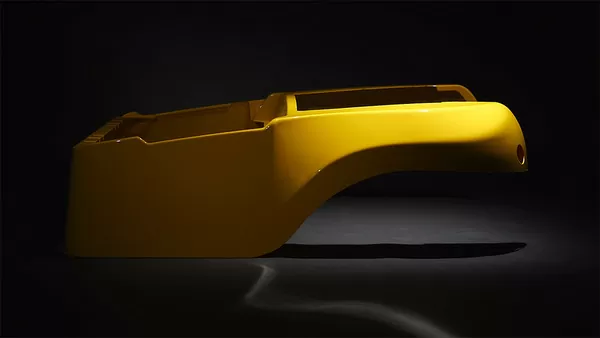
Material selection shapes every downstream cost in heavy gauge thermoforming: sheet price, forming window, trimming strategy and the service life of the finished part. When a project starts with a drawing for an enclosure, tray or machine cover, the first technical conversation is rarely about the tool — it is about ABS, HDPE and PC, the three sheet materials that cover most industrial forming work. This guide explains where each one wins, where each one fails, and how to validate the choice before tooling is cut.
- ABS is the workhorse of heavy gauge thermoforming: balanced formability, impact strength and cost make it the default for equipment housings, cases and guards.
- HDPE wins on chemical resistance, moisture tolerance and price, but its lower stiffness and higher shrinkage demand different tooling assumptions.
- PC delivers clarity and heat resistance for protective covers, at the highest sheet cost and with stricter drying discipline before forming.
- In heavy gauge work, sheet thickness typically runs from about 0.5 to 15 mm, and wall distribution — not datasheet numbers — decides real-world performance.
- Validate the material on the formed part, not the datasheet: tensile data to ISO 527-2, heat deflection to ASTM D648, and flammability to UL 94 where enclosures are involved.
What Does “Heavy Gauge” Actually Mean for Material Selection?
Heavy gauge thermoforming processes sheet stock roughly 0.5–15 mm thick, heated and drawn over a tool by vacuum forming or pressure forming. At these thicknesses the material behaves differently from thin web work: heating takes minutes rather than seconds, and the grade must survive long, uneven thermal cycles without degrading.
That thermal reality drives selection more than any single property value. A grade that forms cleanly at 1 mm may sag, blister or pick up heater mark-off at 8 mm, because the heating window shifts with thickness. On a sheet 2,000 mm long, the centre and the edges never see the heater identically either, so the chosen material needs a wide, forgiving forming window rather than a narrow peak.
Deep draws amplify the challenge. As the sheet stretches over the tool, corner walls thin — commonly by 20–40% on aggressive geometries — so the nominal gauge has to be chosen with that thinning built in. This is why heavy gauge vacuum forming favours materials with strong melt strength: the sheet must carry its own weight while hot and still pick up fine tool detail. For the process fundamentals behind these choices, see our vacuum forming overview.
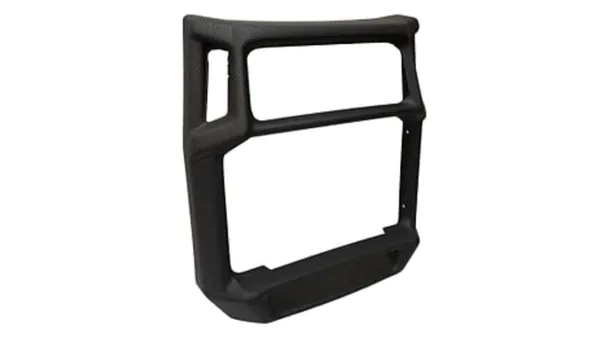
Before tooling is committed, a structured design review pays off: the DFM checklist for heavy gauge thermoformed parts and molds covers the geometry and tolerance issues that material choice feeds directly into.
"If the datasheet strength looks high enough, the formed part will match it."False
Datasheet values come from laboratory test bars, not from sheet stretched over a tool. Wall thinning at corners and heat history can push local properties well below the printed numbers, so a housing designed right at the datasheet limit tends to fail in service.
"Formed-part strength must be confirmed on trimmed samples from the production gauge."True
Coupons cut from formed and trimmed parts capture the real wall distribution and thermal history. That is the only data worth trusting when design margin is tight.
Whatever grade you shortlist, judge it on forming behaviour at your actual gauge, not on a single printed value. That judgement is exactly what a capable forming partner runs before quoting a tool.
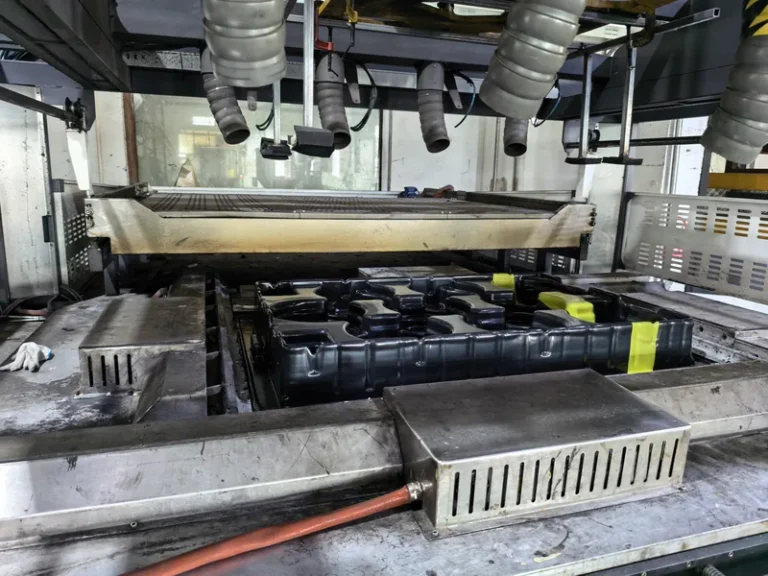
ZetarVac runs more than 20 vacuum forming and thermoforming machines processing sheet from 0.5 to 15 mm, with forming lengths up to about 2,500 mm and 5-axis CNC trimming so the trimmed outline follows the forming tool. For buyers, that means material options can be judged against real forming windows at production scale, not just datasheet curves.
ABS: Why Is It the Default Sheet for Formed Housings?
ABS earns its default status through balance. It forms across a wide temperature window, accepts texture and fine detail, delivers solid impact strength at room temperature, and stays affordable at the 3–10 mm gauges most housings need. That combination explains its dominance in equipment housings, automotive interior parts, cases and guards.
Formability is the quiet advantage. ABS softens gradually instead of sharply, which gives operators generous margin on heater settings and cycle timing — a real benefit on parts approaching 2,500 mm long, where sheet edges and centre heat differently. It also paints, bonds and laminates predictably, which matters when a housing needs a conductive coating or a decorative film later in the process.
The limits are thermal and environmental. Standard ABS loses stiffness as service temperature approaches its heat deflection point1, and it degrades under sustained UV exposure, so untreated ABS is a poor choice for permanent outdoor installation. Grades such as ASA and weatherable blends close exactly that gap for outdoor equipment housings and automotive exterior parts. Where loads turn structural, PC/ABS adds heat and toughness for automotive interiors and equipment housings, and glass-filled sheets serve reinforced industrial parts.

One anonymised example from ZetarVac’s case files: an ABS vacuum-formed seedling tray for agricultural seedling raising, built as a multi-cavity heavy gauge part with custom tray size, cavity count and cell geometry. The grade family serving agricultural trays also serves industrial enclosures — the difference lies in tool design and forming recipe, not in exotic materials.
HDPE: When Does Polyethylene Beat the Engineering Plastics?
Choose HDPE when the environment, not the load, is the enemy. It shrugs off acids, alkalis, cleaning chemicals and water absorption, and it costs less per kilogram than ABS or PC at comparable gauges — which is why industrial trays, equipment liners and storage boxes are its home territory.
The trade-offs are stiffness and dimensional behaviour. HDPE is roughly half as stiff as ABS at the same gauge, so parts need extra thickness, ribs or geometry to resist flex. Its shrinkage and thermal movement run higher, and hot HDPE carries shape memory, so flat panels can warp when cooling is uneven. Tooling for HDPE therefore assumes different shrink allowances and a different cooling strategy than tooling for ABS — treating the two as interchangeable is a classic way to scrap a mold.
Forming behaviour differs too. HDPE sits in a narrower, more rubbery forming window and sags noticeably at forming temperature, so heater zoning and cycle timing need tighter control than on ABS. In the 1.5–10 mm range typical of industrial formed parts it is the polyethylene that matters; thinner packaging work generally moves down to LDPE.
"HDPE is just a cheaper, weaker drop-in replacement for ABS in any housing."False
HDPE is not a weaker ABS; it is a different material system with lower stiffness, higher shrinkage and a narrower forming window. Dropping it into an ABS-designed part without reworking gauge, ribs and shrink allowances usually produces warped panels and loose mounting features.
"HDPE is the correct choice when chemical and moisture resistance outrank stiffness."True
Wash-down trays, liners and storage boxes gain more from HDPE’s chemical inertness than they lose in rigidity. The geometry simply has to be designed around its shrinkage from the start.
PC earns its price when a cover must not break and often must be seen through. Its impact strength exceeds ABS by a wide margin, it stays stiff at higher service temperatures, and it offers clarity that no other sheet in the heavy gauge forming set can match.
That performance comes with discipline. PC absorbs moisture, and wet sheet forms bubbles and streaks, so drying before forming is a process requirement rather than an option. Its forming window is narrower than ABS — the material prefers to be hot and formed quickly rather than coaxed — and sheet cost runs clearly higher at the gauges covers need.
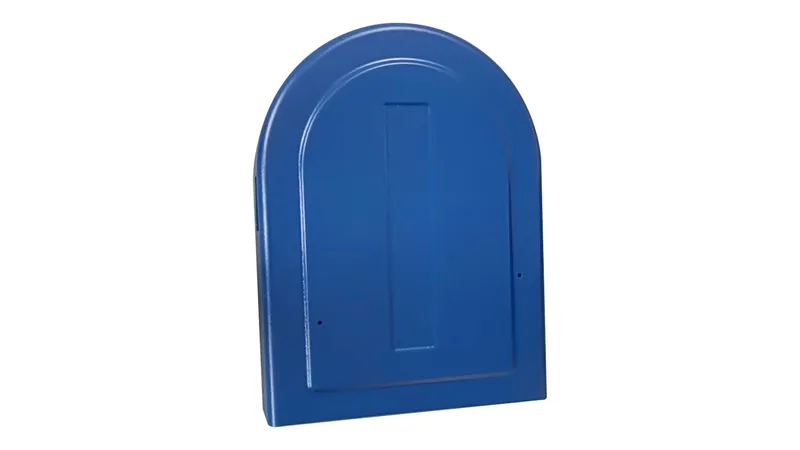
For electrical equipment, the standards picture matters as much as the mechanics. UL 94 classifies the flammability of plastic materials and is required for many equipment enclosures2, which is why flame-retardant PC grades are common in this market. Where a formed cover must keep dust or water out of live equipment, IEC 60529 defines the degrees of protection provided by enclosures, so the part and its gasketing must be designed against that IP code3 from the first drawing.
One caution: PC and acrylic (PMMA) are both clear, but they do not form or fail the same way. PMMA gives excellent clarity and weatherability for display and luminaire covers but is more brittle; PC trades some optical ease for near-unbreakable service. Choosing between them is a service-environment decision, not a price decision.
How Should ABS, HDPE and PC Compare in a Selection Table?
Use the table as a shortlist filter, not a verdict. The three materials separate most cleanly on stiffness, chemical resistance and heat capability, and the right pick depends on which of those your part actually needs.
| Property | ABS | HDPE | PC |
|---|---|---|---|
| Forming window | Wide and forgiving | Narrower, more sag | Narrow, fast forming |
| Impact strength | Good | Good, strong when cold | Excellent |
| Stiffness | Medium to high | Low to medium | High |
| Heat resistance | Moderate | Low | High |
| Chemical and moisture resistance | Moderate | Excellent | Good |
| Optical clarity | Opaque | Opaque | Clear grades available |
| Relative sheet cost | Medium | Low | High |
| Typical heavy gauge parts | Housings, guards, trays | Trays, liners, boxes | Guards, windows, covers |
Read the table by the rows that matter for your application. A wash-down liner justifies HDPE’s stiffness penalty, a machine guard justifies PC’s cost, and a general-purpose indoor housing rarely justifies anything but ABS. The heavy gauge thermoforming overview puts these material roles into full process context.
Which Tests Should Back Your Material Decision Before Tooling?
Datasheet comparison starts the shortlist; validation on the formed part finishes it. The tests below are the ones buyers should expect to see specified before production tooling is cut.
Tensile and stiffness. ISO 527-2 specifies the tensile test conditions run on thermoformed sheet4, so specimens cut from formed, trimmed parts can be compared lot to lot on a common basis. Where bending governs — panel-like enclosures and covers — ASTM D790 measures flexural properties and is the better proxy for wall stiffness.
Heat capability. ASTM D648 determines the deflection temperature of plastics under flexural load, which indicates how hot a formed panel can run in service before it loses shape; ISO 75-2 is the international counterpart for the same property. During forming itself, Vicat softening temperature signals where a heated sheet starts to sag.
Safety and environment. For formed housings over electrical equipment, UL 746C governs the polymeric materials used in that equipment, building on the UL 94 flammability ratings already discussed. Industry bodies such as the SPE Thermoforming Division publish practical guidance that ties these tests into day-to-day process control.
ZetarVac carries more than 45 production lines in total, with reference monthly capacity of roughly 100,000–200,000 pieces across prototyping, small batch and large batch production. Material qualification therefore happens on production-representative machines, which is what makes first-article data meaningful for volume output.
Put together, the sequence is short: qualify the sheet, form a production-representative trial, trim on the 5-axis centre, then test what the process actually delivered. Where that sequence gets skipped, problems surface at the customer instead.
"Passing the first article means the production run will hold the same dimensions."False
A first article is one part from one sheet lot on one machine setup. Sheet lot variation and heater drift move wall distribution and shrinkage over a run, so parts can walk out of tolerance later even though nothing changed on the tool.
"Production stability needs periodic checks on formed and trimmed parts, not a one-time approval."True
Dimensional sampling and sheet lot verification catch drift while correction is still cheap. First-article approval starts process control; it does not end it.
FAQ
How thick can heavy gauge vacuum forming go?
Heavy gauge vacuum forming at ZetarVac processes sheet from 0.5 to 15 mm thick, with forming lengths up to about 2,500 mm and 5-axis CNC trimming that keeps the finished outline aligned with the forming tool. Within that envelope, the practical gauge for a part is set by draw depth and wall thinning, not by a fixed ceiling.
Which material is best for an outdoor equipment enclosure?
Standard ABS degrades under UV, so permanent outdoor service points to ASA or a weatherable blend, with PC as the impact-led alternative. HDPE handles weather and chemicals well but needs geometry support for its lower stiffness. Match the grade to the exposure, not to the datasheet headline.
Is ABS or HDPE the better choice for industrial trays?
For dry, indoor material handling, ABS gives a stiffer tray at a lower gauge. For wash-down, chemical exposure or cold storage, HDPE usually wins despite the extra thickness it needs. The deciding question is what the tray must survive in service, not what looks better on paper.
Can you form materials beyond ABS, HDPE and PC?
Yes. The sheet library also covers PP, TPE, TPU, TPV, PA6/PA66, POM, PMMA and PP/GF for soft liners, seals, precision industrial parts and reinforced structural work. The selection logic in this guide — forming window, service environment, validation testing — applies to every one of them.
How do I move from a material shortlist to a qualified part?
If you are evaluating ABS, HDPE and PC for a specific part, share your drawings and the target service environment with an engineer through our China vacuum forming manufacturer team, or compare capabilities on our service overview. A drawing-based review turns a three-material shortlist into a formable, testable specification.
-
Heat deflection temperature (HDT): The temperature at which a plastic specimen deflects a defined amount under a specified flexural load, used to compare the heat resistance of sheet and formed parts. ↩
-
UL 94: A flammability standard that classifies plastic materials by burning behaviour, with ratings such as V-0, V-1 and V-2 commonly required for equipment enclosures. ↩
-
IP code: The ingress protection rating defined by IEC 60529 that grades enclosures against dust and water intrusion. ↩
-
ISO 527-2: The standard that specifies test conditions for determining the tensile properties of plastics, including specimens prepared from sheet and formed parts. ↩