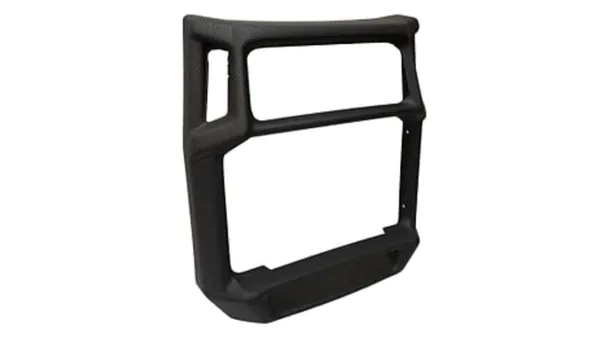
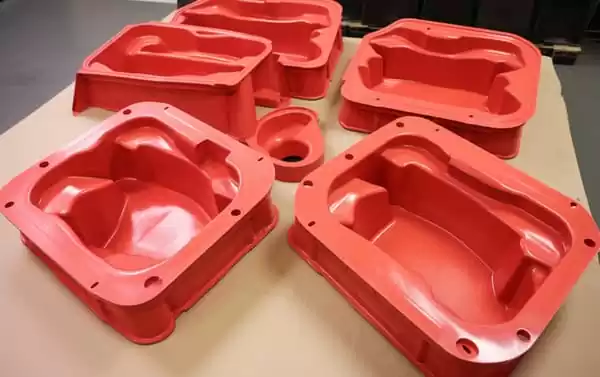
Pressure forming is the step up most engineers reach for when a vacuum formed surface looks too soft: logos lose their edges, leather or woodgrain texture washes out, and styling lines turn rounded. It is a heavy-gauge thermoforming variant that adds positive air pressure to the forming force, which is how large plastic housings and covers get crisp, injection-like detail at a fraction of injection tooling cost. This guide covers how the process works, what the premium buys, which materials respond best, and how to inspect the result before you release tooling.
- Pressure forming adds controlled air pressure above the heated sheet, pushing material into mold detail that vacuum alone cannot reach.
- The premium over vacuum forming buys sharper texture, crisper logos, and tighter radii on visible surfaces — not more strength.
- Production equipment on ZetarVac lines processes sheet from 0.5 to 15 mm with forming lengths up to about 2,500 mm.
- ABS, PC/ABS, and ASA are the workhorses for enclosures; PC and PMMA earn their place when impact or clarity matters.
- Heat deflection and flammability ratings, not datasheet stiffness, decide whether a formed housing survives its working environment.
- A first article proves the tool and the setup; it does not prove every part in the batch will look the same.
What Is Pressure Forming Plastic?
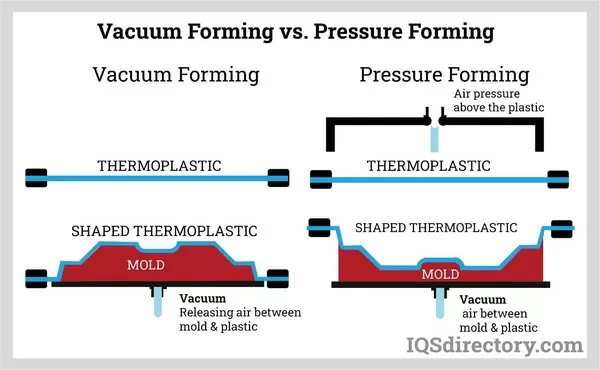
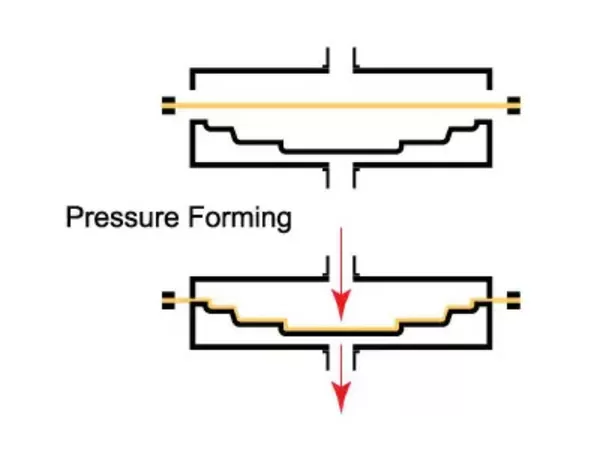
Pressure forming plastic is a heavy-gauge thermoforming method in which a heated sheet is drawn against a mold by vacuum while positive air pressure — typically 3–6 bar depending on machine and material — presses the sheet into fine mold detail from the opposite side. The result is sharper texture, cleaner lettering, and crisper radii than vacuum forming alone produces on the same tool.
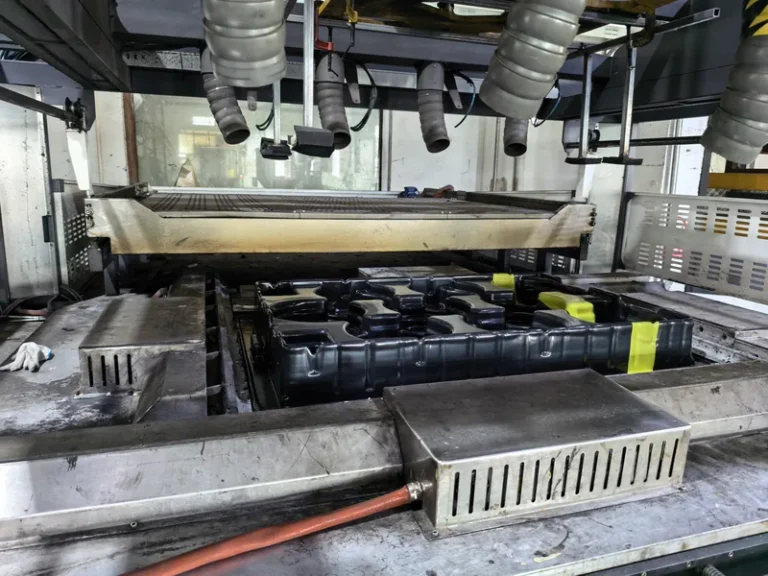
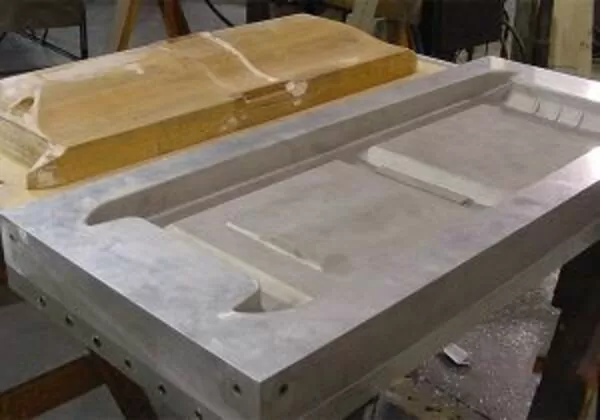
How the pressure box works: In plain vacuum forming, atmospheric pressure of roughly one bar is the only force pushing the hot sheet into the mold, because the vacuum removes air from the far side. A pressure forming tool seals the sheet edge between a pressure box and the mold platen, then feeds in compressed air. The forming force multiplies several times over, and the sheet is driven into surface detail — grain, logo recesses, and sharp parting edges — that one atmosphere of vacuum simply cannot hold on a fast or deep draw.
The benefit scales with geometry. Shallow panels pick up detail almost regardless of process, so the pressure box earns its cost on parts with medium draws, visible three-dimensional styling, or texture that must match a mating injected component. Draw ratio1 matters here: the deeper and more complex the draw, the more wall thinning concentrates in corners, and the more forming force helps distribute the sheet before it freezes off.
How Is Pressure Forming Different From Vacuum Forming?
Both processes heat a plastic sheet and pull it against a mold, but vacuum forming uses only atmospheric pressure acting on the vacuum side of the sheet, while pressure forming seals the platen and adds positive air pressure from above. That extra force is what transfers fine grain, logos, and sharp edges into the finished surface.
| Attribute | Vacuum forming | Pressure forming |
|---|---|---|
| Forming force | ~1 bar, vacuum side only | Vacuum plus 3–6 bar air pressure |
| Surface detail | Good on flat and shallow parts | Sharp texture, lettering, and logos |
| Tooling | Single mold, lower cost | Mold plus sealed pressure box |
| Cycle time | Shortest on simple parts | Slightly longer from sealing step |
| Best fit | Trays, liners, internal covers | Cosmetic housings and panel fronts |
The tooling difference drives the decision more than the cycle time does. A pressure box has to seal reliably at temperature, cycle after cycle, which means better machining, gasket maintenance, and a higher initial tool investment. When the part surface is hidden, that investment buys nothing; when the part is the face of a machine, it buys the difference between a formed cover that reads as premium and one that reads as a shell.
"Pressure forming and vacuum forming are just two names for the same process."False
The terms get used loosely, but the physics differ. Without the pressure box, one atmosphere of vacuum is the entire forming force, which is not enough to hold fine texture on deep or fast draws — the grain washes out and styling lines round over.
"Pressure forming earns its premium only on visible cosmetic surfaces."True
Texture, logo depth, and sharp radii are what buyers and end users actually see. On hidden structural parts, internal covers, and liners, the added tooling cost and sealing time change nothing about function, so conventional vacuum forming is the economical specification.
Because the two variants share heaters, sheet handling, and downstream trimming, a shop that runs both can often prototype in plain vacuum forming and move to pressure tooling once the cosmetic surface is frozen. Asking whether both processes sit under one roof is a fair first question during supplier selection; the ZetarVac service overview is one way to check which forming and finishing steps are covered in-house.
ZetarVac runs 20+ vacuum forming and thermoforming machines processing sheet from 0.5 to 15 mm with a maximum forming length of about 2,500 mm. That spread means shallow cosmetic parts and large, deep enclosures can each be matched to the right process variant on the same shop floor, with the same material library.
Which Materials Work Best for Pressure Formed Parts?
Most pressure formed parts are specified in ABS, PC/ABS, ASA, PC, or PMMA, because these resins stay strong when hot and hold surface detail as they cool. TPE and TPV are reserved for soft liners and seals, while HDPE and PP are usually chosen for trays and structural parts where cosmetic depth is not the point.
Detail retention is a hot-strength story, not a stiffness story. A sheet that sags quickly under the heaters will thin unpredictably under positive pressure, so the datasheet numbers that matter most are thermal. ASTM D648 defines the deflection temperature of a plastic under a specified flexural load, and it is the figure to check before committing a formed enclosure to a warm electrical cabinet2. UL 94 governs the flammability classification of plastic materials, and it is the rating most buyers must see on the specification before a formed housing can be approved for electrical equipment3.
Material families earn their roles in specific ways. ABS and PC/ABS dominate equipment housings and automotive interiors because they texture cleanly and trim predictably. ASA holds color and gloss outdoors, which is why it is specified for outdoor equipment housings and automotive exterior parts. PC brings impact performance to guards and protection covers. PMMA stays optically clear, and ISO 13468 defines the total luminous transmittance test used to compare transparent plastics — the number to request when a formed display cover must remain genuinely clear.
"Any sheet that vacuum forms well will pressure form just as well."False
Detail transfer depends on hot melt strength, not general formability. Resins that lose hot strength quickly can thin excessively or blow through under several bar of air pressure, leaving thin corners and a surface that never picks up the mold grain at all.
"Material and forming pressure must be qualified together on real tooling."True
Sheet suppliers publish forming windows, but heater output, plug assist, and air pressure interact tool by tool. A forming trial on the actual resin grade is the only reliable way to confirm texture depth and wall distribution, so treat it as part of tooling acceptance.
Where Does Pressure Forming Pay Off?
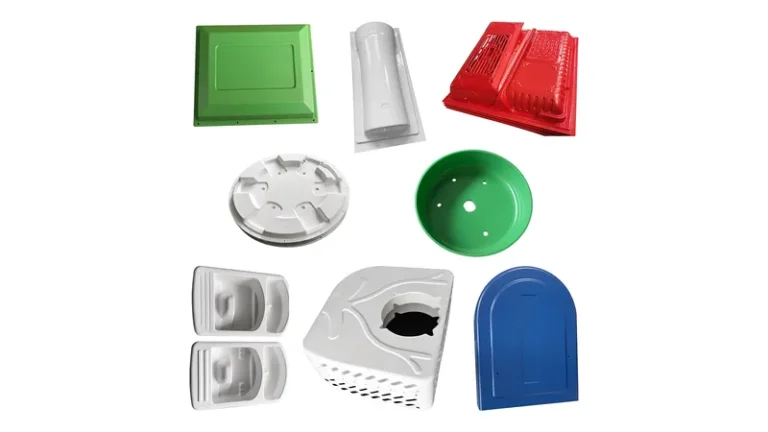
Pressure forming pays off wherever a large surface is seen and judged: equipment housings, control panel fronts, medical and diagnostic equipment covers, and retail display parts. Internal trays, liners, and structural panels usually stay with conventional vacuum forming because appearance there does not change value.
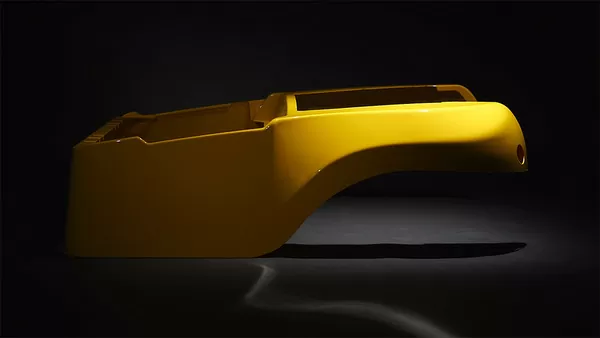
Two representative cases show the pattern. A PC vacuum-formed medical equipment housing, formed as a large and complex curved shell, carries custom cut-outs, mounting holes, and reinforcement — geometry where pressure forming keeps the visible surfaces crisp while the part still meets the enclosure expectations of medical and diagnostic equipment. UL 746C governs polymeric materials used in electrical equipment, and IEC 60529 defines the IP code that classifies how well an enclosure resists dust and water4; both are worth referencing on drawings for formed housings and covers.
Retail display work follows the same logic from the other side. An acrylic (PMMA) vacuum-formed display cover uses high clarity and custom curved geometry to make the product underneath the visible story, and the pressure assist keeps edges and radii sharp enough that the cover reads as a finished design element rather than a bent sheet.
ZetarVac’s material library pairs PC with clear guards and equipment protection covers, ASA with outdoor equipment housings and automotive exterior parts, and PC/ABS with automotive interiors and equipment housings. Those pairings map directly onto the applications where cosmetic forming detail carries value, which is why material and process should be selected together.
What Tolerances and Quality Checks Should You Specify?
For heavy-gauge formed parts, overall profile tolerance widens as the part gets larger, and formed wall thickness varies with draw ratio, so tolerance bands belong in the drawing review rather than being assumed from a material datasheet. Put the critical items in writing on the drawing: trimming outline, hole positions, texture depth, and the surfaces where the part mates to other components — then confirm them on first articles5 before release.
Wall distribution deserves the most attention in review. Forming thins the sheet as it stretches, so the corners of a deep draw can sit well below nominal gauge while flat areas stay close to it. ISO 527-2 defines the tensile test used to verify thermoformed sheet and formed parts, and it is how a material substitution or a badly processed sheet gets caught before it reaches your assembly line.
Formed parts on ZetarVac lines are trimmed on a five-axis CNC centre, with the trimmed outline following the forming tool, across a plant of 45+ production lines and reference monthly capacity of about 100,000–200,000 pieces. Five-axis trimming machines drafted walls and curved trim lines in one setup, which keeps edge-to-feature relationships consistent across a batch.
Consistent trimming is what turns a formed shell into a manufacturable component. When the trim program and the forming tool are defined together, hole positions land where the mating panel expects them, and edge-to-feature dimensions survive from the first part to the last. When trimming is treated as an improvised secondary step, those relationships are the first thing that drifts, and assembly problems follow.
"Once the first article is approved, the whole batch will match it."False
A first article proves the tool, the sheet grade, and the setup on one part. Wall distribution and texture depth drift with heater output and ambient conditions across a run, so periodic in-process checks are what protect the batch — not the initial signoff.
"Texture depth is a measurable specification, not a visual opinion."True
Mold grain depth can be measured and compared against the tool specification at receiving inspection. Writing the grain code and depth into the drawing gives both sides an objective acceptance criterion and removes the most common source of cosmetic disputes on formed parts.
How Do You Decide Between the Two Processes?
Choose pressure forming when the part has a large visible surface that must carry texture, logos, or sharp styling lines, and volumes are too low to justify injection tooling. Choose conventional vacuum forming when function drives the part — trays, liners, internal covers, and structural panels where no one grades the surface.
Work the decision in that order: surface first, geometry second, volume last. If the cosmetic requirement can be met with a shallow draw and forgiving texture, vacuum forming at a lower tool cost may already pass. If the surface must match an injected neighbor or carry a brand mark, pressure forming is the cheaper route to that surface at almost any volume. The trap is deciding from the process side first — asking for pressure forming by name instead of describing the surface you actually need.
To go deeper before you talk tooling, the ZetarVac vacuum forming guide walks through sheet selection, tooling basics, and process variants in detail. It is useful reading when you are still framing what to put on the drawing.
FAQ
Is pressure forming the same as thermoforming?
Thermoforming is the family name for all sheet-heating-and-forming processes; vacuum forming and pressure forming are its two main production variants. Pressure forming is thermoforming with positive air pressure added, so every pressure formed part is thermoformed, but not every thermoformed part is pressure formed.
How thick can the sheet be?
Heavy-gauge thermoforming equipment on ZetarVac lines processes sheet from 0.5 to 15 mm with forming lengths up to about 2,500 mm, which covers most enclosure, cover, and tray applications. Parts outside that window should be reviewed case by case against the available gauge range and forming length.
Can pressure forming match injection molded surface detail?
On large, shallow to medium depth parts, pressure forming transfers texture and logo detail close to injection quality, which is exactly why it is used for cosmetic housings. Deep draws and knife-edge features remain injection territory, because stretched sheet cannot be forced into extreme detail without thinning.
Does pressure forming work with pre-textured sheet?
It can, but matching mold grain to sheet grain is fussy work that limits your texture choices. Most cosmetic parts start from smooth sheet and take their entire surface from the mold, which gives you direct control over the exact grain code specified on the drawing.
What should I send a supplier for a first recommendation?
A drawing with material, gauge, texture callouts, and expected annual volume is enough for a first process recommendation, plus photos of the intended application. Visible-surface requirements drive whether the pressure box is worth it, so describing how the part will be judged matters more than naming the process.
To keep researching before you discuss tooling, explore the ZetarVac vacuum forming guide for process fundamentals, or see how a China vacuum forming manufacturer structures heavy-gauge projects from sheet selection through five-axis trimming. Both walk through the decisions that shape a forming program while you are still defining the part.
-
Draw ratio: The ratio of formed part surface area to starting sheet area; higher draw ratios mean more wall thinning toward deep corners of the part. ↩
-
HDT: Heat deflection temperature, measured under ISO 75-2 or ASTM D648 — the temperature at which a loaded plastic bar deflects a specified amount, used as a proxy for part behavior under heat and load. ↩
-
UL 94: The flammability classification standard for plastic materials; ratings such as V-0 describe how quickly a material self-extinguishes after ignition. ↩
-
IP code: The ingress protection rating defined in IEC 60529, classifying how effectively an enclosure resists dust and water. ↩
-
First article: The first production-intent part from production tooling, inspected and approved before the batch is released. ↩