Choosing between PVC, HDPE and PP is the first real decision in any profile extrusion project, and it locks in cost, tooling and failure modes long before the first meter comes off the line. Buyers are rarely burned by a dramatic property gap. They are burned by a polymer that looked fine on the datasheet but was wrong for the profile’s section geometry, service temperature or compliance environment. This guide compares the three workhorse materials the way a procurement engineer should: by stiffness and impact behavior, heat and weathering limits, processing behavior on the extrusion line, and the total cost of a conforming extruded profile rather than the resin price alone.
- PVC delivers the highest stiffness at the lowest material cost and is the only one of the three governed by dedicated building-profile standards such as EN 12608.
- HDPE wins on impact toughness, chemical resistance and low-temperature behavior, but its higher shrinkage demands more generous tolerances on the profile cross-section.
- PP offers the best heat resistance and survives repeated flexing, making it the default for living hinges, wear strips and heat-adjacent profiles.
- Soft-touch or sealing functions rarely need a second material decision: co-extrusion with TPE, TPV or TPU puts a flexible lip on a rigid substrate in one pass.
- Judge materials on cost per conforming meter. Resin price alone hides scrap rates, line speed differences and tolerance risk.
What Does an Extruded Profile Demand From a Polymer?
An extruded profile needs a polymer that holds its cross-section as it leaves the die head, cools without warping, and keeps its properties meter after meter of continuous production. Unlike a molded part, a profile is judged over hundreds of meters, so melt stability and dimensional repeatability matter as much as any datasheet strength value.
A rigid channel, a soft gasket and a clear light cover all leave an extrusion die, yet they punish a polymer in different ways. Stiffness decides whether a thin-walled section resists bending in service, and flexural data on datasheets comes from ASTM D790, the standard flexural test normally cited for extruded profile sections1. Tensile strength and elongation figures come from ASTM D638, the default tensile test referenced for extruded profiles2. Read both as starting points, because die orientation and the profile’s cooling history move the numbers, sometimes noticeably.
For profile extrusion, three processing questions dominate the material choice. Does the melt hold its shape at the die exit? Rigid PVC, barely molten at processing temperature, holds fine detail, while HDPE’s melt elasticity rounds sharp corners. How much does the material shrink on cooling? Semi-crystalline HDPE and PP shrink several times more than amorphous PVC, which directly widens the tolerance you must quote on the cross-section. And does the compound stay thermally stable over a long run? PVC degrades if melt temperature or residence time drifts, while HDPE and PP are more forgiving but warp more.
"Once a profile passes first-article inspection, it will hold that tolerance for the rest of the run."False
First-article approval only proves the die head, calibration and setup were right at hour zero. Dimensional stability over hundreds of meters depends on melt temperature control, cooling-bath uniformity and haul-off consistency, none of which one sample can prove. Buyers who treat sign-off as done routinely discover drift, or a full shift of out-of-tolerance stock, halfway through an order.
"Sustained dimensional accuracy is a process-capability question, not a one-time measurement."True
A responsible profile extrusion supplier monitors melt temperature, calibration and haul-off continuously and inspects cut stock at intervals across the run, not only at the start. Ask how dimensional checks are scheduled during production. ZetarVac works to a minimum cross-sectional tolerance of ±0.05 mm, subject to material and section geometry, on lines covering profile widths from 5 to 600 mm.
Section geometry interacts with all three processing questions, so review the drawing against extrusion constraints before the die is cut. The DFM checklist for extruded plastic profiles and extrusion dies covers wall-thickness uniformity, corner radii and tolerance zoning in detail, while the plastic extrusion molding guide gives a full overview of the process from material feed to haul-off.
PVC Profiles: Stiffness, Fire Behavior and Standards Compliance
Unplasticized PVC is the stiffest and least expensive of the three, which is why it dominates window and door profiles, decorative trims, pipes and sealing strips. Its amorphous structure gives low shrinkage and crisp surface detail, and rigid compounds are classified by ASTM D1784, which sorts rigid PVC and CPVC compounds into cell classes covering impact resistance, tensile modulus, heat deflection and flammability, so you can specify a compound class instead of a brand name3.
For building applications the standards go further. EN 12608 specifies the geometry, impact resistance after accelerated ageing and heat reversion limits that PVC-U window and door profiles must meet4. Heat reversion matters in profile extrusion because a profile that shrinks back toward its die shape after installation will distort frames and joints over time. If your market follows European building specifications, PVC is effectively the default, and the compliance work is already built into qualified compounds.
PVC’s limits are thermal. Typical rigid compounds soften near 75–80 °C, measured as the Vicat softening temperature under ISO 306, the standard test that gives a comparable heat and creep indicator across thermoplastics5. A PVC profile next to a sustained heat source will soften long before PP would. Where fire behavior matters, PVC’s chlorine content provides inherent flame retardance that PP and HDPE lack, and compounds are routinely screened against UL 94 for parts in devices and appliances.
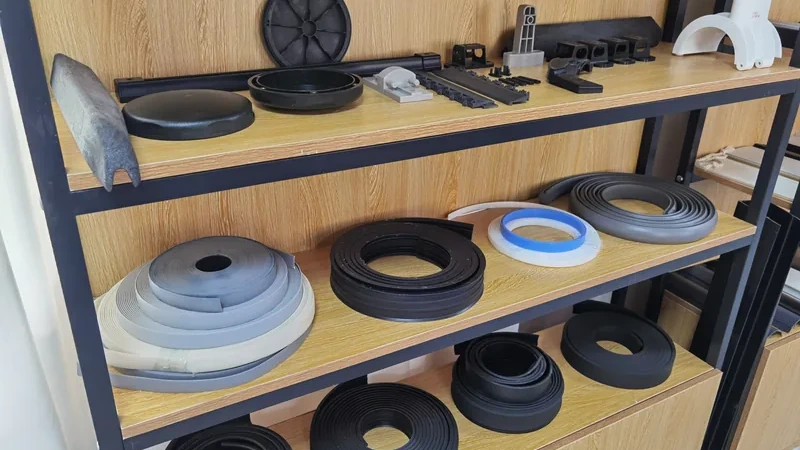
Where a PVC profile must also seal or wipe, co-extrusion solves it without a second process. PVC+TPU is one of the rigid-flexible combinations actually run in multi-layer profile production, placing a wear-resistant flexible lip on a stiff PVC body in a single pass.
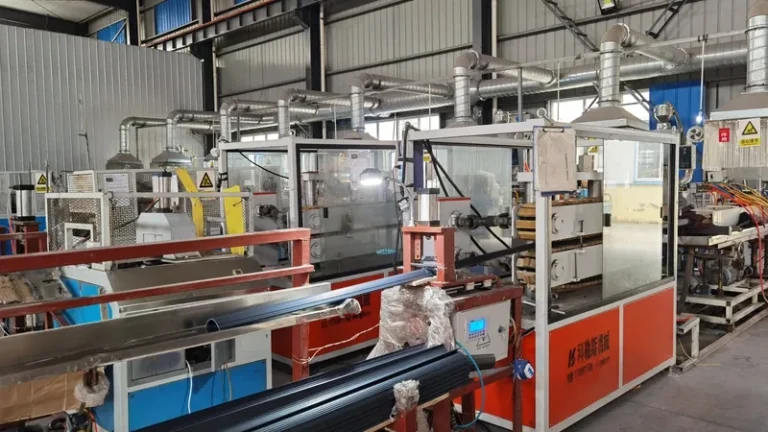
ZetarVac runs PVC across window and door profiles, decorative trims, pipes and sealing strips, with single, double and triple-layer co-extrusion available on 7+ automated lines. That means a PVC profile with an integrated soft lip or a dual-color face does not need a second supplier or a secondary bonding step — it comes off the same line, under the same tolerance budget.
When Does HDPE Beat PVC for Extruded Profiles?
HDPE is the right choice when a profile must survive impact, chemicals or cold. It outperforms rigid PVC in toughness, stays ductile at low temperatures where PVC goes brittle, and resists most acids and alkalis, which is why it is the standard for edge trims, guide rails, wear strips and pipes.
That toughness comes from HDPE’s semi-crystalline structure, and the same structure creates two processing behaviors to plan for. Shrinkage on cooling is high, typically several times that of rigid PVC, so tolerances on the profile cross-section must be quoted more generously, and uneven crystallization can bow thin-walled sections as they freeze. Melt elasticity also rounds corners, so sweeping radii and thick-walled, simple sections suit HDPE naturally while fine, sharply detailed sections do not.
Outdoor exposure is the third differentiator. Unstabilized polyolefins weather quickly, so any outdoor profile in HDPE or PP should be specified with UV stabilization qualified by accelerated weathering under ISO 4892, the standard series covering exposure of plastics to laboratory light sources6. For long-term outdoor color and surface retention, ASA — also in ZetarVac’s material library — exists precisely for outdoor and building profiles where appearance stability outranks cost.
"HDPE profiles always cost less because the resin is cheaper per kilogram."False
Resin price is one input among several. HDPE’s higher shrinkage widens tolerances, its slower crystallization can slow line speed on thick sections, and scrap from warping eats the savings. A cheaper kilogram that yields fewer conforming meters is the more expensive material on the finished profile.
"Profile cost should be compared as cost per conforming meter, not per kilogram of resin."True
When the same drawing is quoted in both materials, thick and simple sections often favor HDPE through faster, stable running, while fine detailed sections favor PVC through lower scrap and tighter tolerances. Ask each supplier to price both materials against identical tolerance callouts before you decide.
Is PP the Right Pick When Profiles See Heat or Repeated Flexing?
Yes. Sustained service temperatures above roughly 80–90 °C or repeated flexural cycling put PP ahead of both PVC and HDPE. It keeps stiffness where PVC softens and tolerates millions of flex cycles, which is why it dominates living hinges, wear surfaces and appliance guides.
PP’s higher heat capability makes it the default for profiles near heat sources, from appliance components to automotive interior sections, and glass-filled PP/GF extends it into high-strength industrial profiles. Its fatigue behavior is equally distinctive: a properly designed polypropylene section can flex repeatedly across its service life without cracking, something rigid PVC in thin sections cannot match, especially at low temperature.
The weaknesses are the mirror image. Unfilled PP loses impact strength sharply below about 0 °C, so cold-environment profiles need copolymer grades or a different material. UV resistance is poor unstabilized. And like HDPE, its semi-crystalline shrinkage demands deliberate tolerance planning on the profile cross-section.
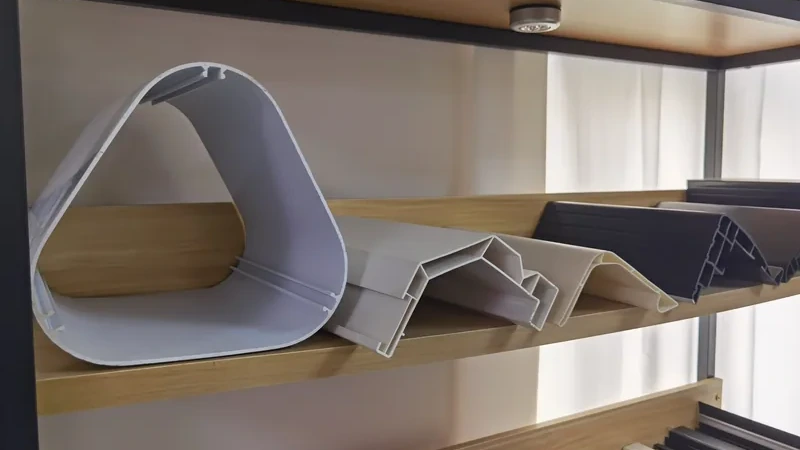
In a single co-extrusion pass of up to three layers, PP can be combined with TPV or TPE — combinations ZetarVac actually runs — to place a flexible, low-friction sealing lip on a rigid PP substrate. The automotive seat slide rail strip built this way combines dust exclusion, guiding, wear resistance and low friction with structural support in one extruded profile, and the same logic applies to appliance guides and industrial rails.
Whatever grade you specify, verify impact behavior on real stock rather than on datasheets, because die orientation changes the story.
"Datasheet impact values predict how an extruded profile behaves when struck in service."False
Datasheet impact numbers come from standardized coupons, usually injection-molded, with no die orientation and a different cooling history. An extruded profile carries molecular orientation along its length, so longitudinal and transverse behavior differ, and thin calibrated walls notch easily. Profiles therefore fail transverse impacts well below the datasheet figure.
"Impact performance must be verified on the actual extruded profile at the lowest service temperature."True
Ask for samples cut from production-length stock, tested in both longitudinal and transverse directions at the coldest realistic service condition. This is standard practice for PP in cold environments and for any profile exposed to handling abuse. One batch of samples prevents the classic field failure of a profile that looked fine on paper.
PVC vs HDPE vs PP: A Selection Table for Profile Engineers
The table below condenses the trade-offs into a first-pass filter. Choose the row that matches your profile’s worst service condition — coldest temperature, hottest temperature, harshest impact or chemical — and the compliance environment your market imposes.
| Selection factor | Rigid PVC | HDPE | PP |
|---|---|---|---|
| Stiffness | Highest of the three | Moderate | Moderate; higher with glass fill |
| Impact toughness | Moderate; brittle when cold | Excellent, best at low temperature | Good; drops below ~0 °C unfilled |
| Continuous heat capability | Softens near 75–80 °C | Roughly 90–100 °C | Best of the three, ~90–110 °C |
| Shrinkage on cooling | Low | High | High |
| Weathering | Good when stabilized | Needs UV stabilization | Needs UV stabilization |
| Chemical resistance | Good; limited solvent resistance | Excellent vs acids and alkalis | Very good |
| Flame behavior | Inherently flame-retardant | Burns; needs FR grades | Burns; needs FR grades |
| Typical extruded profiles | Window and door profiles, trims, pipes, sealing strips | Edge trims, guide rails, wear strips, pipes | Hinges, functional parts, industrial profiles |
| Relative material cost | Lowest | Low to moderate | Low to moderate |
Treat the table as a shortlist, not a verdict. Two profiles with identical geometry can justify different materials once mounting loads, snap-fit deflections and aging requirements are added, and the extrusion die design changes with the material as well. Where the answer sits between two columns, co-extrusion with a flexible layer frequently removes the need to choose at all.
FAQ
Which material gives the tightest tolerances on an extruded profile?
Rigid PVC, in most cases. Its low, uniform shrinkage lets the die hold the finest detail and the narrowest tolerance band, which is why fine decorative and building profiles are routinely specified in PVC. HDPE and PP reach good tolerances too, but their higher shrinkage calls for more generous callouts on the same drawing.
Can rigid and flexible functions be combined in one profile?
Yes, through multi-layer co-extrusion. Up to three layers can be run in a single pass, and combinations actually in production include PP+TPV, PP+TPE, PVC+TPU and ABS+TPU. This is how a rigid structural body and a flexible sealing or wiping lip become one continuous profile with no secondary assembly.
Is HDPE or PVC the safer choice for a profile around electrical wiring?
Specify it rather than assume it. Rigid PVC’s chlorine chemistry gives inherent flame retardance, and electrical compounds are qualified against UL 1581, the reference standard covering extruded insulation and jackets for wires, cables and flexible cords. ZetarVac’s transparent PVC electronic tube profile, for instance, serves cable protection, insulation and guiding in electrical and electronic assemblies. HDPE needs a flame-retardant grade if fire behavior is a requirement.
How much does material choice affect capacity and order size?
Less than section complexity does. PVC, HDPE and PP are all standard in ZetarVac’s material library, so prototyping, small batch and large batch production are supported on any of them. ZetarVac’s household robot vacuum squeegee strip shows the co-extrusion approach at work: ABS provides the rigid support while a TPU layer supplies the flexible, wear-resistant wiping contact.
The plant runs 45+ production lines in total, with reference monthly capacity of about 300–500 tonnes across the extrusion lines. For a buyer, that means the material decision can be driven by engineering fit rather than by which line happens to be free, and a switch from PVC to HDPE or PP does not push the project to the back of the queue.
What should I send a supplier to get a material recommendation?
Your profile drawing with section dimensions and tolerances, the worst-case service environment — temperature range, impact exposure, UV and chemicals — and any standard your market requires. With those three inputs, a profile extrusion supplier can shortlist PVC, HDPE or PP, and flag where co-extrusion beats a single material, before any die is quoted. An overview of what a full-service extrusion partner covers is available on the our service page.
If you are weighing PVC, HDPE and PP for an upcoming profile, share your drawings and service requirements with ZetarVac and talk to an engineer about the trade-offs against your section geometry. You can also evaluate our extrusion capabilities, tolerances and material range directly on the China plastic extrusion manufacturer page.
-
ASTM D790: Standard test method for flexural properties of plastics, the stiffness figure normally cited for extruded profile sections. ↩
-
ASTM D638: Standard test method for tensile properties of plastics, the default tensile test cited for extruded profiles. ↩
-
ASTM D1784: Standard classification for rigid PVC and CPVC compounds, assigning cell classes for impact, modulus, heat and flammability. ↩
-
EN 12608: European standard for PVC-U window and door profiles covering profile geometry, aged impact resistance and heat reversion. ↩
-
ISO 306: Standard defining the Vicat softening temperature test for thermoplastics, a comparable heat and creep indicator. ↩
-
ISO 4892: Standard series defining exposure of plastics to laboratory light sources for accelerated weathering qualification. ↩