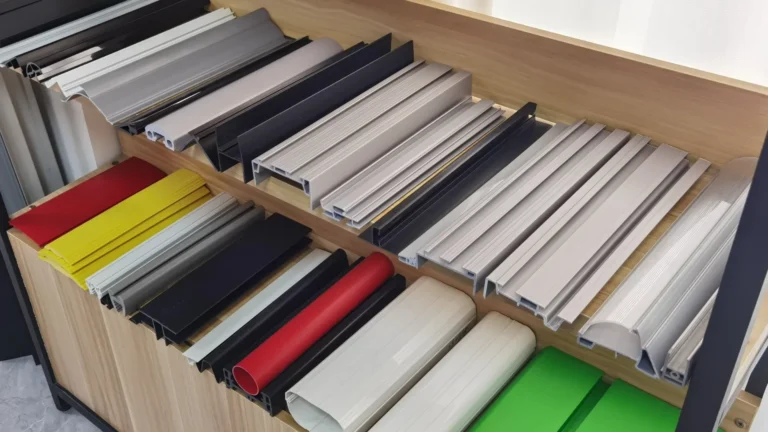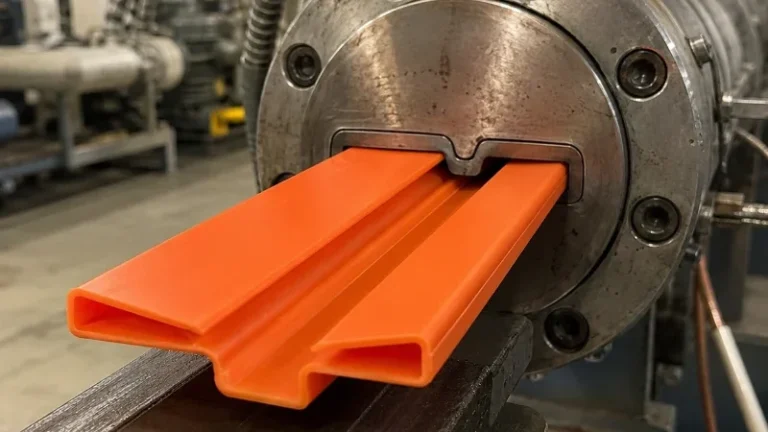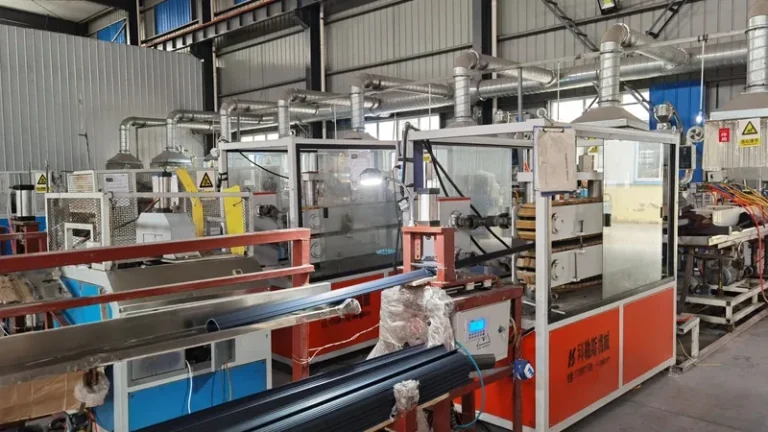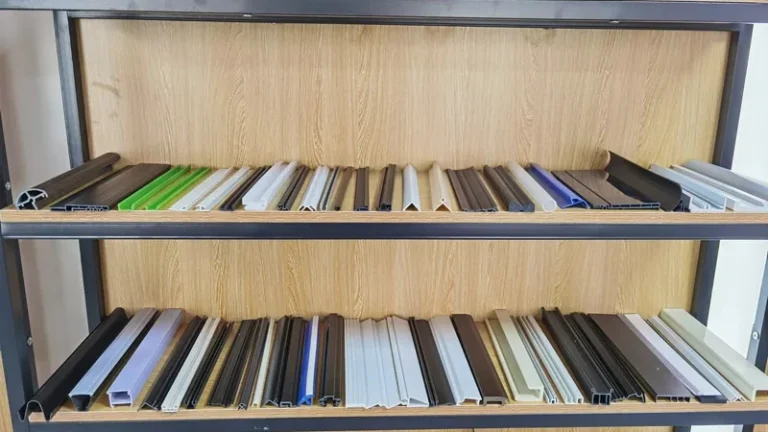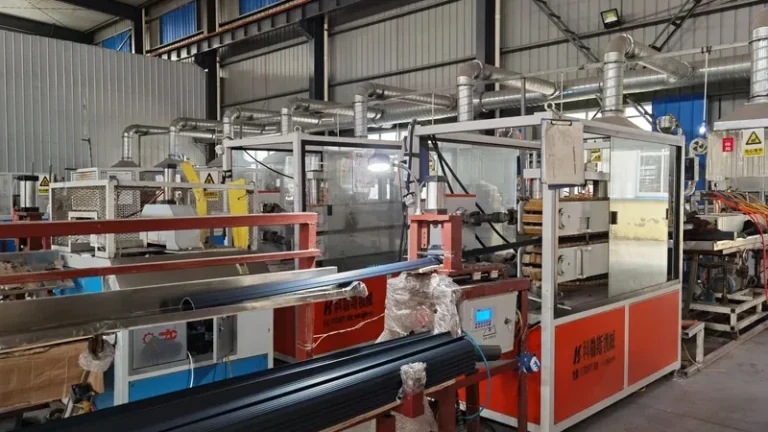
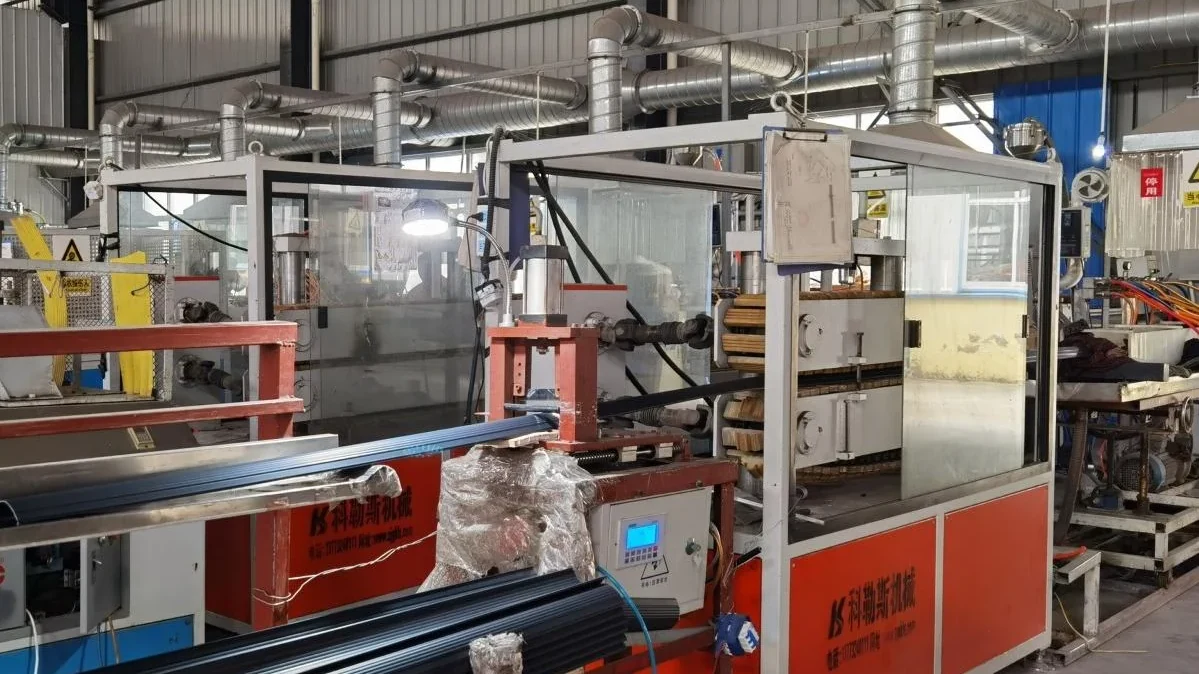
An extrusion die is the last thing the melt touches before it becomes a product, and it is often the least examined line item in a project budget. Buyers compare line rates and resin prices, then accept whichever die steel the supplier defaults to. That default decides how long a profile extrusion holds tolerance, how often the line stops for cleaning, and whether a worn die head can be reworked or has to be replaced. This guide sets out how the decision is made in practice: which steel families are used, how the polymer formulation attacks the tool, what actually ends a die’s service life, and which maintenance habits separate a die that runs for years from one scrapped early.
- Die steel selection starts from the polymer formulation: abrasive fillers push toward hard grades, acidic rigid PVC pushes toward corrosion-resistant ones.
- Four steel families cover most profile work: pre-hardened grades, through-hardened hot-work grades, corrosion-resistant stainless grades and high-wear cold-work grades.
- Dies rarely fail suddenly. Service life ends gradually through land wear, flow-channel scoring and joint-plane leakage.
- Maintenance discipline — cleaning tools, polishing direction, re-nitriding intervals, storage conditions — often matters more than the initial steel grade.
- Judge a die on lifetime cost: the steel price is small against line downtime, scrap tonnes and requalification at the buyer’s end.
Which Steels Are Used for Profile Extrusion Dies, and When?
Four steel families cover most die work. Pre-hardened tool steels suit custom sections still being proven and moderate volumes. Through-hardened hot-work grades are the default for long-running production. Corrosion-resistant stainless grades handle acidic rigid PVC melts. High-carbon cold-work grades and nitrided variants serve heavily filled, abrasive compounds. The right answer is a trade-off between hardness, polishability, corrosion resistance and cost.
Pre-hardened steels are delivered already heat treated, so they machine quickly and hold geometry well, which keeps tooling lead time short. The limitation is surface hardness: on compounds with mineral fillers, the land wears measurably faster than on a through-hardened grade.
Through-hardened hot-work steel is the workhorse of long-running profile extrusion1. It resists thermal fatigue at die-head temperatures, polishes to a good finish and tolerates repeated strip-downs. Most multi-layer co-extrusion2 die heads are built on hot-work grades for exactly these reasons.
Where the melt is corrosive — above all rigid PVC — corrosion-resistant stainless tool steels earn their premium. Pitting in a flow channel is self-accelerating: each pit traps degraded material, which produces streaks and black specks downstream. A stainless body avoids that cycle entirely.
For heavily filled sections, high-carbon cold-work grades provide the highest wear resistance of the common die steels, at the cost of brittleness. Thin lands and sharp external edges need generous radii and careful handling, because a chipped land is expensive to recover.
Steel is only half of the tooling decision; the geometry half — land length, drawdown ratio, flow balancing — is covered in detail in our extrusion die head design guide. If the terminology is new, this introduction to what a die does in the extrusion process is the place to start.
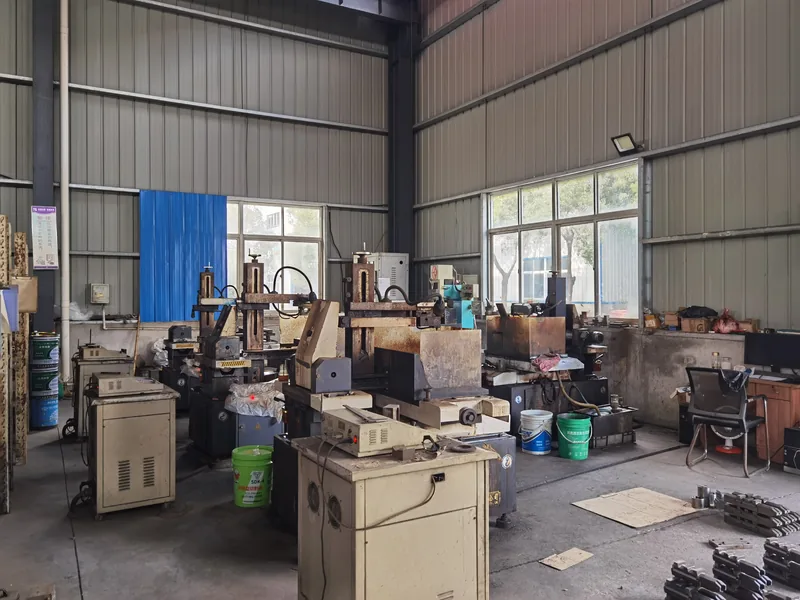
| Steel family | Typical condition | Best suited to | Main limitation |
|---|---|---|---|
| Pre-hardened tool steel | Supplied heat treated, machined as delivered | Custom sections in development, moderate volumes | Faster land wear with filled compounds |
| Hot-work tool steel | Through-hardened and tempered | Long-run rigid profiles, co-extrusion die heads | Needs careful polishing for gloss surfaces |
| Stainless tool steel | Corrosion-resistant, hardened | Acidic melts, rigid PVC, humid conditions | Higher cost, lower thermal conductivity |
| High-carbon cold-work steel | Highest surface hardness of common grades | Heavily filled, abrasive sections | Brittle edges; radii required on thin lands |
ZetarVac runs co-extrusion combinations such as PP+TPV, ABS+TPU and PVC+TPU on lines rated for up to three layers. Every layered section makes the steel decision satisfy two melts at once: a rigid structural layer and a soft elastomer layer with very different adhesion and degradation behaviour.
How Does the Polymer Formulation Attack the Die?
Three mechanisms dominate. Abrasion comes from mineral fillers and glass fibre. Corrosion comes from acidic decomposition products — rigid PVC releases hydrochloric acid as it degrades. Adhesive galling appears where soft elastomer layers slide across the land. The compound data sheet tells you which mechanism to design for.
Fillers such as calcium carbonate, talc and glass fibre pass through the whole melt path, and the final metering happens across the land, where shear and velocity peak. Glass-filled PP, used for high-strength industrial profiles, is among the most abrasive melts a flow channel can see: expect dimension drift and visible surface lines unless the steel and its coating are matched to the filler.
Standards help here. ISO 1163, which specifies designation and requirements for unplasticized PVC moulding and extrusion materials, classifies PVC-U compounds by properties that include filler-related characteristics — a direct indicator of how aggressively the melt will wear a flow channel3. An experienced die maker reads a customer’s ISO 1163 class as a wear forecast before the first trial run.
Corrosion is slower but less forgiving. Rigid PVC releases hydrochloric acid at processing temperatures; combined with moisture or aggressive stabilizer packages, it pits unprotected steels. The pits then hold degraded melt, and the visible symptom appears metres downstream as streaks and discoloured specks that look like a material problem rather than a tooling one.
Soft elastomer layers bring the third mechanism. In sections where a TPU or TPV lip slides across a steel land, localized sticking can tear the melt surface and drag fragments back into the flow. Higher polish, release-active coatings and land geometry that lowers contact pressure all help.
"Abrasive fillers only wear the screw and barrel, never the die."False
Fillers such as calcium carbonate, talc and glass fibre pass through the entire melt path, and final metering happens across the land, where melt velocity is highest. Ignoring filler abrasion shows up as dimension drift and surface lines within the first production campaign.
"The compound specification should be fixed before die steel is chosen."True
Filler type and content, the base polymer and any corrosive additives determine which attack mechanism dominates. Selecting steel from that specification lets the die maker balance hardness, corrosion resistance and polishability instead of gambling on a generic grade.
What Actually Limits the Service Life of an Extrusion Die?
Dies rarely fail suddenly. Service life ends when land wear4 pushes critical dimensions outside tolerance, when flow-channel scoring produces visible lines or melt hesitation, or when joint-plane leakage and heater damage make the die head unstable at operating temperature.
Dimension drift is the most common endpoint. The land is the short parallel section at the die exit that sets final dimension and surface quality, so it sees the highest shear and the most wear. As it opens up, the operator compensates with drawdown ratio and line speed until the compensation itself starts distorting the section — at that point the die comes off the line.
Flow-channel condition fails before dimensions do on appearance-critical profiles. A single scratch across a polished channel, usually from cleaning with the wrong tool, prints a continuous line down the extruded profile. Scratched or pitted zones also hold up degraded melt, which periodically releases as black specks.
Suppliers usually express die life in linear metres, and the honest range is wide. A well-maintained hot-work die running an unfilled polyolefin profile can stay in production for years, while the same geometry on a heavily filled rigid PVC section may need re-polishing and re-nitriding within a fraction of that time. Formulation, line speed and maintenance discipline decide where in that range a die lands.
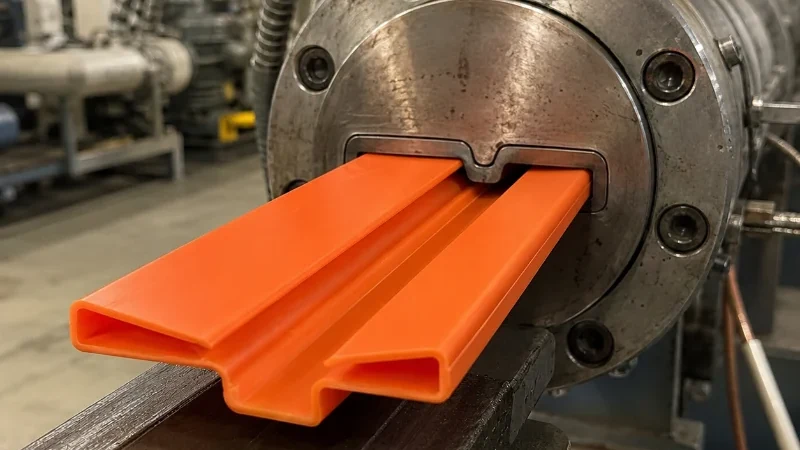
Maintenance Practices That Extend Die Life
Scheduled strip-downs beat reactive ones. How often depends on the compound and the hours run, but the principle is fixed: the die comes off, is fully disassembled, and the flow channel is inspected under good light before wear becomes a quality complaint.
Cleaning method is where die life is most often lost. Brass and copper scrapers, plastic scrapers and appropriate solvents only; never steel tools on a polished channel. Polishing is always done in the flow direction, and any repair welding is followed by re-machining and re-polishing of the full channel, not just the repaired spot.
ZetarVac commits to a minimum dimensional tolerance of ±0.05 mm on the profile cross-section, subject to material and section geometry. A die whose lands have worn even a few hundredths beyond their cut geometry can quietly consume that entire allowance, which is why die condition is tracked alongside line settings.
Coatings need lifecycle planning. Nitriding5 hardens the surface against abrasion and corrosion, and chrome plating is common on lands where gloss matters. Both are consumables: they wear, and the intervals for renewal should be recorded per die, not guessed.
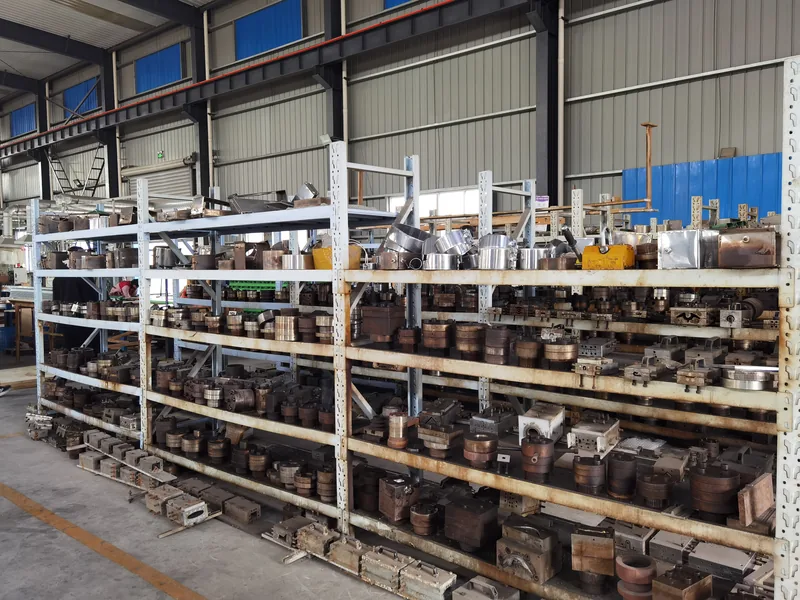
Storage decides whether an idle die comes back healthy. Faces protected, channels lightly oiled, joint planes sealed, desiccant in the crate, and a card recording cumulative linear metres and every rework performed. A die that returns from storage with pitted joint faces has cost the shop its next changeover.
"Once a die drifts out of tolerance, it is scrap."False
Tolerance drift from land wear can usually be recovered. Lands can be re-polished or re-cut, surfaces re-nitrided or re-plated, and joint planes re-ground, as long as land stock remains and the flow channel is undamaged.
"Most premature die failures come from maintenance mistakes, not steel selection."True
Steel tools on a polished flow channel, skipped coating renewals and damp storage destroy dies long before their steel is exhausted. A disciplined routine routinely returns a worn die to tolerance several times over its working life.
Total Cost of Ownership: the Die Price Is the Small Part
Die steel cost is a modest share of a profile project, yet it multiplies into every hour the line runs. A die that needs an extra cleaning stop every shift, or that scrapes during every restart, costs more in downtime and scrap than a premium steel grade ever would. For the wider process context around tooling and line capability, see our plastic extrusion molding hub.
Requalification is the hidden line item. When a worn die forces dimension drift at the customer’s end, every downstream assembly that relied on the profile cross-section has to be rechecked. Priced over its full service life, a die built from the right steel with a documented maintenance plan is almost always the cheaper purchase.
Reference capacity across ZetarVac’s extrusion lines is about 300–500 tonnes per month. At that throughput, a degraded die head that raises scrap by even one or two percent becomes tonnes of wasted material per month — far more than any saving on the steel purchase order.
The practical takeaway during supplier selection: ask which steel the quotation assumes, which rework intervals it budgeted, and what happens when the die drifts. Those three answers separate a serious die maker from a reseller.
"The lowest die quotation is automatically the cheapest option."False
A die built from the wrong steel family wears early, and the cost lands where nobody budgeted it: line downtime, scrap tonnes and requalification. The steel saving is a rounding error against one unplanned week of stopped production.
"A die should be priced over its full service life, not its invoice."True
Total cost includes expected reworks, coating renewals, downtime per stop and scrap during restart. Comparing suppliers on lifetime cost during procurement surfaces the honest differences between quotations.
FAQ
How long does an extrusion die actually last?
There is no single number. An unfilled polyolefin die can run for years with only routine cleaning, while a heavily filled rigid PVC die may need re-polishing and re-coating within months. Life is best tracked in cumulative linear metres between reworks, not in calendar time.
Does die steel grade affect profile tolerance?
Yes. Tolerance capability at first article is a geometry question; how long that tolerance holds is a steel and maintenance question. Wear-resistant, correctly coated steels keep a profile inside specification far longer on filled or corrosive compounds.
Can a worn die be repaired, or must it be replaced?
Most wear is recoverable. Lands can be re-polished, re-cut, re-nitrided or re-plated, and joint planes re-ground. Replacement becomes necessary only when land stock is exhausted, the flow channel is deeply damaged, or repeated rework has distorted the section geometry.
What should I send a supplier so the die steel is chosen correctly?
The compound specification with filler content, target output rate and run length, the profile drawing with tolerances, and any surface-finish requirement. With those four inputs, a die maker can match the steel family and coating instead of defaulting to a generic grade.
When you have a profile drawing or a compound specification ready, send it to our team through our service page to discuss your project and request a quote — the earlier the die steel decision is made, the cheaper the whole program runs.
-
Hot-work steel: Hot-work tool steels are alloy grades formulated to retain hardness and resist thermal fatigue at the elevated temperatures of a die head. ↩
-
Co-extrusion: Co-extrusion pushes two or more materials through a single die head at the same time to build a layered profile in one pass. ↩
-
ISO 1163: ISO 1163 is the standard for the designation and specification of unplasticized PVC (PVC-U) moulding and extrusion materials. ↩
-
Die land: The die land is the short parallel section at the die exit where the melt takes its final dimension and surface quality. ↩
-
Nitriding: Nitriding is a case-hardening heat treatment that diffuses nitrogen into the steel surface to raise hardness and wear resistance without quenching. ↩