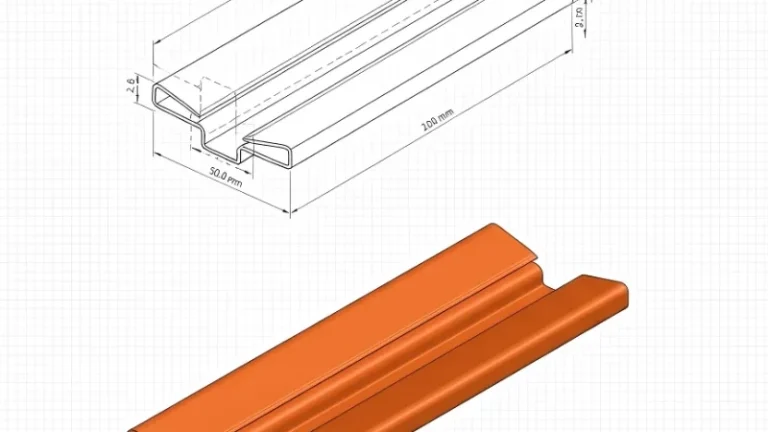
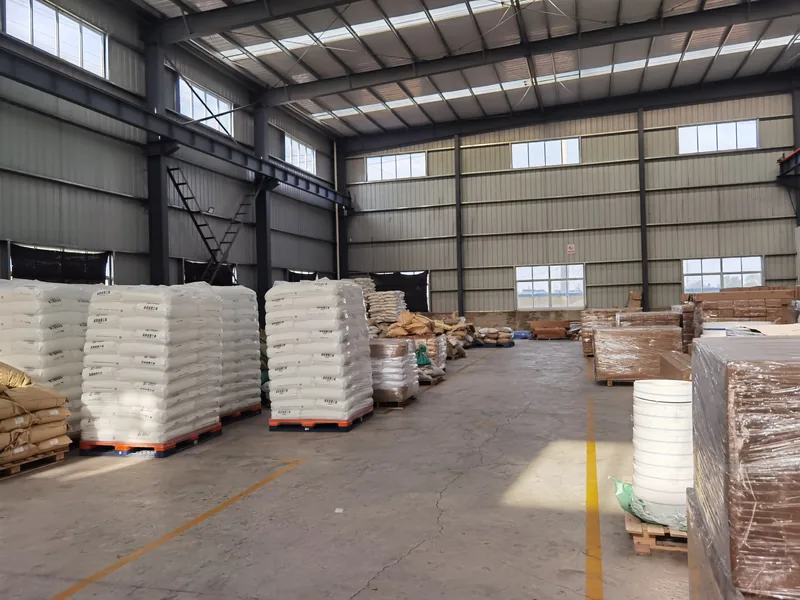
Material selection is the first engineering decision in any profile extrusion project, and it locks in cost, tooling design and long-term performance more than any later choice. A section that runs cleanly in rigid PVC may warp or fail impact testing in polypropylene; a sealing lip that recovers in TPV may take a permanent set in a cheaper TPE. This guide covers the polymers that dominate extruded profiles, how a grade differs from a resin name, which standards apply, and how material quality is verified. If you need the process defined first, start with what material extrusion is; the wider capability picture is covered in our guide to plastic extrusion molding.
- A resin name alone is not a specification: melt flow index, additive package and grade determine how a material behaves inside an extrusion die.
- Rigid PVC, ABS, HDPE, LDPE, PP, PC, PMMA, PA6/PA66, POM, TPE, TPU, TPV, PC/ABS, ASA and PP/GF cover the majority of extruded profile applications.
- Co-extrusion in up to three layers pairs a rigid carrier with a soft functional surface, such as PP with TPV, in a single section.
- Standards including ISO 1163, ASTM D1784 and EN 12608 define how extrusion materials are designated, classified and tested.
- Property verification combines tensile and flexural testing, Vicat softening point and weathering exposure with in-process dimensional control.
- Transparent, outdoor, wear and sealing duties each point to a different shortlist of materials.
What Materials Are Used in Material Extrusion?
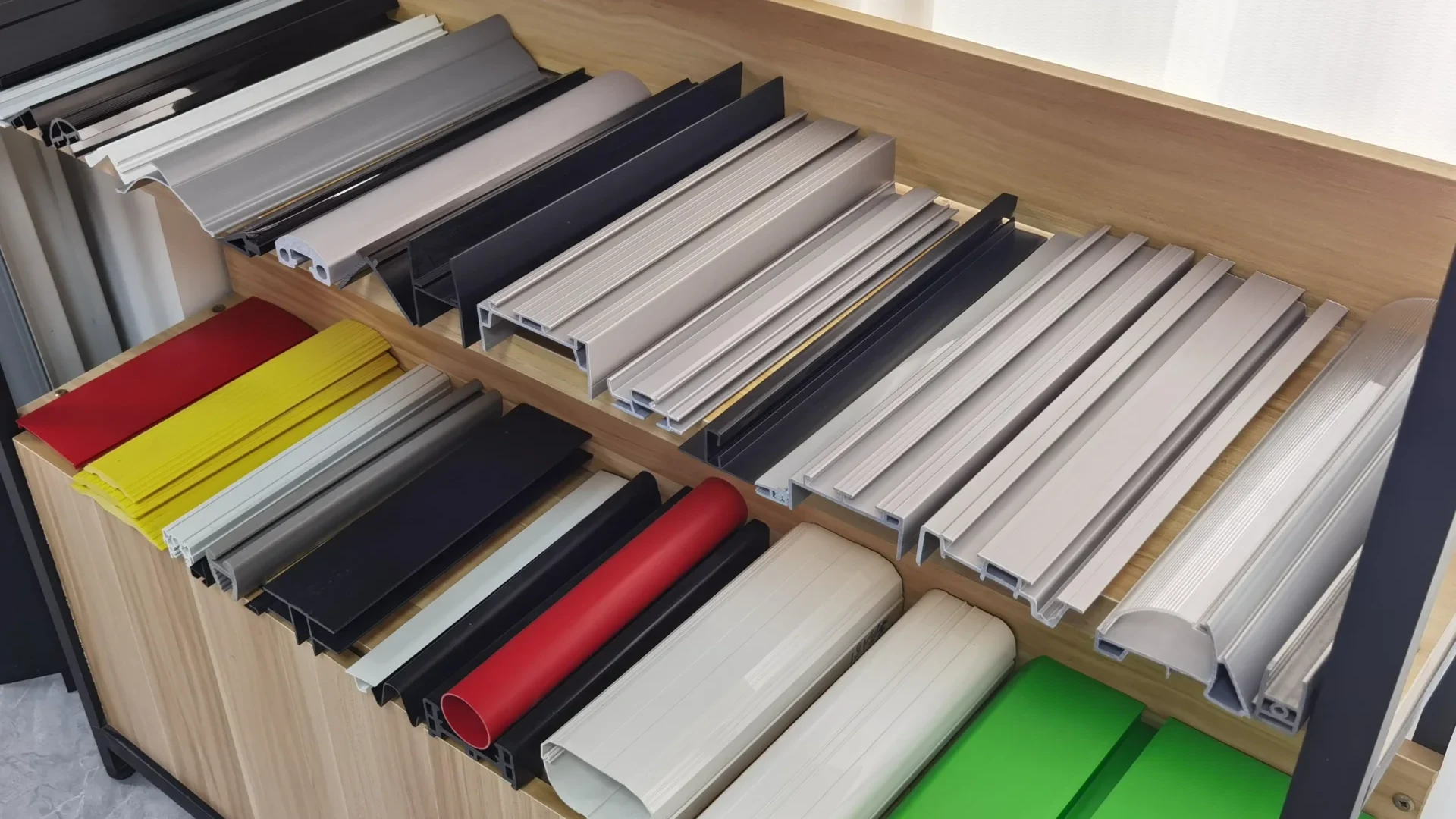
The most widely extruded materials are rigid PVC, ABS, HDPE, LDPE, PP, PC, PMMA, PA6/PA66, POM, and the flexible families TPE, TPU and TPV, alongside blends such as PC/ABS and glass-filled PP. Each family earns its place through a specific property: PVC for rigid, flame-resistant sections at low cost, PC and PMMA for transparency, PA and POM for wear resistance, and TPE or TPV for flexible sealing duties.
Rigid PVC remains the volume leader for construction profiles. It extrudes at moderate melt temperatures, holds a crisp section geometry, and accepts stabilizer packages that meet flame and weathering requirements, which is why window and door profiles, decorative trims, pipes and sealing strips are so often specified in PVC-U. The standard ISO 1163 defines the designation and specification system for unplasticized PVC moulding and extrusion materials1, so a drawing that calls out a PVC-U designation references a defined compound family rather than a generic resin name.
ABS brings higher impact strength and a good as-extruded surface, making it the usual choice for automotive and industrial profiles and decorative parts. HDPE covers pipes, edge trims, guide rails and wear strips where chemical resistance and toughness matter, while its softer cousin LDPE serves film, flexible tubing and soft profiles. PP offers an excellent stiffness-to-cost balance with strong chemical and fatigue resistance for profiles, pipes and functional parts.
Transparency and optics belong to PC and PMMA. PC delivers impact-resistant transparent pipes, light covers and clear profiles; PMMA adds optical clarity and weatherability for light covers and display profiles. For precision motion, PA6 and PA66 supply industrial profiles, wear parts and mechanical parts, while POM gives low-friction precision profiles and guide rails. The flexible families complete the library: TPE for sealing strips, gaskets and buffer parts, TPU for hoses, conveyor belts and protective sleeves, and TPV for automotive and building seals that must survive compression over years.
| Material | Typical Extruded Applications | Deciding Property | Watch-Out |
|---|---|---|---|
| Rigid PVC | Window and door profiles, trims, pipes, sealing strips | Cost, rigidity, flame behavior | Heat reversion; stabilizer package required |
| ABS | Automotive and industrial profiles, decorative parts | Impact strength, surface finish | Limited outdoor UV resistance |
| HDPE | Pipes, edge trims, guide rails, wear strips | Chemical resistance, toughness | Higher thermal expansion |
| LDPE | Film, flexible tubing, soft profiles | Flexibility, low cost | Low stiffness |
| PP | Profiles, pipes, functional parts | Fatigue and chemical resistance | Brittle at low temperature without modification |
| PC / PMMA | Transparent pipes, light covers, clear profiles | Light transmission, clarity | Drying and stress-cracking control |
| PA6 / PA66, POM | Guide rails, wear parts, mechanical parts | Wear resistance, low friction | Moisture uptake; drying before extrusion |
| TPE / TPU / TPV | Sealing strips, gaskets, hoses, sleeves | Flexibility, compression set | Hardness selection drives sealing force |
| ASA, PP/GF | Outdoor profiles, high-strength sections | Weatherability, stiffness | ASA for surface life; PP/GF for load |
The material library at ZetarVac spans PVC, ABS, HDPE, LDPE, PP, PC, PMMA, PA6/PA66, POM, TPE, TPU, TPV, PC/ABS, ASA and PP/GF, each mapped to defined applications such as window profiles, automotive sealing strips, wear rails and light covers. For a buyer, that means the material shortlist can be built against real production experience rather than data sheets alone.
Which Polymer Should You Choose for Your Profile Section?
Start from the dominant failure mode of the application, not from a favorite resin. Stiffness points to PVC, ABS or PP/GF; continuous heat points to PP or PA; outdoor exposure points to ASA or stabilized PVC; sealing and cushioning point to TPE, TPU or TPV; transparency points to PC or PMMA.
Once the duty is clear, quantify it. Tensile strength and elongation are measured under ASTM D638, the default tensile test cited for extruded profiles2, while the stiffness of a section is judged from flexural data under ASTM D790. Heat capability is best screened with the Vicat softening temperature defined by ISO 3063, which indicates where a compound begins to soften under load. For any outdoor section, ask for weathering data generated under ISO 4892, which covers exposure of plastics to laboratory light sources and predicts how color and impact strength will drift.
"If the resin name matches, any grade of that polymer will run the same in extrusion."False
Two identical polymer names can hide very different melt flow indices, additive packages and stabilizer systems. A grade chosen for injection molding will surge in a profile die, drift dimensionally and may never reach the target surface, so the wrong grade costs a tooling trial, not just a pellet order.
"The grade, melt flow index and additive package must be specified alongside the polymer family."True
Extrusion grades sit in a controlled melt flow window that keeps die pressure stable and the section dimensionally consistent. Writing the grade and key additives into the drawing makes material supply a checkable contract instead of a nameplate.
Section geometry then narrows the field further. Wall thickness transitions, ribs and hollow chambers change how a compound cools, so a section with heavy and light walls may need a stiffer, faster-setting material than the same outline in a uniform wall. Share the drawing early: an experienced die designer will flag where a material change saves the extrusion die from repeated flow-balancing loops.
How Does Co-Extrusion Expand the Material Options?
Co-extrusion runs two or three compatible materials through a single die head so one profile delivers two property sets: a rigid carrier with a soft, functional surface. Combinations in regular production include PP+TPV, PP+TPE, PVC+TPU, ABS+TPU and TPV+CPVC.
The die head distributes each melt into its own channel and merges them just before the exit, so layer thickness, adhesion and shore hardness all become design variables in the same pass. That is what makes a rigid body and a compliant lip possible in one section, and it also allows a visible cap layer over a cheaper core where appearance matters on one face only.
Two production examples show the logic. An automotive seat slide rail strip co-extrudes PP with TPV: the PP carries structural load while the TPV lip provides dust exclusion, guiding, wear resistance and low friction. A household robot vacuum squeegee strip pairs ABS with TPU, where ABS supplies the rigid support and TPU the flexible wiping contact and wear resistance. In both cases a single-material section would have forced a compromise on one function.
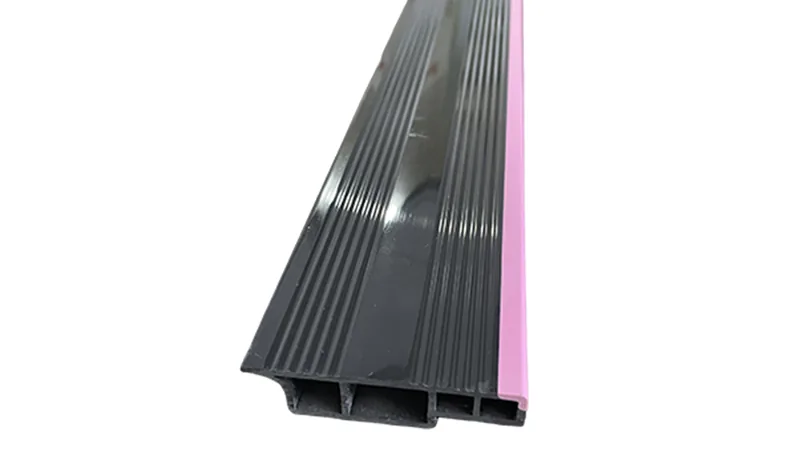
ZetarVac runs single, double and triple layer co-extrusion in up to three layers, with combinations such as PP+TPV, PP+TPE, PVC+TPU, ABS+TPU and TPV+CPVC in regular production, plus foam extrusion where a lighter section is needed. In-line punching, embossing and printing are available on the same line, so secondary features do not require a separate handling step.
For a deeper look at how layers are balanced inside the tooling, see the guide to co-extrusion die heads and multi-layer profiles.
Which Standards Govern Material Selection for Extruded Profiles?
Material selection is anchored by designation and classification standards that define what a supplier must actually deliver. ISO 1163 designates PVC-U extrusion materials, ASTM D1784 classifies rigid PVC and CPVC compounds by cell class4, and EN 12608 specifies the profile geometry, impact resistance and heat reversion requirements that PVC-U window and door profiles must meet5.
Cell classes and designations then flow directly into quotations. When a buyer cites an ASTM D1784 cell class or an ISO 1163 designation, every bidder is pricing the same compound family, which removes the quiet substitution of a cheaper grade. For window systems, EN 12608 additionally constrains the finished profile, so the compound and the section geometry are audited together rather than separately.
Safety and service environment add further layers. UL 94 classifies the flammability of plastic materials for parts in devices and appliances6, which matters wherever an extruded profile sits near electronics. For pipes, ASTM D2241 and ASTM D3035 fix the dimension systems for pressure-rated PVC pipe and controlled-outside-diameter PE pipe, while ISO 4427 defines material and dimensional requirements for polyethylene water supply pipes.
On drawings, the practical rule is to name the governing standard next to the material. A note such as a PVC-U designation per ISO 1163, with impact and heat reversion per EN 12608, turns a preference into a testable requirement and gives both sides a shared basis for incoming inspection.
How Is Material Quality Verified Before and During Production?
Verification starts before the hopper. Melt flow index, moisture content and additive certificates are checked against the agreed grade, and hygroscopic materials such as PA, PC and ABS are dried to their specified limits, because residual moisture shows up as surface defects and bubbles rather than as a failed lab test.
On the line, quality is confirmed continuously rather than at the end. First-article measurement against the drawing is followed by periodic cross-section checks, surface inspection and weight monitoring, with the results used to trim line speed, vacuum and cooling before drift becomes scrap. Common failure patterns such as die lines, warping and wall variation are diagnosable when the material record and the process record travel together, as covered in the extrusion defects troubleshooting guide.
"A passed first article proves the material will hold tolerance across the whole production run."False
A first article is measured after the process has been tuned for that moment. Without periodic cross-section checks over continuous running, resin lot changes and die wear can push dimensions out hours later, which is exactly when nobody is measuring.
"Process stability must be confirmed over continuous running, not only at first article."True
Dimensional checks at defined intervals, tied to resin lot numbers and line hours, show whether the material and the die remain in control. This is the evidence a buyer should ask for when qualifying an extruded profile for volume supply.
Tolerance capability is also material-dependent: a rigid section in PVC or ABS will hold tighter cross-section limits than a soft TPE lip, so tolerance callouts should reflect the material on each feature. Agreeing material-specific tolerances during supplier selection prevents most disputes at inspection.
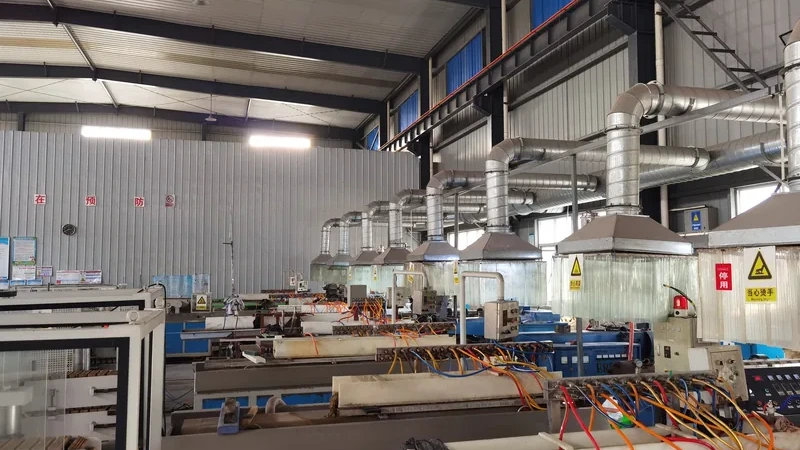
ZetarVac operates 7+ automated extrusion lines with a maximum profile width of 600 mm and holds a minimum achievable dimensional tolerance of ±0.05 mm on the profile cross-section, subject to material and section geometry. With reference monthly capacity of roughly 300–500 tonnes across the extrusion lines and 45+ production lines in total at the plant, the same material review framework applies from prototyping through small and large batch production.
FAQ
What is the most commonly extruded plastic?
Rigid PVC remains the most commonly extruded plastic by volume, driven by window and door profiles, pipes and trims in construction. HDPE and PP follow closely in pipe and industrial applications, where chemical resistance and toughness decide.
Can one extrusion line switch between different materials?
Yes, but not instantly. The screw, die head and downstream tooling are designed around a material family and melt flow window, so a change usually requires purging, and often a tooling change, to re-stabilize dimensions and surface.
What is the difference between TPE, TPU and TPV in extruded profiles?
TPE is a broad family of block-copolymer elastomers, TPU is a harder-wearing urethane with excellent abrasion resistance, and TPV is a dynamically vulcanized blend that holds its elasticity at higher temperatures. Hardness and compression set, not the family name, decide which one seals correctly.
How should a material be specified on a profile drawing?
Name the polymer family, the grade or melt flow window, hardness for flexible members, color, and the governing standard with its test methods. Ambiguity in any of these is where a quoting supplier will quietly substitute a cheaper grade.
Which materials suit transparent extruded profiles?
PC for impact-resistant covers and clear profiles, PMMA for optical clarity and weatherability, and clear rigid PVC for economical transparent sections such as electronic tube protection. Each needs controlled drying and mild process conditions to keep clarity.
If you are weighing materials for a new section, review your drawings with our engineers or share them through our plastic extrusion manufacturing team; an early material and tolerance review costs far less than a failed tooling trial.
-
ISO 1163: International standard for unplasticized PVC (PVC-U) moulding and extrusion materials, covering designation and specification. ↩
-
ASTM D638: Standard test method for tensile properties of plastics, the default tensile test cited for extruded profiles. ↩
-
ISO 306: Standard test method for the Vicat softening temperature of thermoplastics, an indicator of heat and creep resistance. ↩
-
ASTM D1784: Standard classification system for rigid PVC and CPVC compounds based on cell class. ↩
-
EN 12608: European standard for PVC-U profiles for windows and doors, covering profile geometry, impact resistance and heat reversion. ↩
-
UL 94: Standard for flammability of plastic materials for parts in devices and appliances. ↩