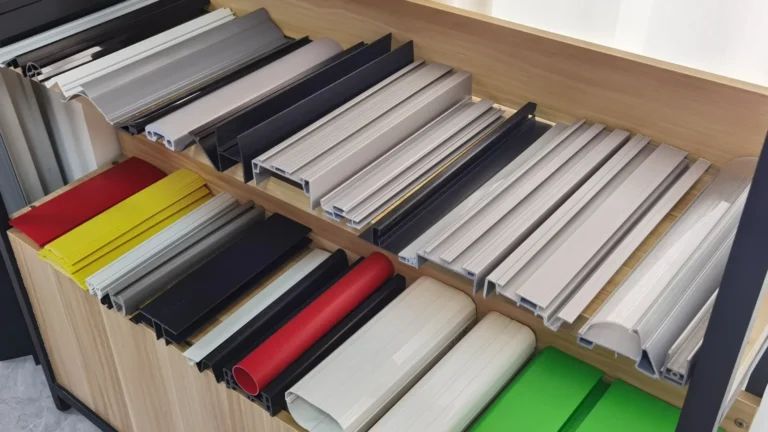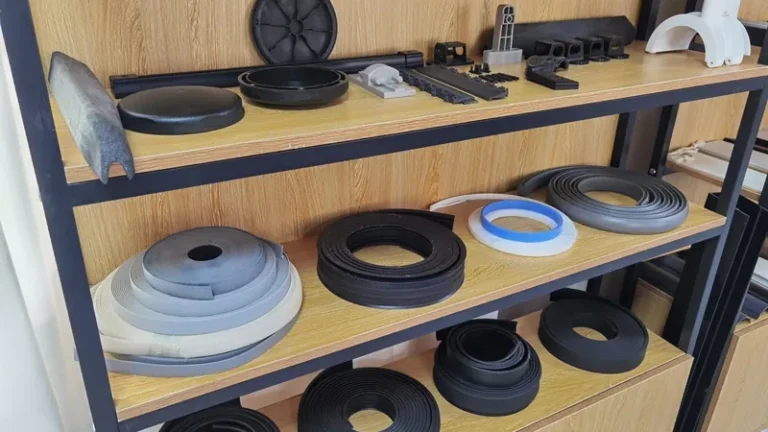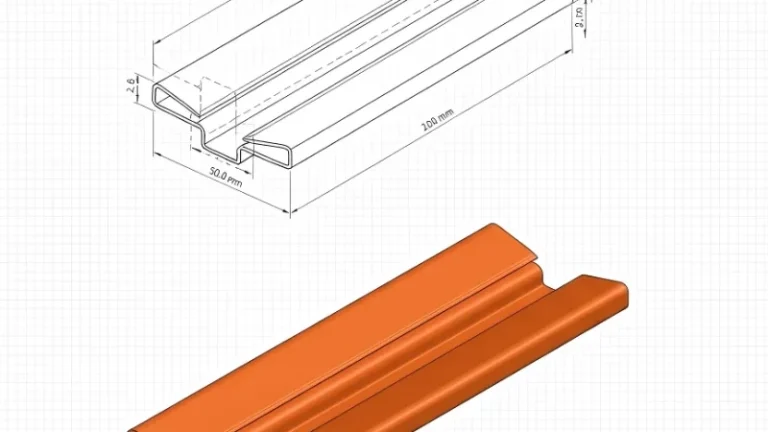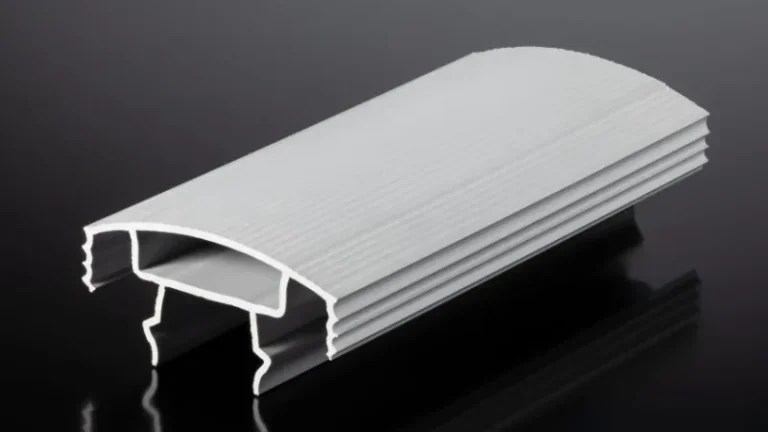
When a sourcing team searches for an extrusion control and supply company, the conversation is rarely about what a profile extrusion line looks like. It is about accountability: who controls the melt, who owns the die, who guarantees the tolerance, and who answers when a long run starts to drift. This guide gives procurement engineers and product designers a working definition of that role, the process variables that decide extruded profile quality, and a concrete checklist for comparing suppliers at the procurement stage.
- An extrusion control and supply company is accountable for melt conditions at the die head, calibration and cooling downstream, in-line secondary operations, material supply and delivery — not just for shipping parts.
- Dimensional stability is created at the die and the vacuum sizing tank; final inspection can only confirm it, never create it.
- Tighten tolerances only on mating, sealing and guiding dimensions; blanket tight tolerances inflate cost and scrap rates without adding function.
- Co-extrusion, up to three layers in one pass, lets a single extruded profile combine a rigid carrier with a soft sealing or low-friction lip.
- Judge suppliers on evidence — process data, material traceability, die maintenance records — rather than machine photographs or headline prices.
What Does an Extrusion Control and Supply Company Actually Do?
In plain terms, it owns every variable that keeps an extruded profile inside specification: melt temperature and pressure at the die head, vacuum calibration and cooling downstream, haul-off speed, and in-line operations such as punching, embossing and printing. It also supplies the tooling, the resins and the production schedule, so the buyer holds one party accountable instead of splitting responsibility across a die maker, a resin trader and a separate converter.
That single point of accountability changes how problems get solved. When a profile bows after cooling, a full-scope supplier can adjust the sizing tank, the cooling water temperature and the haul-off setting the same day. A trading intermediary, in contrast, has to relay the symptom to a third party and wait. The same logic applies to tooling: die corrections, land-length changes and flow balancing are done in-house on the supplier’s own dies, which shortens the loop between a first-article report and a corrected die head1.
The supply half of the role is just as concrete. It covers resin selection from a material library, batch-to-batch consistency checks such as melt flow index2, and the logistics of delivering profiles cut, punched or printed. For a buyer, the practical test is simple: ask who tunes the process and who owns the tooling. If the answer involves two or three companies, control is fragmented — and so is the risk. If you want wider process context first, the plastic extrusion molding guide covers the process end to end.
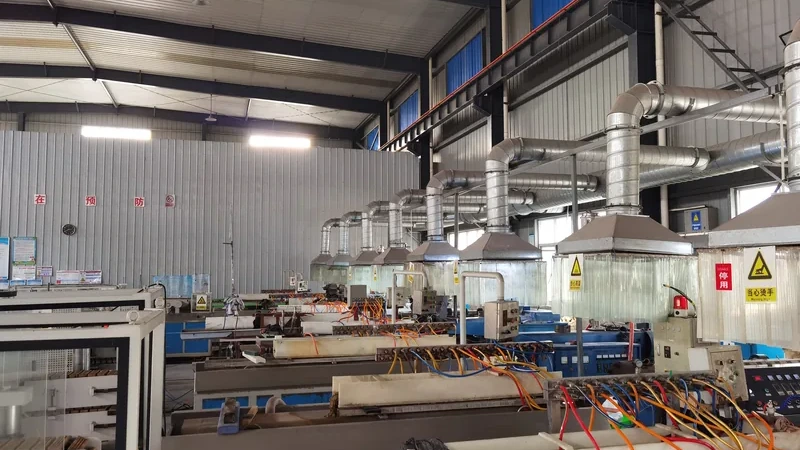
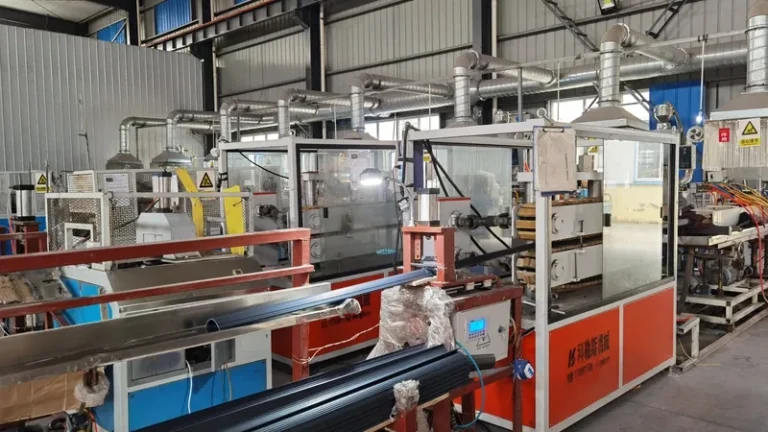
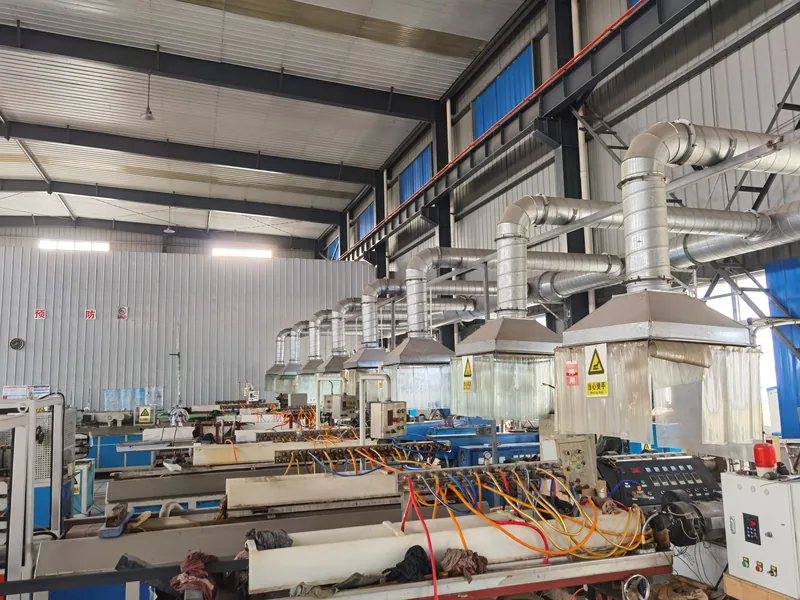
The plant runs 7+ automated extrusion lines with a maximum profile width of 600 mm and 45+ production lines in total, with punching, embossing and printing available in line. For a buyer, that means secondary operations sit on the same line as extrusion, so hole positions and printed marks stay referenced to the profile instead of being re-fixture in a separate operation.
Process Control Points That Decide Profile Quality
Melt condition comes first. Each polymer has a workable melt temperature window — as a broad engineering range, rigid PVC sits around 170–190 °C and PP around 200–250 °C, while engineering resins such as PA or PC run higher — but the exact setpoint depends on the resin grade, the screw design and the die head geometry. What matters on the floor is stability: a melt temperature drifting by 10 °C across a shift changes wall thickness and surface finish long before anyone sees scrap. Melt pressure at the die, read through a pressure transducer, is the earliest warning of a surging screw or a blinded screen pack.
Downstream, calibration does the dimensional work. The hot profile enters a vacuum sizing tank where vacuum holds the outer surfaces against calibrated sleeves while water cools the section3. Vacuum level, water temperature and tank length are set by section geometry: a thin-walled channel needs different settings than a solid rod. The haul-off4 must pull in exact synchronization with extruder output; even a one-percent mismatch appears immediately as a lengthwise dimension error. None of these settings are supplier secrets — a capable extruder will show you the recorded setpoints for your part.
A common belief at the procurement stage deserves a direct correction.
"If the first article is good, the line is stable for mass production."False
A first article is a single sample taken minutes after start-up. Stability is behavior over hours: melt temperature drift, die wear and cooling water fluctuations only reveal themselves across a full production run, so approving a program on one sample transfers real dimensional risk to volume output.
"Long-run process data, not a single first article, proves production stability."True
Ask for dimensional data collected over several hours of continuous running, ideally presented as control charts. A supplier who can show SPC records for wall thickness, overall width and straightness has already demonstrated the process control you are actually buying.
Which Tolerances Belong on a Profile Drawing?
State tight tolerances only where the geometry actually demands them. Modern profile extrusion can hold ±0.05 mm on critical cross-section dimensions, subject to material and section geometry, but applying that class of tolerance to every feature is a false economy: it drives extra tooling iterations, slower line speeds and higher scrap. The workable split is to tag mating, sealing and guiding dimensions as critical and leave everything else at the supplier’s standard commercial tolerance.
Wall thickness deserves its own note, because shrinkage differs by material family. Semi-crystalline resins such as PP shrink roughly 1.5–2.5 percent while amorphous resins like PVC, ABS and PC sit nearer 0.4–0.8 percent, so the same tooling produces different as-cooled dimensions. Amorphous materials generally hold tight tolerances more easily; semi-crystalline sections need shrinkage anticipated in the die. This is why a die designed around PVC cannot simply be reused for PP and expected to hit the same drawing values.
The table below is a practical starting point for a drawing review.
| Dimension group | Practical tolerance approach | Engineering reason |
|---|---|---|
| Mating or slide dimensions | ±0.05 mm where material and geometry allow | Directly affects assembly fit and sliding function |
| Overall width and height | Standard commercial tolerance | Rarely functional; tightening here only adds cost |
| Wall thickness | Matched to resin shrinkage and section design | Governs stiffness and cooling time; shrinkage varies by resin |
| Straightness or bow | Specified in mm per metre of length | Distortion comes from uneven cooling, not tooling alone |
| Hole and slot positions | Tight tolerance only when referenced to profile features | Best held with in-line punching rather than secondary re-fixture |
Material verification completes the drawing. Tensile properties are checked to ASTM D6385, the standard test method for tensile properties of plastics, which is the default citation for confirming that an extruded profile’s resin behaves as specified. For a detailed view of how tolerance class, tooling and volume interact on price, this custom profile cost breakdown walks through the cost drivers line by line.
How Should You Evaluate a Supplier Before Committing Volume?
Judge the system, not the sample. A capable supplier can show you five things during a technical review: in-house die design and maintenance, a documented process window for your material class, dimensional data from long runs, a material library with equivalent grades, and capacity matched to your volume range. Photographs of machines prove nothing about any of these; records do.
Capacity and flexibility questions come next. Ask what monthly tonnage the extrusion lines run, whether prototyping and small batches are supported alongside large series, and how a die change affects lead time. The profile extrusion company overview is a useful benchmark for which capabilities belong in that conversation, and for China-based programs the manufacturer page covers line-level detail.
Reference monthly capacity across the extrusion lines is roughly 300–500 tonnes, and prototyping, small batch and large batch production are all supported. For a buyer, that span matters: the supplier who runs your prototype can also run your annual volume without a process transfer between factories.
Pricing structure is the third checkpoint, and it is where sourcing teams most often lose the plot.
"The lowest quoted price is always the lowest total cost."False
Quotes differ in what they include: die corrections, material certification, in-line punching and packaging are frequently excluded from headline numbers. A cheap quote that omits tooling maintenance and scrap allowance usually returns as change orders once volume starts — negotiated from a weaker position than before.
"Compare quotes line by line on the same scope before comparing totals."True
Normalize the scope first: tooling ownership, tolerance class, inspection frequency, packaging and delivery terms. Only then compare prices. Most real-world gaps between two quotes turn out to be scope differences rather than efficiency differences.
When Does Co-Extrusion Pay for Itself?
Co-extrusion puts two or three materials into one profile in a single pass — up to three layers — and earns its keep whenever one resin cannot deliver two opposite properties. Combinations actually running in production include PP+TPV, PP+TPE, PVC+TPU, ABS+TPU and TPV+CPVC. The rigid layer carries load; the soft layer seals, grips or wipes. Designing the co-extrusion die head so the layers bond properly is the hard part, because layer adhesion is a materials-compatibility and melt-temperature question that no downstream inspection can create afterwards.
Two production cases show the logic. An automotive seat slide rail strip uses PP+TPV co-extrusion: the PP carries structural load in the seat rail and guide system while the TPV lip excludes dust, resists wear and runs at low friction. A household robot vacuum squeegee strip uses ABS+TPU: ABS provides the rigid support and TPU the flexible wiping contact with wear resistance. Both parts would need assembly and bonding if made as separate components, with all the tolerance stack and bond-failure risk that brings.
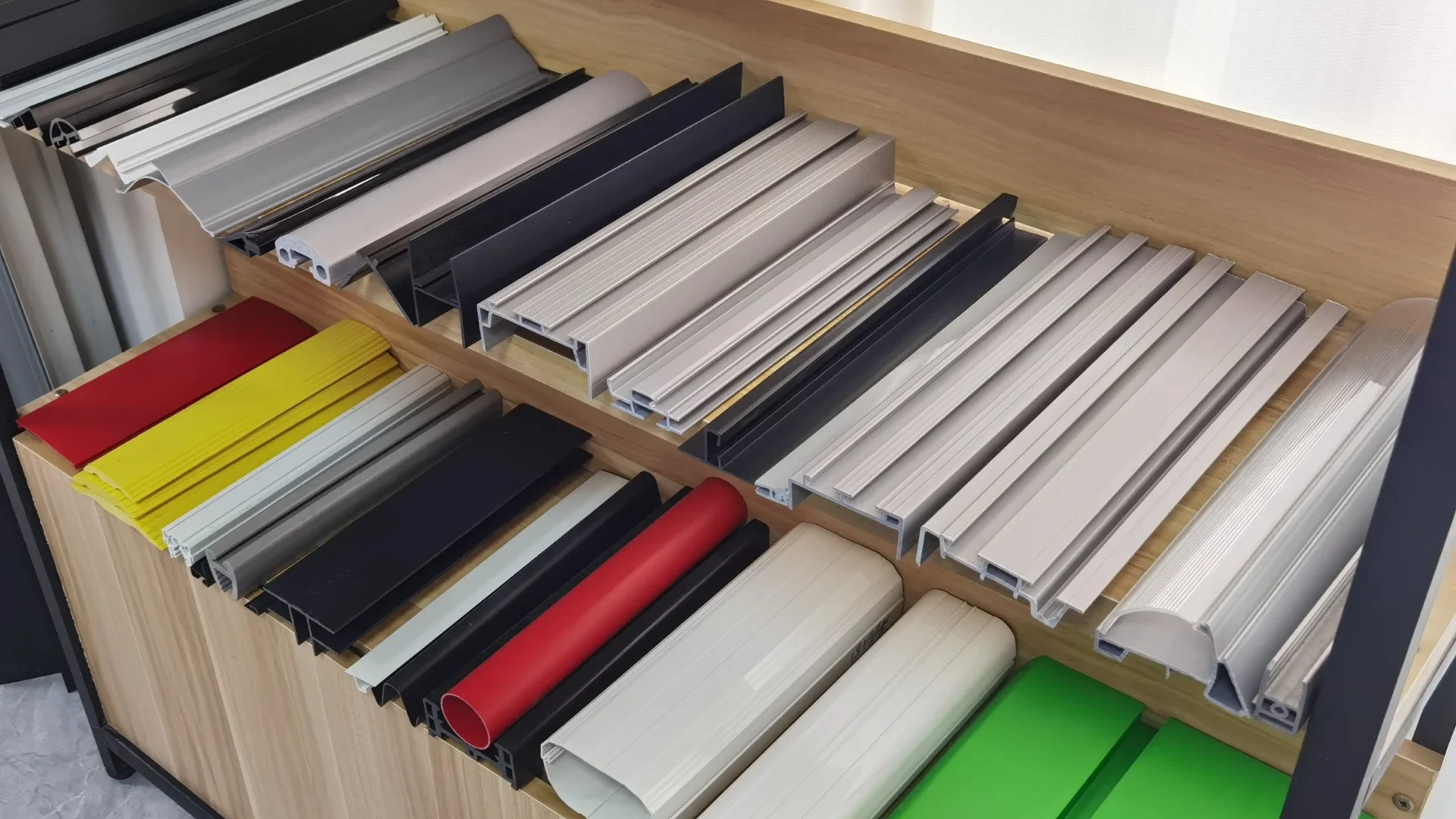
Co-extrusion capability reaches three layers in a single pass, and non-standard custom sections are developed to customer drawings. That combination — multi-layer tooling plus custom section design — is what lets a buyer consolidate two components into one extruded profile instead of assembling them later.
Where Do Extrusion Projects Go Wrong?
Most failures trace back to four mechanisms: uneven cooling that bows the section, abrupt wall thickness transitions that sink or void, layer delamination in co-extruded parts, and long-run drift that walks dimensions out of tolerance. Each has a specific check: cross-sectioning under a stereo microscope, straightness measurement in mm per metre, and periodic dimension sampling during the run rather than only at start-up. Heat resistance questions are screened with ISO 306, which defines the Vicat softening temperature used as an indicator of heat and creep resistance in thermoplastics.
Outdoor and safety-critical applications add further standards. EN 12608 specifies the profile geometry, impact resistance after ageing and heat reversion requirements that PVC-U window and door profiles must meet, so a building-profile drawing should reference it explicitly. Parts destined for appliances or electrical enclosures are screened to UL 94, the flammability classification for plastic materials used in devices and appliances. For a broader industry view, the SPE Extrusion Division publishes technical resources worth an hour of any sourcing engineer’s time.
FAQ
What information does a supplier need to quote an extruded profile?
Provide the cross-section drawing with critical dimensions flagged, the resin or an acceptable equivalent, expected annual and per-order volumes, the tolerance class, and any in-line operations such as punching or printing. With those five inputs, a quoting engineer can price tooling and per-metre cost without a chain of follow-up questions.
Can one supplier handle prototyping and mass production?
Yes, when the plant supports both under one roof. The practical advantage is that die corrections and process settings validated during prototyping carry directly into volume production, eliminating a process transfer. Prototyping, small batch and large batch production are all supported on the same lines.
What tolerance can be held on a custom profile?
A minimum dimensional tolerance of ±0.05 mm is achievable on the profile cross-section, subject to material and section geometry. Thin, simple sections in amorphous resins hold it most easily; thick or semi-crystalline sections may need relaxed values on non-critical dimensions.
Is co-extrusion only for high-volume programs?
No. The added die complexity raises tooling cost, so breakeven depends on how much assembly, bonding or secondary lining the two-material design eliminates. For many parts, consolidating two components into one co-extruded profile pays back the tooling difference well below automotive-scale volumes.
Which standards should an extruded profile drawing reference?
Reference the standards that match the application: EN 12608 for PVC-U window and door profiles, ASTM D638 for tensile verification, UL 94 for appliance parts, and ISO 306 where heat resistance matters. Citing them on the drawing removes ambiguity during incoming inspection.
If you are comparing suppliers now, send your profile drawing to our team and request a quotation with the tolerance class and volumes above. You can also review the full extrusion service scope on our service page before you shortlist.
-
Die head: The tooling assembly at the discharge end of the extruder that shapes the molten polymer into the profile cross-section before calibration. ↩
-
Melt flow index: A measure of how easily a molten polymer flows through a standardized orifice, used to check resin consistency between batches. ↩
-
Vacuum sizing tank: A calibrated water bath held under vacuum that cools and dimensions the hot extrudate to its final cross-section. ↩
-
Haul-off: The pulling unit that draws the profile from the die at a controlled speed synchronized with extruder output. ↩
-
ASTM D638: The standard test method for tensile properties of plastics, commonly cited to verify the mechanical specification of extruded profile resins. ↩