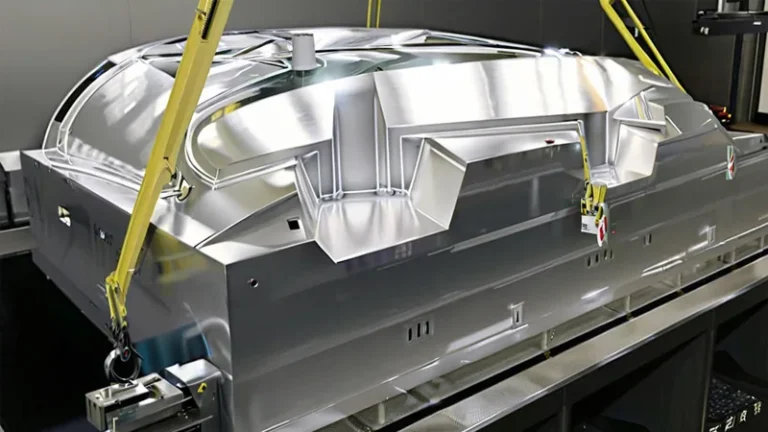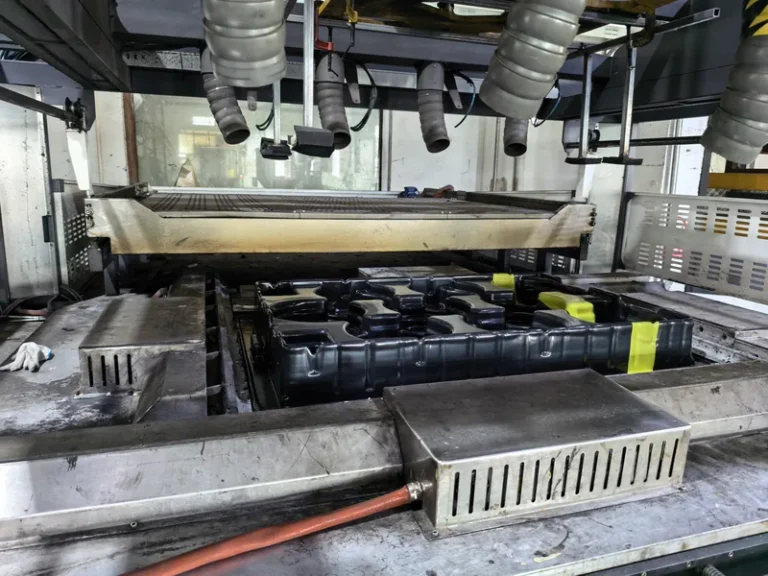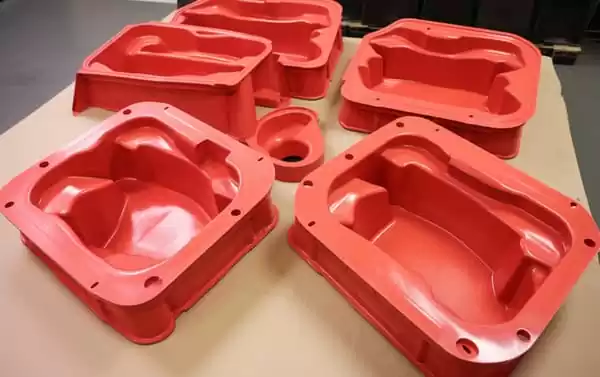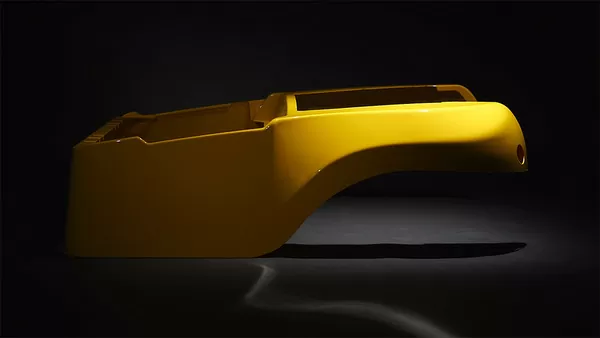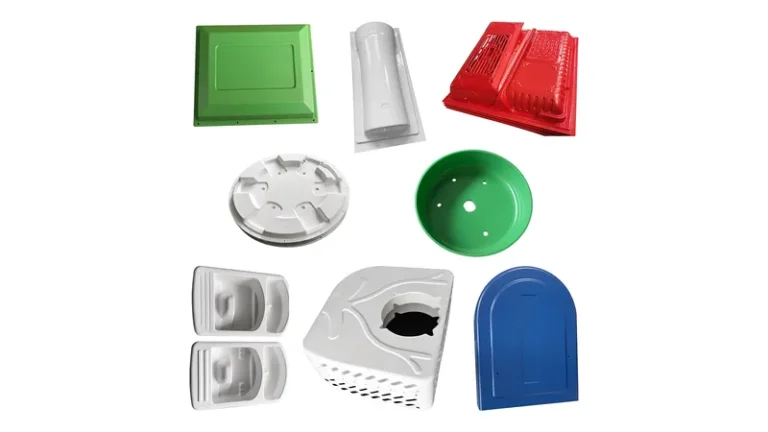

Plastic vacuum forming is a sheet-forming process: a rigid thermoplastic sheet is clamped, heated until pliable, sealed against a single-sided mold, and drawn into shape by vacuum. Once cooled, the part is trimmed to its final outline. It is the method behind most large equipment housings, machine covers, industrial trays, and curved panels — parts that are too large, too curved, or too low-volume to justify high-cavitation tooling.
- Vacuum forming shapes a heated thermoplastic sheet against a single-sided mold using vacuum of roughly 0.07–0.09 MPa.
- Heating is the most parameter-sensitive stage; most forming defects trace back to sheet temperature, not to the mold.
- Wall distribution after forming, not starting gauge alone, governs the stiffness and impact strength of the finished part.
- Heavy-gauge formed parts are trimmed on 5-axis CNC centres so the outline follows the forming tool geometry.
- Industrial heavy-gauge capability spans sheet from 0.5 to 15 mm and forming lengths up to about 2,500 mm.
- Material choice — ABS, HDPE, PC, PVC, PMMA, PP — drives the heating window, service temperature, and flammability path.
How Does Plastic Vacuum Forming Work?
In vacuum forming, a heated thermoplastic sheet is clamped over a mold and vacuum is pulled through the tool, so atmospheric pressure presses the softened sheet onto the mold surface. A full cycle runs through six stages — clamping, heating, forming, cooling, release, and trimming — and each stage has its own process window and its own characteristic failure modes.
Clamping and loading: The sheet is locked into a clamping frame that seals its edges and keeps it flat while it softens. Heavy-gauge sheet needs a rigid frame with even edge pressure; if the seal breaks during vacuum pull-down, the cycle is scrapped and the sheet is usually too degraded to re-run.
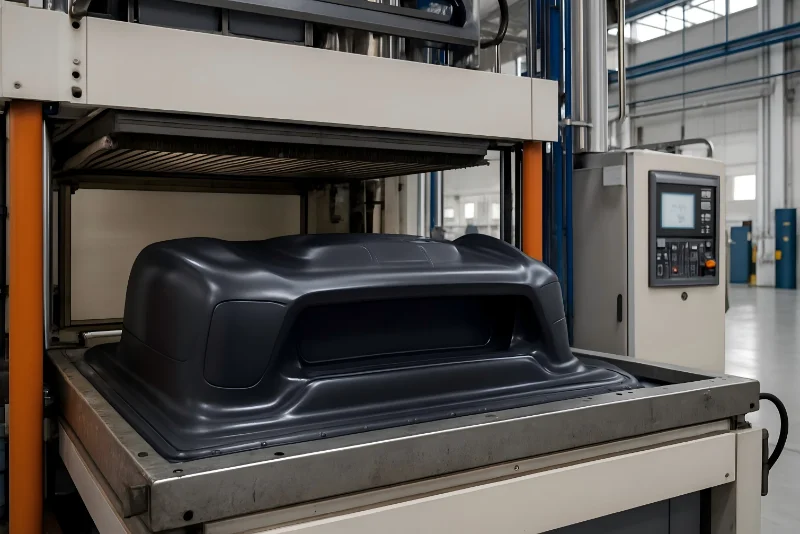
Heating: Ceramic or infrared radiant panels bring the sheet into its forming window. Heavy-gauge sheet is normally heated from both sides so the core reaches temperature without skinning the surfaces.
Forming: The mold rises into the sagging sheet, the edges seal, and vacuum drawn through vent holes in the tool pulls the plastic down. Most industrial machines develop 0.07–0.09 MPa of vacuum; sharper detail demands cleaner seals, well-placed vent holes, and sometimes a plug assist to pre-stretch the sheet before the tool contacts it.
Cooling, release, and trimming: Fans or chilled air solidify the part against the tool, the frame opens, and the part comes out with trim allowance still attached. Cycle time in heavy-gauge work is dominated by heating and cooling, which is why sheet gauge is a cost decision as much as a strength decision.
What Happens During the Heating Stage?
Heating turns a rigid sheet into a formable membrane, and it carries most of the process risk. Depending on material and gauge, the sheet is brought into a forming window of roughly 110–200 °C — ABS and HDPE commonly around 140–180 °C, PC higher still — and readiness is judged by sag, the visible droop of the sheet between the clamping frame.
Sag is not a single number. Amorphous materials such as ABS, PC, and PMMA soften gradually and forgive small temperature errors, while semi-crystalline materials such as PP and HDPE pass through a sharper transition and demand tighter control. Too cold, and the sheet will not pick up detail, corners turn thin and highly stressed, and webs form between features. Too hot, and the sheet marks on the rails, blisters, sags unevenly, or tears under its own weight.
Heavy-gauge sheet adds a through-thickness problem: the surfaces can reach forming temperature while the core is still stiff. Two-sided heating and adequate soak time matter more as gauge rises, and a cold zone shows up downstream as webbing, thin corners, and parts that release unevenly from the tool.
Two reference temperatures help set expectations away from the machine. Heat deflection temperature, determined per ISO 75-2 — the standard that specifies how a plastic’s deflection under a defined flexural load is measured — marks the practical upper service temperature for a formed housing mounted near a heat source.1 Vicat softening temperature per ISO 306 indicates where the same material starts to soften under load, a useful comparator when a datasheet does not publish a forming window.
ZetarVac processes sheet from 0.5 to 15 mm and forms parts up to about 2,500 mm long on 20+ vacuum forming machines, so large single-piece housings and trays sit inside standard capability rather than special arrangements — which is how one formed panel can replace a multi-piece fabricated enclosure.
Why Does Wall Distribution Decide Part Performance?
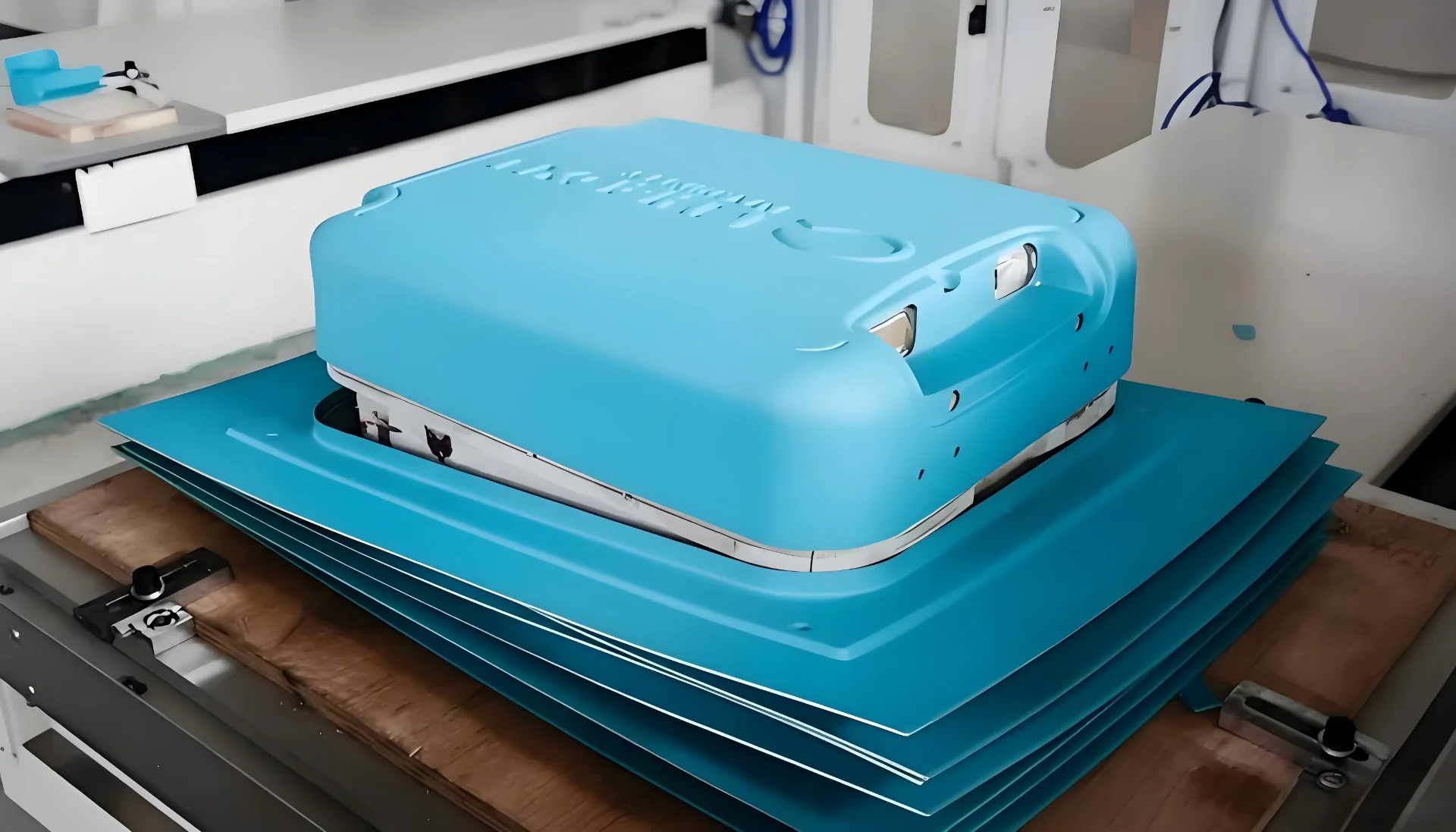
A vacuum formed part is never uniform in thickness. Stretching thins the sheet wherever it travels farthest — deep corners, tall male features, steep side walls — so finished performance is decided by where the material ended up, not by the gauge you loaded. Designers describe this with the draw ratio, the part depth divided by its smallest mold opening.2
Draw ratio explains most forming decisions before a tool is cut. Straight vacuum forming handles moderate draws well; deeper parts usually need plug assist or billow pre-stretch to move material toward the corners before the tool contacts it. Female tools give crisp outside detail but thin the outer corners; male tools distribute wall more evenly but transfer every mold mark to the visible surface. Where two male features sit close together, the sheet bridges between them and forms webs — the most common cosmetic reject in industrial thermoforming trays and liners.
Design mitigations are concrete: generous corner radii instead of sharp inside corners, at least 2–3° of draft on male cores, vent holes at the last points to contact, and texture where surface marks are unavoidable. The SPE Thermoforming Division publishes detailed guidance on pre-stretch methods and draw-ratio limits, and it is a sound reference when a concept sits outside proven practice.
"A thicker starting sheet automatically makes the finished part stronger."False
Strength follows the final wall map, not the loaded gauge. A 6 mm sheet formed into a deep draw can thin to 1.5 mm at the corners while a well-prestretched 4 mm sheet holds 3 mm there, so the thicker sheet can end up with the weaker corners and the higher material cost.
"Corner and side-wall thinning must be measured before a design is released."True
Cut a formed part at its deepest section, or specify ultrasonic spot checks in production, and put the real wall thickness into mounting bosses and impact-critical radii. That measured number, not the nominal sheet gauge, is the honest input for stiffness and impact calculations on a formed part.
Which Materials Suit Heavy-Gauge Vacuum Forming?
Material selection sets the heating window, the service environment, and the certification path before any tooling question is asked. The table below maps the common heavy-gauge grades to the parts they form best.
| Material | Typical formed parts | Why it is chosen |
|---|---|---|
| ABS | Equipment housings, cases, guards, automotive interiors | Broad forming window, good impact strength, easy to trim and finish |
| HDPE | Industrial trays, equipment liners, storage boxes | Chemical resistance and toughness at moderate cost |
| PVC | Trays, packaging, industrial liners | Deep-draw behavior with clear or colored options |
| PP | Automotive interiors, trays, boxes, equipment liners | Chemical resistance with integral-hinge capability |
| PC | Clear guards, protection covers | High impact strength and clarity for safety-critical covers |
| PMMA | Clear covers, luminaires, display parts | Optical clarity and weather resistance |
| PC/ABS | Equipment housings, automotive interiors | PC toughness blended with ABS formability |
| ASA | Outdoor equipment housings, automotive exteriors | UV-stable surface for long outdoor exposure |
| TPE | Soft liners and seals | Soft, formable regions where gasketing is needed |
The practical differences show up in the process window as much as in the datasheet. PVC draws deeply and holds detail at modest temperatures, which is why it dominates trays and liners; PP’s sharper transition narrows its window; PC punishes overheating with bubbles but rewards careful control with impact strength. For housings near electronics, flammability becomes a selection criterion: UL 94 — the standard that classifies how plastic materials ignite, burn, and extinguish — defines the HB, V-2, V-1, and V-0 ratings that many enclosure specifications call out by grade.3 ZetarVac’s service overview lists the full material library and forming capability in one place.

How Are Formed Parts Trimmed and Verified?
Forming gives the part its shape; trimming gives it its size. Heavy-gauge parts carry a trim allowance out of the mold and are cut on 5-axis CNC routers, so the trimmed outline follows the forming tool geometry instead of a manual layout line drawn around a warped part.
Verification then follows the part’s duty. Tensile validation typically runs per ASTM D638, the standard tensile test for plastics, on samples cut from formed sheet so the measured properties reflect the as-formed, oriented condition rather than raw resin data.4 For covers protecting electronics, ingress performance is specified against IEC 60529, the standard that defines the IP code for enclosures — an IP-rated formed cover has to demonstrate its sealing path, gasket compression, and cable entries, not merely look sealed.5
Tolerance expectations should be set honestly for a sheet-formed process. Features formed directly against the tool commonly hold about ±0.5 mm, while accuracy loosens on large free surfaces as the formed area grows; material-dependent post-forming shrinkage on the order of a few tenths of a percent shows up over the first days after forming. Interfaces that need tighter control are best carried by formed-in inserts or machined bosses rather than by the formed surface itself.
"If the first article passes inspection, the process is proven for volume production."False
One good part proves that tool, sheet lot, and setup aligned once. Heavy-gauge forming drifts with heater aging, sheet lot variation, and ambient conditions, so a passing first article only becomes a stable process when heating zones, cycle times, and wall-thickness checks are documented and re-audited during the run.
"Process stability is judged from documented parameters, not from a single sample."True
Ask which heating zones, sheet temperatures, and cycle times are written down, and how formed wall thickness is verified across a production batch. A repeatable vacuum forming operation can show you the parameter window and the audit record, not just a box of good parts.
The residual risk in heavy-gauge thermoforming is rarely the tool itself; it is the gap between what was proved on the first article and what the line sustains in week six. Written parameter windows, scheduled wall-thickness audits, and trim-path checks close that gap.
Formed parts at ZetarVac are trimmed on a 5-axis CNC centre whose path follows the forming tool, so dimensional accuracy is not lost at the manual layout-and-saw step where heavy-gauge parts most often go out of tolerance.
FAQ
What sheet thickness counts as heavy-gauge vacuum forming?
Most of the industry draws the line where the sheet can no longer be treated as thin-gauge packaging — in practice, roughly 1.5 mm and above, with demanding structural work between 3 and 12 mm. ZetarVac processes 0.5–15 mm, covering thin industrial parts and heavy structural panels in one shop.
How accurate are vacuum formed parts?
Features formed against the tool hold the tightest tolerances, commonly around ±0.5 mm; large free surfaces need a wider allowance that scales with the formed area, plus material-dependent shrinkage on top. Critical interfaces should be designed as post-machined bosses or inserts rather than left on the formed surface.
What is the difference between vacuum forming and pressure forming?
Pressure forming adds positive air pressure above the sheet, pushing it into fine texture and sharp detail that vacuum alone cannot transfer. Vacuum forming is sufficient for most housings, trays, and covers; pressure forming justifies its higher tooling cost when cosmetic texture on a visible surface is a specification.
Is vacuum forming economical for low volumes?
Yes. Because the tool is single-sided and machined rather than built as a multi-cavity hardened steel mold, tooling cost stays proportionate, and prototypes, small batches, and large runs all stay on the same process. Reference capacity of 100,000–200,000 pieces per month across 45+ production lines means a validated part scales without changing process.
If you want to go deeper, explore the ZetarVac vacuum forming guide to see how material, tooling, and trim decisions fit together, or walk through how a China-based heavy-gauge thermoforming manufacturer structures projects from first sample to series production.
-
HDT (ISO 75-2): Heat deflection temperature — the temperature at which a plastic test bar deflects a specified amount under a defined flexural load, measured per ISO 75-2. ↩
-
Draw ratio: The depth of a formed part divided by its smallest mold opening; it predicts how far the sheet must stretch and where it will thin. ↩
-
UL 94: A flammability standard that classifies plastic materials by burning and extinguishing behavior, with ratings such as HB, V-2, V-1, and V-0. ↩
-
ASTM D638: The standard tensile test for plastics, used to validate sheet and formed-part strength properties. ↩
-
IP code (IEC 60529): The ingress protection classification defined by IEC 60529, rating enclosures against access by solids and liquids. ↩