Heating is the step where a vacuum forming cycle succeeds or fails. It fixes the thickness distribution of the finished part, the surface detail, the cycle time, and most of the scrap. It is also the most commonly misjudged step in heavy-gauge thermoforming, because the variable that matters — temperature through the full thickness of the sheet — is invisible from the outside. This guide explains how plastic sheet is heated, what temperature each material needs, how heater zoning works, and how a production team decides a sheet is ready to form.
- Vacuum forming heats the clamped sheet with infrared radiant panels — ceramic, quartz, or metal-sheathed elements — arranged in independently controlled zones.
- Thick sheet, roughly 3 to 15 mm, generally needs two-sided heating so the core reaches the forming window without overheating the skin.
- Forming readiness is judged by controlled sag plus measured temperature, not by gloss or color.
- Typical sheet surface forming temperatures fall between roughly 120 and 200 °C depending on the polymer, grade, thickness, and machine.
- Heater zone power, heater-to-sheet distance, and soak time are the three settings that determine wall-thickness distribution in the formed part.
- Verification relies on contact thermocouples or infrared pyrometers at several defined points, never on a single reading.
How Is the Plastic Sheet Heated in Vacuum Forming?
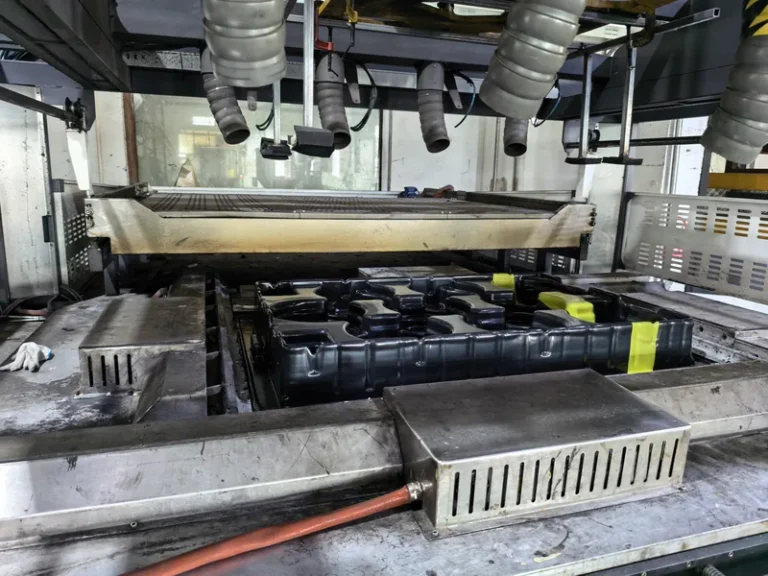
The sheet is heated by infrared radiant heater panels mounted above the clamped plastic sheet — and, for thick stock, also below it. The panels raise the surface until conduction brings the core into a softened, formable window, which the operator confirms through controlled sag and measured temperature before the vacuum is applied.
Radiant heating dominates because the oven must deliver a large amount of energy to a wide, flat target in a short time, and infrared radiation transfers heat directly into the polymer far faster than circulating air could. Ceramic panels, medium-wave quartz emitters, and metal-sheathed calrod elements are the common choices. They differ in wavelength output and response speed, and each polymer absorbs those wavelengths with different efficiency, which is why heating recipes are material-specific rather than universal.
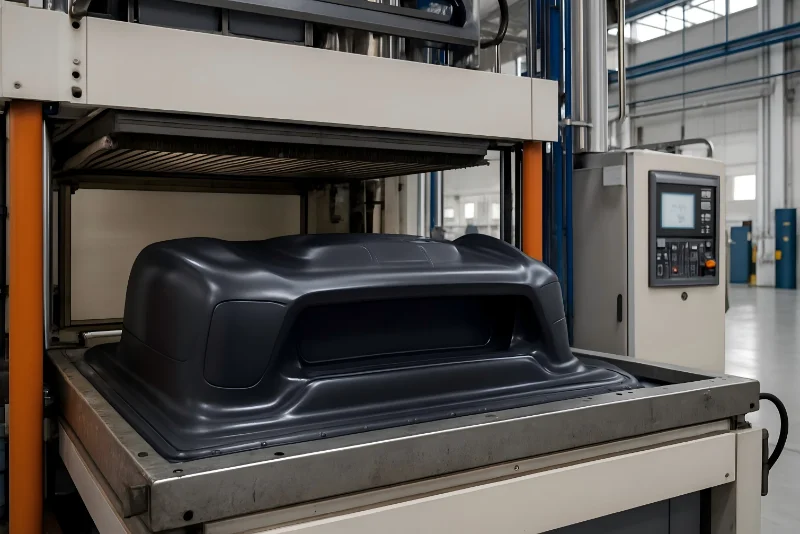
In most heavy-gauge machines the sheet is clamped in a frame and either shuttles sideways between a heating station and a press, or stays in place while the oven opens and the frame travels to the mold. During heating, the upper and lower banks are powered independently, so the process engineer can bias energy toward the side that will first contact the tool. That bias is one of the quiet levers behind consistent wall thickness in vacuum forming.
Heater Zones, Distance, and Soak Time
A modern thermoforming oven is not one heater; it is a grid of independently controlled zones, often a dozen or more on a production machine. Each zone holds its own setpoint, and the operator trims individual zones rather than moving the whole oven up or down. This matters because a real sheet is never heated under perfectly uniform conditions: the clamping frame conducts heat out of the edges, and sag pulls the center of the sheet closer to the lower heaters.
Three settings interact. First, zone power: edge zones typically run a few percent hotter than center zones to compensate for frame losses, and the offset is tuned per material and thickness. Second, heater-to-sheet distance: reducing the gap raises radiative intensity steeply, which shortens cycles but narrows the margin between forming temperature and skin degradation. Third, soak time: heat must diffuse through the thickness, and for thick sheet that diffusion time grows roughly with the square of the gauge.
ZetarVac processes sheet from 0.5 to 15 mm and forms parts up to about 2,500 mm long on more than 20 vacuum forming machines. Across that thickness span, heater zoning and soak time are not cosmetic settings — they are what keeps a 12 mm panel and a 1 mm tray within their own forming windows on the same equipment base.
Because these settings interact, a change to one is a change to all. Raising oven temperature to shorten the cycle shrinks the safe soak window; widening the heater gap to protect the skin forces a longer soak. Experienced process engineers treat the heating recipe as a balanced triangle of power, distance, and time rather than a single dial.
"If the whole oven is set to the right temperature, every zone of the sheet will be right too."False
Oven setpoint and sheet condition are not the same thing. Frame heat losses, heater aging, and sag geometry leave the edges and center of the sheet tens of degrees apart unless zones are trimmed individually.
"Heater zones are trimmed per material and per thickness, then locked into a repeatable heating recipe."True
That is how production thermoforming stays consistent. The recipe records zone setpoints, heater distance, and soak time, so a repeat order starts from proven settings instead of being relearned on the first sheets.
What Temperature Should the Sheet Reach?
Most thermoplastics used in heavy-gauge work form at a sheet surface temperature between roughly 120 and 200 °C. The exact window depends on the polymer, its grade, the sheet thickness, and the machine, so the values below are conventional engineering ranges rather than universal setpoints.
| Material | Typical sheet surface window | Heating behavior in vacuum forming |
|---|---|---|
| ABS | 120–160 °C | Wide, forgiving window; the default for housings and trays |
| HDPE | 130–165 °C | Low melt strength; sags quickly and needs close sag control |
| PP | 145–175 °C | Very soft when hot; often formed with plug or pressure assist |
| PC | 170–200 °C | Narrow window; must be dry and heated very evenly |
| PMMA | 140–180 °C | Chosen for clear covers; overheating marks the surface and cuts clarity |
Two published benchmarks help set the ceiling of these windows. ISO 75-2 defines the heat deflection temperature of plastics under a specified flexural load, and it matters here because a material’s HDT marks roughly where a heated sheet can no longer carry its own weight without uncontrolled deformation.1 ISO 306 defines the Vicat softening temperature, the point where a specimen begins to soften under a loaded indenter; on the shop floor, pushing a sheet past this region is exactly when sag runs away from the operator.2
Heating performance also depends on the incoming sheet itself — gauge consistency, moisture content, and storage history — which is why sheet preparation for vacuum forming deserves its own review before any oven setting is touched.
Why Does Even Heating Matter More Than Peak Temperature?
Uneven heating becomes uneven wall thickness, and wall thickness cannot be corrected after forming. A sheet that is hotter on one side thins prematurely there, webs over deep features, and shows cold, understretched areas where it never fully softened.
The classic heating defects each leave a recognizable signature. Blisters point to an overheated skin, or to trapped moisture flashing out of a hygroscopic material such as PC or ABS that was not dried before forming.3 Poor detail replication and stress whitening point to cold spots. Webbing and folds in deep draws often trace back to a sheet that entered the forming station with a non-uniform temperature profile. None of these can be fixed downstream; they all start at the oven.
Moisture control is part of heating, not a separate topic. Hygroscopic sheet should be dried before it enters the oven, because surface water turns to steam bubbles the moment the skin softens. The failure is unambiguous: small clusters of bubbles that appear on the formed surface even though the heater settings look correct.
"A single pyrometer reading in the center proves the sheet is evenly heated."False
One point says nothing about the edges, which lose heat to the clamping frame. Without a multi-point check, a sheet can pass a center reading and still form thin at all four corners.
"Readiness is confirmed with a sag check plus temperature readings at several defined points on the sheet."True
Sag gives a fast visual proxy for the average state of the sheet, while multi-point readings catch edge losses and zone drift. Together they form the repeatable release criterion before the sheet moves to the mold.
How Do You Verify the Sheet Is Ready to Form?
Production teams use two checks together: a visual sag measurement against a calibrated target, and direct temperature measurement with contact thermocouples or non-contact infrared pyrometers at several defined points across the sheet.
Sag is monitored by watching how far the center of the sheet drops at a set moment, or with photoelectric sensors that record the sag height automatically. A calibrated sag target gives the operator an objective go or no-go signal, which matters because human judgment of sag drifts across a shift. For materials with narrow forming windows, optical sag recording removes that variability entirely.
Temperature instruments need care. A contact thermocouple pressed against the sheet edge or a scrap coupon gives a trustworthy local reading. An infrared pyrometer is faster and non-contact, but its emissivity setting must match the polymer and the reading spot must be defined, otherwise the same instrument reports two different numbers on the same sheet. Verification points are usually fixed: center, quarter points, and both edges.
With 45+ production lines across the plant, repeatability comes from fixed verification routines rather than individual feel. A heating recipe plus a defined sag target and defined measurement points is what lets a job move from prototyping to batch production without relearning the cycle.
Heating Thick Sheet: Two-Sided Ovens and Soak Strategy
Above roughly 3 mm, single-sided heating stops working well. The skin facing the heaters reaches the forming window while the core is still stiff, and by the time the core is hot the skin has degraded. Thermoforming shops solve this with sandwich heating — upper and lower oven banks running simultaneously — and with two-stage heating, where the sheet soaks first from one side and then from both.
The power split between the upper and lower banks is a genuine process decision. The mold side of the sheet is usually kept slightly cooler so it does not mark against the tool, which means the non-mold side carries more of the energy input. For very thick sections, some shops preheat sheets in a separate slow oven before finishing them in the main station, trading cycle time for uniformity.
Twin-sheet forming raises the stakes: two sheets are heated simultaneously and must arrive at the forming station with matched temperature profiles, or the weld between them will be weak on one side. Matching two sheets through one oven cycle is one of the clearest demonstrations that sheet heating is a control problem, not just a temperature problem.
"Turning every heater to maximum is the fastest way to shorten the cycle on thick sheet."False
Maximum power overheats the skin long before the core softens, which invites blisters, surface marking, and runaway sag. On thick stock the cycle is limited by heat diffusion through the thickness, not by heater output.
"Thick sheet needs a longer soak with two-sided heating, and the split between upper and lower banks is tuned deliberately."True
Heat must diffuse through the full gauge, and only the non-mold side should carry the extra energy. That is slower than a flat-out oven, but it is the path to uniform wall thickness in heavy-gauge parts.
FAQ
Does vacuum forming heat the sheet from one side only?
Thin sheet, generally up to about 2 to 3 mm, forms well with single-sided heating from the top bank. Thicker stock needs two-sided heating, because heat diffusion through the gauge becomes the limiting step and a single-sided oven would degrade the skin before the core softens.
How long does it take to heat a sheet for vacuum forming?
Heating time scales roughly with the square of the sheet thickness. Thin sheet can be ready in well under a minute; a 10 mm heavy-gauge sheet may need several minutes of soak. The exact time depends on material, heater type, and machine, which is why recipes are established per job rather than assumed.
Can you overheat a sheet before forming?
Yes. Overheating shows up as blisters from moisture or degradation, surface marking on the mold side, and runaway sag that wrinkles the sheet against the lower heaters. Once a sheet has been cooked, the defect sits in the material itself and the part usually cannot be saved.
Why does my sheet sag unevenly in the oven?
Uneven sag usually traces to zone imbalance, an aging heater bank, or heat losses into the clamping frame at the edges. Check the edge zones first, verify heater output across the bank, and confirm the sag reading with multi-point temperature measurement before changing any setpoint.
Which materials are hardest to heat evenly?
PC and PP sit at opposite ends of the difficulty scale. PC has a narrow window and must be dry and evenly heated, while PP is so soft when hot that sag control dominates. Both reward disciplined zoning and verification far more than a higher oven setpoint.
To keep digging into the process side, explore the ZetarVac vacuum forming overview for the full workflow from sheet to trimmed part, or learn how a heavy-gauge supplier approaches tooling and material selection in the vacuum forming manufacturing guide. Both walk through these same heating principles in the context of complete projects.
-
HDT: Heat deflection temperature, the temperature at which a plastic specimen deflects a defined amount under a specified flexural load, commonly tested per ISO 75-2 or ASTM D648. ↩
-
Vicat softening temperature: The temperature at which a loaded needle penetrates a plastic specimen to a defined depth, per ISO 306; a practical indicator of where softening begins. ↩
-
Hygroscopic material: A polymer that absorbs moisture from the air, such as PC, ABS, and PA; hygroscopic sheet must be dried before heating to prevent steam blisters. ↩