Heavy gauge thermoforming turns thick plastic sheet into large, structural parts — machine shrouds, equipment housings, material-handling trays, protective covers — without injection-molding tooling cost. This guide explains what the process actually is, where the heavy and thin gauge line sits, which materials and standards gate enclosure projects, and where formed parts typically fail in production.
- Heavy gauge thermoforming heats thick thermoplastic sheet — roughly 0.5 to 15 mm — and forms it over a single-sided tool; the finished outline is then trimmed on a 5-axis CNC.
- Vacuum forming is the dominant heavy-gauge variant; pressure forming adds air pressure when surface detail and texture definition matter.
- Material choice is a standards decision, not only a cost decision: flammability ratings and heat deflection temperature usually gate enclosure projects before price does.
- Wall thickness in a formed part is never uniform; deep draws thin the corners, so critical walls should be specified by measurement, not by sheet spec.
- An approved first article does not lock in a stable production window; sheet lots, heater drift and cooling rates all move the process.
What Is Heavy Gauge Thermoforming?
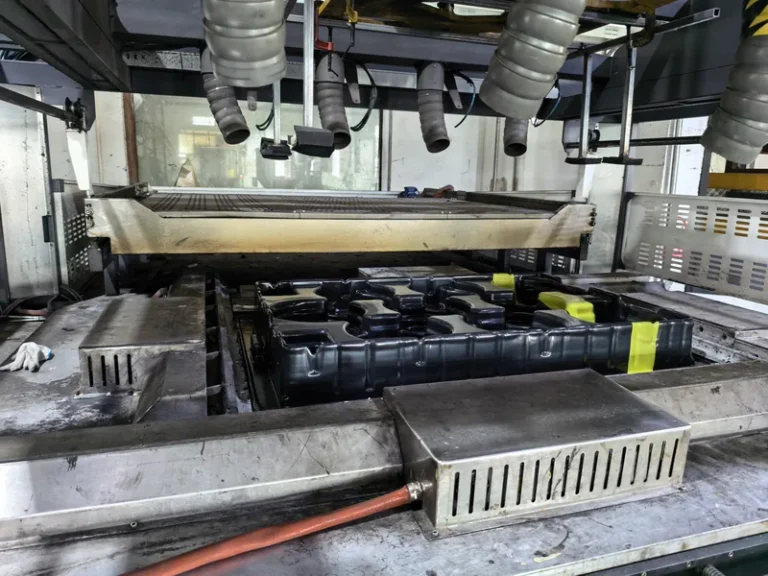
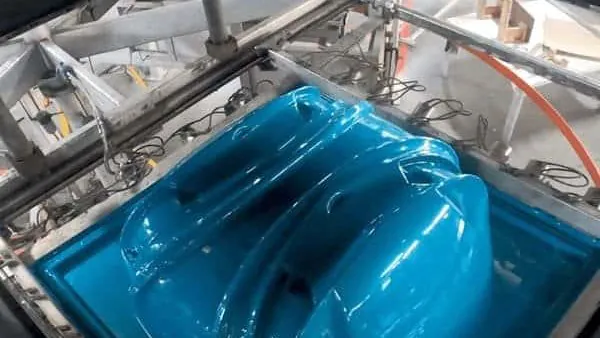
Heavy gauge thermoforming is a plastics process that heats a thick thermoplastic sheet until it is pliable, drapes it over a single-sided mold, and uses vacuum — sometimes assisted by air pressure — to pull it against the tool. The formed part is then CNC-trimmed to its final geometry.
The “heavy gauge” label describes the sheet, not the part. Heavy-gauge work uses cut sheet, with roughly 0.5 mm to 15 mm as the normal processing range, while thin-gauge forming runs sub-millimetre roll stock at high speed for packaging. Because thick sheet is stiff, heavy-gauge thermoforming is a one-sheet-at-a-time process on machines with independent top and bottom heaters — speed comes from process control, not from cycle rate.
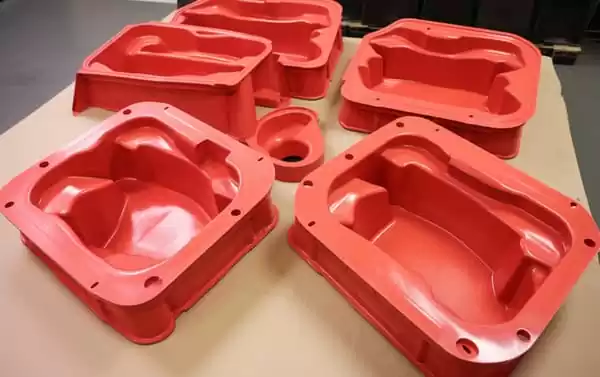
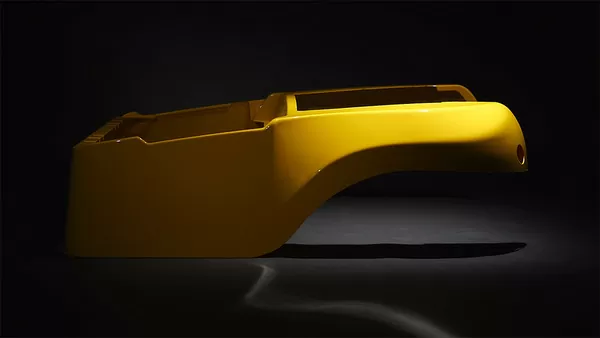
The practical consequence for a buyer is part scale. A single formed sheet can become a housing or machine shroud well beyond two metres long, formed as one piece with no joints and no fastened seams. Deep features, mounting details and trimmed flanges are all decided at the tooling stage, which is why heavy gauge vacuum forming rewards early design-for-manufacturing review.
ZetarVac runs heavy gauge vacuum forming on more than 20 vacuum forming machines, processing sheet from 0.5 to 15 mm thick with a maximum forming length of about 2,500 mm. For a buyer, that means one-piece enclosures, shrouds and trays over two metres can be formed without joints — a structural advantage for industrial equipment covers.
How the Vacuum Forming Process Works, Step by Step
The heavy-gauge forming sequence is short, but each stage has a process window that either holds or ruins the part.
Sheet preparation and heating. Sheet is cut to size and clamped in a frame, then heated from both faces. Two-sided heat matters with heavy sheet: a single-sided oven skins the surface while the core stays cold, and the sheet refuses to conform. Surface temperatures depend on the material — ABS generally forms with sheet surfaces in the roughly 120–180 °C range, PC runs hotter, HDPE lower — and the operator watches sag rather than trusting a timer alone.
Forming and vacuum draw. Once the sheet is plasticized, it is sealed against the mold and vacuum is applied. A healthy vacuum system pulls close to full atmospheric pressure — around 85–99 kPa of draw — and reaches it quickly, because thick sheet starts cooling the moment it leaves the heaters. Slow draw-down on heavy gauge material is a classic cause of cold sheet that never fully seats in the mold detail.
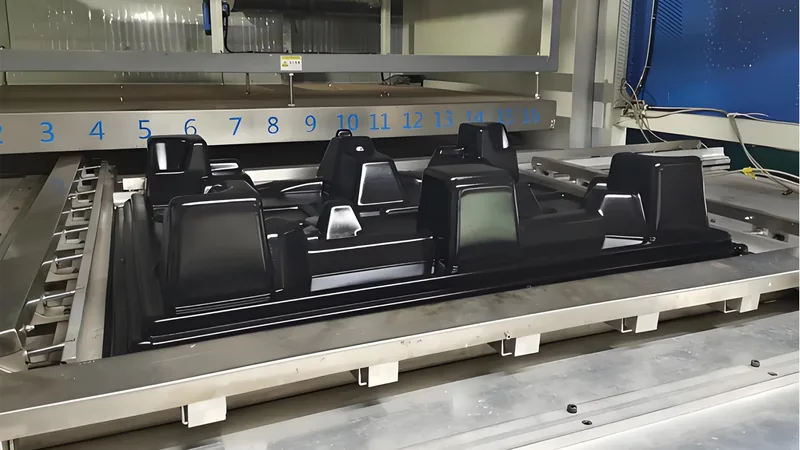
Cooling and release. Thick sections hold heat long after the surface looks set. Parts are cooled with fans or water mist until they are safely below their heat deflection temperature, then released onto flat support. Releasing early saves seconds and costs panels: residual heat keeps warping the geometry for hours.
Trimming and finishing. A formed part carries the mold’s flange and web; trimming defines the final part. ZetarVac trims formed parts on a 5-axis CNC trimming centre, and because the trimmed outline follows the forming tool, edge geometry stays consistent from the first part to the ten-thousandth. Housings that mate to machine frames depend on exactly this consistency.
The same forming operation supports prototyping, small batches and large series, with reference monthly capacity of about 100,000–200,000 pieces across the plant’s 45+ production lines. For a project team, that means the process you qualify on a prototype is the process that runs at volume — no mid-stream change of forming method.
Where Does Heavy Gauge Begin and Thin-Gauge End?
The dividing line is usually drawn at sheet thickness: roughly 0.5 mm and above is treated as heavy gauge (also called thick-gauge) thermoforming, while thin-gauge work runs thinner roll-fed stock. The more meaningful differences are in machine architecture, tooling and downstream handling.
| Aspect | Thin-gauge thermoforming | Heavy gauge thermoforming |
|---|---|---|
| Sheet supply | Roll-fed, sub-0.5 mm | Cut sheet, ~0.5–15 mm |
| Cycle style | High-speed, multi-cavity | One sheet per cycle |
| Typical parts | Cups, lids, packaging inserts | Housings, shrouds, trays, structural panels |
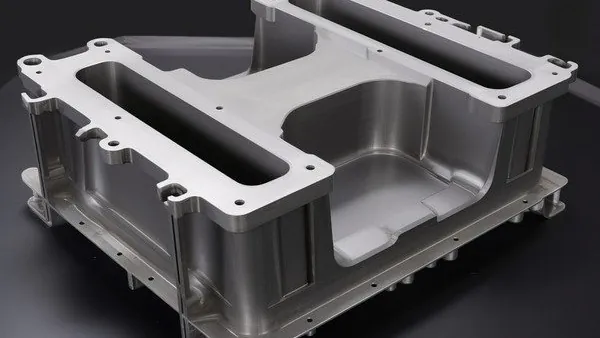
| Tooling | Multi-cavity aluminum molds | Single-cavity machined or cast molds |
| Detail option | Vacuum or pressure forming | Vacuum forming; pressure forming for crisp detail |
| Downstream | In-line die cutting | 5-axis CNC trimming |
The two gauge classes also fail differently. Thin-gauge defects are usually cosmetic or dimensional at packaging speed; heavy-gauge defects — warp, webbing, thin corners — are structural and expensive to find late. If you are weighing the classes for a specific part, our heavy and thin gauge thermoforming comparison walks through that decision in detail.
"Heavy gauge thermoforming is just thin-gauge forming with thicker sheet, so the same process settings carry over unchanged."False
Heating, cooling and trimming all scale with sheet thickness. A heavy-gauge sheet needs two-sided heat, a longer soak, assisted cooling below heat deflection temperature and CNC trimming — applying thin-gauge settings produces warped, under-formed parts that fail dimensional checks.
"Moving from thin to heavy gauge changes the whole process window, not just the material thickness."True
Heavy-gauge forming is one sheet per cycle with independent heating, controlled draw and machined trimming. Planning cycle time, tooling and inspection around those realities is what keeps formed housings consistent across a production run.
Which Materials and Standards Govern Formed Parts?
Material selection is driven by three questions: service temperature, flammability and impact. For enclosures and guards, standards usually settle the argument before unit cost does.
| Material | Typical formed applications | Why it gets specified |
|---|---|---|
| ABS | Equipment housings, cases, guards, automotive interiors | Balanced formability, impact and cost |
| PC | Clear guards, equipment protection covers | High impact, optical clarity |
| PC/ABS | Housings, interior trim | Toughness with easier forming |
| HDPE | Industrial trays, liners, storage boxes | Chemical resistance, low cost |
| PP | Trays, boxes, equipment liners | Chemical and fatigue resistance |
| PMMA | Clear covers, luminaires, display parts | Clarity and weatherability |
| ASA | Outdoor housings, automotive exterior parts | UV and weather resistance |
Standards do the same job on the validation side. UL 94 classifies the flammability of plastic materials, and many formed equipment enclosures must meet a specified UL 94 rating before they can be built into electrical equipment.1 Tensile capability of the same sheet typically comes from ASTM D638, the standard tensile test run on thermoformed sheet and used to validate formed parts.2 For heat, ISO 75-2 specifies how heat deflection temperature is measured under flexural load — the number that predicts whether a formed cover holds its shape near a heat source.3
"If a sheet is sold as engineering grade, it automatically satisfies enclosure flammability requirements."False
Flammability performance is a property of the specific grade and thickness, not of the resin family name. Specifying without a UL 94 rating on the datasheet risks an enclosure that fails equipment safety review after tooling is already cut.
"Flammability, heat deflection and impact ratings must be confirmed on the exact sheet grade and gauge being formed."True
Ratings move with additives, fillers and sheet thickness, so the datasheet for the purchased sheet — not the generic resin family — is the reference. Checking this before tooling release costs minutes; after tooling release it costs a redesign.
For a broader view of how the forming industry tracks practice and standards, the SPE Thermoforming Division publishes technical resources aimed at exactly these process decisions.
ZetarVac forms a broad material library — PVC, ABS, HDPE, LDPE, PP, PC, PMMA, PA6/PA66, POM, TPE, TPU, TPV, PC/ABS, ASA and PP/GF — mapped to end uses from medical equipment housings to agricultural trays and clear display covers. For a housing project, that usually means the flammability, clarity and heat questions can be answered inside one material family rather than by redesigning the part.
Where Do Heavy Gauge Formed Parts Fail in Production?
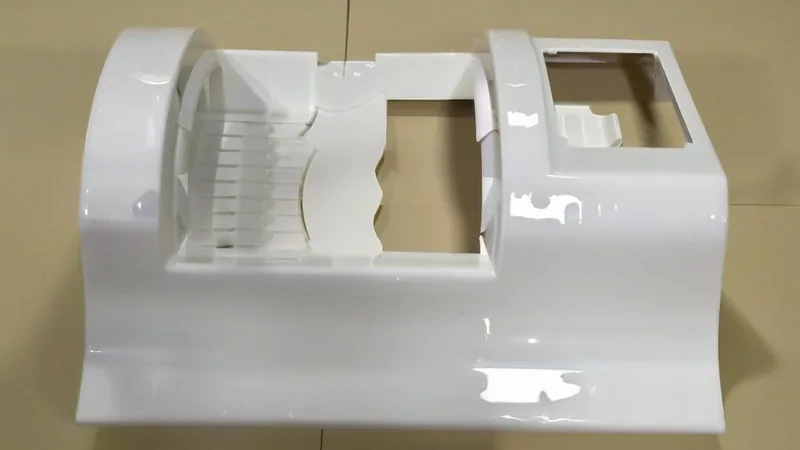
Most heavy gauge scrap comes from four places: uneven wall thinning, webbing in deep draws, distortion after release and trimming drift. All four are predictable, and all four are catchable with checks at the right stage.
Wall thinning. Forming stretches sheet, so corners and deep draws thin below nominal — severe draws can locally reach 50–70 % of the starting gauge. Critical walls should be specified as measured minimums, verified on cut sections or with an ultrasonic gauge, not assumed from the sheet spec.
Webbing and bridging. Sheet folds between tall or closely spaced features when the draw ratio or vacuum hole layout is wrong. The wrinkles weaken flanges and can jam mating hardware — visible only after trimming unless the forming stage itself is inspected.
Post-release distortion. Parts released above their heat deflection temperature keep creeping as they cool. Cool below HDT, support large panels flat, and let the part settle before trimming.
Trim drift. The trimmed outline is what mates to the machine. CNC trimming follows the forming tool datum, so checking trimmed parts against the drawing — dimension, hole position, flange squareness — closes the loop. For a structured pre-tooling review, use a DFM checklist for heavy gauge thermoformed parts and molds.4
For structural trays and guards, impact is verified, not assumed: ISO 6603-2 specifies the instrumented puncture impact test for rigid plastics, a common acceptance route where a formed panel must survive dropped-tool or point-load events.
"Once a first article is approved, the production run will hold the same tolerances without further checks."False
Sheet lots, heater drift and cooling variation all move the process between approval and volume. Without periodic dimensional and wall-thickness checks, a run can drift out of tolerance while every part still looks correct on the rack.
"Production formed parts need periodic dimensional and wall-thickness verification, not just one first-article approval."True
A stable heavy-gauge process is monitored: trimmed dimensions sampled against the drawing, critical walls measured on sections, and results fed back into heater and cooling settings. That monitoring is what makes the first article meaningful across thousands of parts.

FAQ
What sheet thickness counts as heavy gauge thermoforming?
Practice varies by shop, but heavy gauge forming generally starts around 0.5 mm and extends to about 15 mm; ZetarVac processes sheet across that full 0.5–15 mm range. Above roughly 1–2 mm the process is unambiguously heavy gauge, with one-sheet-at-a-time handling.
Is vacuum forming strong enough for structural parts?
Yes, when gauge and material are chosen for the load. Heavy-gauge ABS, HDPE, PC and glass-filled PP formed parts serve as industrial structural parts, trays and equipment liners; stiffness comes from section depth, ribs and flange design, not from the forming process itself.
Can vacuum forming reproduce fine surface detail?
Vacuum forming transfers tool detail under about one atmosphere of pressure, which is enough for many textures but softens very fine grain. Pressure forming adds air pressure against the sheet and is the usual answer when a formed housing needs crisp texture or sharp aesthetic lines.
How is a formed part trimmed to final size?
On a 5-axis CNC trimming centre. Because the trimmed outline follows the forming tool, hole patterns and flange geometry repeat consistently across the run, and mating to machine frames stays predictable.
What tolerances can heavy gauge thermoforming hold?
Formed surfaces move with material shrinkage and cooling, so tight tolerances belong on CNC-trimmed features; formed walls are best specified with realistic formed-tolerance bands confirmed on first articles. If your next step is budgeting, our heavy gauge thermoforming cost breakdown and quoting guide shows which design choices move price.
To keep going deeper on process windows, material selection and tooling for heavy gauge vacuum forming, explore the ZetarVac vacuum forming hub — it walks through the same decisions in the order a design review would. When you reach the stage of comparing suppliers, you can also see how ZetarVac works as a heavy gauge thermoforming manufacturer and review the full service overview to understand how forming projects are scoped from prototype through production.
-
UL 94: A flammability classification standard for plastic materials that rates how specimens extinguish after ignition; many formed equipment enclosures must meet a specified UL 94 rating. ↩
-
ASTM D638: The standard tensile test for plastics, used to qualify thermoformed sheet and validate formed part properties. ↩
-
HDT: Heat deflection temperature, measured per ISO 75-2 under flexural load — a practical ceiling for formed parts operating near heat sources. ↩
-
DFM: Design for manufacturability — designing draft, radii, walls and trim so the forming and trimming process can hold geometry reliably. ↩