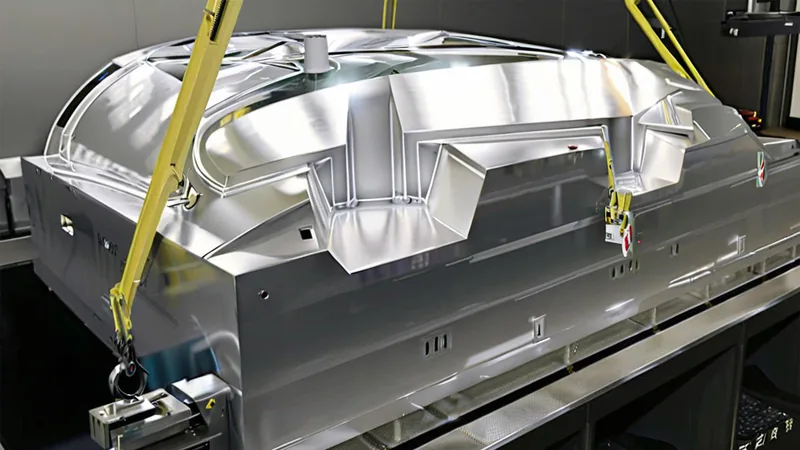
In heavy-gauge thermoforming, the mold is not a purchased commodity. It is the single decision that fixes draft angles, webbing risk, sheet distribution and trim accuracy for the life of a program, which is why choosing a thermoforming mold supplier is a process-engineering decision rather than a machining quotation. This guide walks through what a capable supplier actually delivers, how male and female tools change part control, which mold materials fit which production volumes, and how to read a mold quote line by line before you commit a drawing to tooling.
- A thermoforming mold supplier delivers the tool, the trim fixtures and the process window, not just a machined block of aluminum.
- Form over a male mold when inside dimensions matter most; form into a female mold when the outer cosmetic surface carries the dimensions.
- Machined aluminum suits production and pressure forming; cast aluminum, composite and plaster tools serve prototypes and shorter runs at lower cost.
- Sheet gauge drives mold depth, heating strategy, cooling design and trim method, so no quote is real until the gauge is fixed.
- Judge capability by sheet range from 0.5 to 15 mm, forming length near 2,500 mm, 5-axis trimming and repeatable pulls, not a single perfect sample.
- A usable quote separates mold cost, trim fixtures and per-piece forming price, with assumptions written next to each number.
What a Thermoforming Mold Supplier Actually Delivers
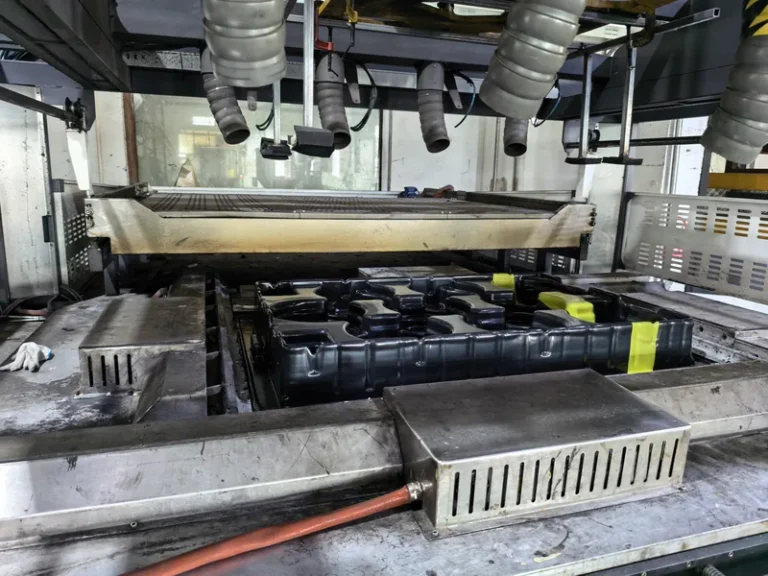
A serious supplier delivers three things: the tool itself, the fixtures around the tool, and the process window that makes the tool work. The mold — usually machined aluminum for production, cast or composite material for shorter runs — is only the visible part. Around it sit the vacuum path, the cooling design, the trim fixture and the first-article protocol, and together those elements decide whether your parts come off the machine consistent for years rather than consistent for one week.
On the engineering side, expect the supplier to propose draft angles rather than just receive them. For heavy-gauge parts, roughly 2–5 degrees of draft is a common starting range on female walls, with male plugs often needing more because the sheet grips and shrinks onto the tool as it cools.1 The supplier should also flag webbing risk in deep pockets, predict where the sheet will thin — 30–50% thinning at the deepest draw is a normal engineering expectation depending on geometry and gauge — and define the trim datum so the cutting head works from one unambiguous reference.
Tooling conversations should also settle early whether the part will run as plain vacuum forming or as pressure forming, because the two change vent sizing, surface finish and sealing details on the tool. Vacuum forming pulls heated sheet against the mold under vacuum alone and suits most structural and enclosure work; pressure forming adds air pressure on the opposite side so the sheet picks up fine texture and crisper detail. A supplier who can explain why those tool details differ is usually a supplier who can build the tool correctly the first time.
For a plain-language refresher on how the forming stages fit together, the overview of thermoforming on CustomPartNet is a reasonable starting point; the rest of this article stays on the tooling decisions that overview does not cover.

Should Your Part Form Over a Male or Into a Female Mold?
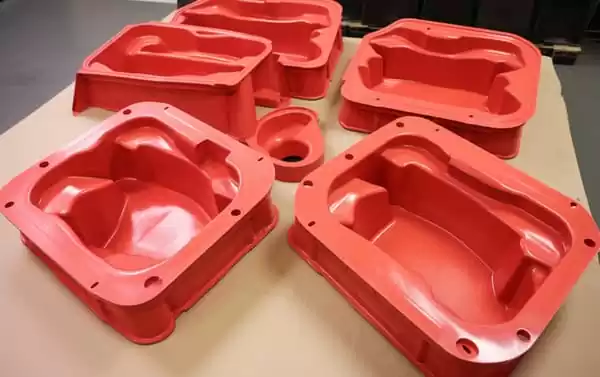
Form over a male mold when the inside surface of the part carries your critical dimensions, and into a female mold when the outside surface does. Male tools give better control of inner cavities and of wall thickness at the bottom of deep draws, while female tools protect the outer cosmetic surface because it never touches the tool.
The trade-offs run deeper than cosmetics. On a male tool, the sheet drapes over the peak first and thins across the top, so ribs and raised features need generous radii to avoid thin-spot failures. On a female tool, the sheet bridges the cavity before vacuum pulls it down, which is why sharp internal corners web if draft and radii are too small. Most enclosure work lands on female tools for appearance; most structural and tray-type parts land on male tools for dimensional control.
Where the geometry justifies it, matched male and female halves running together give the most uniform wall distribution on thick sheet, at the cost of a heavier tool and a more capable machine. Our earlier breakdown of positive and negative thermoforming molds covers this choice in detail, including how the answer shifts when a part moves from vacuum forming into pressure forming. Whatever the outcome, the decision belongs in the mold quotation stage, not after the first forming trial.
Which Mold Material and Construction Fit Your Volume?
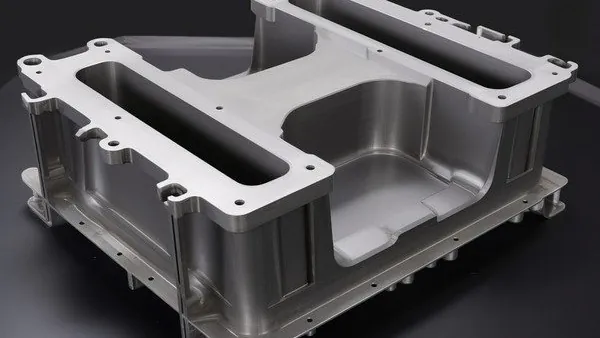
Match the mold construction to the number of pulls you actually need. Machined aluminum is the default for production tools, cast aluminum suits large or organic shapes at medium volume, and composite or plaster tools buy fast iteration when the geometry is still moving.
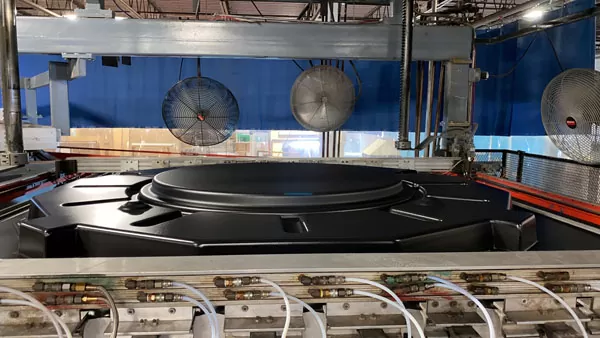
Aluminum, whether machined or cast, conducts heat fast and holds dimension across long runs, which is why it dominates heavy-gauge production tooling. Machined aluminum gives the tightest detail and the cleanest surface for pressure forming; cast aluminum keeps cost down on large, sculptural surfaces where machining hours would explode, at the price of porosity control and a longer casting lead time. For prototype and short-run work, filled composite and plaster tools pull a handful to a few hundred parts cheaply, and our plaster thermoforming mold guide shows how far those iterations can go before cutting metal.
Cavity count is the other volume decision. Single-cavity tools suit large parts such as equipment housings; multi-cavity tools spread machine time across small parts such as trays and cells, and our article on thermoforming mold cavities explains how cavity layout changes cooling and sheet width. The table below summarizes the selection logic.
| Mold construction | Best suited to | Key strengths | Watch-outs |
|---|---|---|---|
| Machined aluminum | Production runs, pressure forming | Tight detail, stable dimensions, fast heat response | Highest upfront machining cost |
| Cast aluminum | Medium volumes, large organic shapes | Lower cost on sculptural surfaces | Porosity sealing, casting lead time |
| Filled composite | Prototypes, short runs | Fast, cheap iteration on moving geometry | Limited surface temperature and tool life |
| Plaster | Early form studies | Hours to produce, easy to revise | A few pulls only, fragile detail |
"A supplier can quote the mold accurately from a 3D model alone."False
A model fixes geometry but not the sheet gauge, material grade, cavity count or trim method, and each of those changes mold depth, heating load and fixture design. A number built on assumptions usually resurfaces as a change order once forming trials start.
"Sheet gauge, forming depth and trim datum must be fixed before a mold quote means anything."True
Gauge sets the heating and cooling design, depth sets vacuum demand and draw ratio, and the trim datum sets the fixture. With those three settled, quotes become comparable and the mold shop can commit to a real number.
One practical note: when comparing quotes on the same part, normalize them against the same gauge and material. A quote that assumes 3 mm ABS and another that assumes 4 mm HDPE are quotes for two different programs, even though the part drawings look identical.
How Do You Judge a Supplier’s Forming Capability Before You Commit?
Check the forming envelope, the sheet gauge range and the trim system first, then ask for evidence of repeatable pulls rather than one perfect sample. A supplier who can form your part at both ends of the process window will hold tolerances in between.
Machine base matters less as a badge than as an envelope around your part. In heavy-gauge work, sheet from 0.5 to 15 mm covers everything from thin packaging trays to structural equipment enclosures, and a forming length of roughly 2,500 mm decides whether large covers come out of one piece or must be split and joined. Ask the supplier to place your part on their actual working envelope, not a catalog maximum.
ZetarVac runs more than 20 vacuum forming and thermoforming machines, processes sheet from 0.5 to 15 mm thick, forms parts up to about 2,500 mm long, and trims formed parts on a 5-axis CNC centre that follows the forming tool reference. For buyers that means large, deep-draw parts stay on one floor with the tooling, so a mold correction does not wait on a third party.
Validation should follow the standards your end market will apply. Tensile properties on formed sheet are normally measured to ISO 527-2, the standard tensile test that defines how strength and elongation of plastics are determined — run it on the formed gauge, because forming changes the polymer’s orientation and therefore its numbers. Heat resistance is judged through the deflection temperature of plastics under flexural load, measured per ASTM D648 or its ISO 75-2 equivalent,2 which tells you the load-bearing limit of a formed panel or enclosure wall as service temperature rises.
Electrical and safety claims carry their own gates. Where a formed housing will enclose electrical equipment, UL 94 defines the flammability classification the material must meet,3 and any promised ingress protection has to be demonstrated against the IEC 60529 IP code.4 A supplier who knows which of these apply to your part before you ask is showing you the process maturity you are paying for.
"A first-article approval proves the mold will run stable in production."False
A first article is one point sampled inside a process window, usually on fresh sheet and a hot, clean mold. Oven drift, sheet-lot variation and mold fouling all move dimensions over hours, which is why parts that passed at approval get rejected at volume.
"Judge stability from several pulls spread across the forming window, with dimensions recorded each time."True
Pulling parts at different oven settings and mold temperatures shows how far the process can drift before dimensions leave tolerance. That spread, not the hero sample, is what predicts scrap rates once the program runs weekly.
None of this requires elaborate instrumentation on your side. Ask the supplier to state the oven zones and sheet temperature range they qualified, and to record part dimensions on a simple check sheet across the trial; a supplier confident in their window will do it without being chased.
What Should a Thermoforming Mold Quote Actually Include?
A usable quote separates mold cost, trim fixtures and per-piece forming price, and states the assumptions behind each line: sheet gauge, material grade, cavity count, cycle estimate and trim method. Bundling everything into one number hides exactly the trade-offs you may want to renegotiate.
Line by line, expect to see the mold price with its material and construction stated, the trim fixture or 5-axis program cost, and a per-piece forming price that reflects gauge, cycle time and cavity count. If texture or pressure forming is quoted, the sealing and finish work on the tool should appear as its own line. Ambiguity in any of these lines is where projects later stall.
ZetarVac supports prototyping, small batch and large batch production across 45+ production lines in total, with a reference monthly capacity of about 100,000–200,000 pieces. For buyers that means the same team that builds and corrects the mold can also scale the program, instead of handing the tool to a different factory once volumes rise.
FAQ
Can one mold run both vacuum forming and pressure forming?
Some tools can, but they must be designed for it from the start: pressure forming needs a pressure box or platen sealing around the sheet, finer venting and a surface finish that survives air pressure. Retrofitting a vacuum-only tool usually costs more than building it correctly upfront, so declare the intended process in the request for quotation; our vacuum forming overview explains the process-side differences.
How long does a thermoforming mold last?
Machined aluminum production tools commonly run for many years of scheduled production, since forming pressures are low compared with injection molding and there is no screw or runner wear. What actually ends a tool’s life is usually damage — dented peaks, plugged vents, scored trim datums — which is why a documented cleaning and vent-inspection schedule matters more than a shot-count promise.
What files should I send for a mold quotation?
Send a 3D model in a neutral format such as STEP, plus a 2D drawing marking critical dimensions, the material grade and the sheet gauge, the annual and per-order quantities, and any texture or flame-rating requirements. Add the service environment — outdoor, medical, electrical enclosure — because it changes material selection and the standards the part must meet.
Do formed parts always need a separate trim fixture?
For production, yes in practice. A 5-axis trimming centre can cut the formed outline directly along the forming tool reference, but consistent fixturing is what holds repeat dimensions, edge quality and cycle time across operators. Prototype parts are often trimmed on the machine alone; the fixture investment belongs with the production decision.
Which materials suit heavy-gauge vacuum forming?
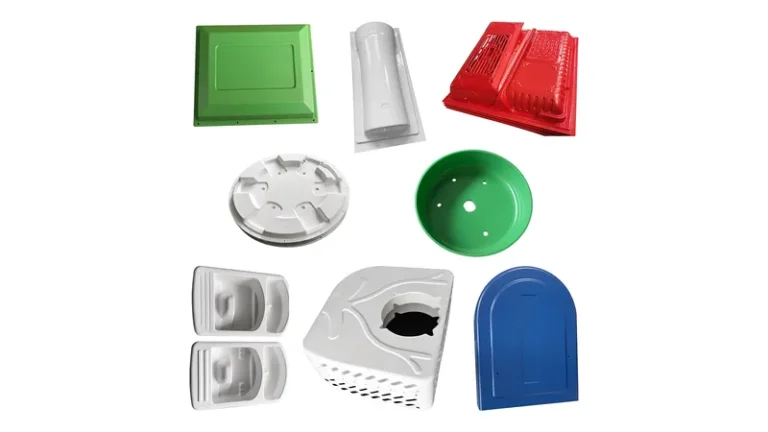
ABS and PC/ABS dominate equipment housings and automotive interiors for their balance of formability and impact strength; PC brings clarity and toughness for guards and protection covers; HDPE and PP serve industrial trays and equipment liners; PMMA covers retail and lighting applications where clarity matters; ASA and TPV extend the range outdoors and into soft-touch parts. Match the grade to the standards your market applies, not to price alone.
Where should a buyer start with a concrete part?
Start by putting the drawing in front of the forming engineer rather than the sales desk. If you are ready to compare suppliers and request a quote, send your part model to our team through the our service page with the assumptions listed above; you can also begin from the China vacuum forming manufacturer overview for the full forming and tooling context.
-
Draft angle: The tapered wall built into a thermoforming mold so the cooled sheet releases cleanly; expressed in degrees, typically 2–5 degrees for heavy-gauge female walls and more for male plugs. ↩
-
HDT: Heat deflection temperature, the temperature at which a plastic bar deflects a specified amount under flexural load, measured per ASTM D648 or ISO 75-2. ↩
-
UL 94: The flammability classification standard for plastic materials, rating how samples extinguish after ignition; commonly required for electrical equipment enclosures. ↩
-
IP code: The ingress protection rating defined by IEC 60529, classifying how well an enclosure keeps out solids and liquids. ↩