
Material selection decides most of what happens downstream in vacuum forming: how much detail the sheet picks up, how the part holds dimension after trimming, and whether the housing survives heat, impact, and sunlight in service. Buyers often arrive with a resin name in mind, but the better question is which grades form cleanly in heavy-gauge thicknesses and still meet the mechanical, thermal, and regulatory demands of the application. This guide covers the materials commonly formed on industrial thermoforming lines, the properties that decide whether a sheet forms well, and the checks that separate a stable production material from one that generates rejects.
- ABS, PC, PVC, HDPE, PP, and PMMA cover most heavy-gauge vacuum forming applications; ASA, TPE, TPU, TPV, PA6/PA66, POM, and PP/GF solve specific problems.
- Every resin has its own forming temperature window; settings that form ABS cleanly will sag or under-form PC.
- Sheet gauges from 0.5 to 15 mm and forming lengths up to about 2,500 mm define the practical part envelope.
- Wall thinning on deep draws means strength depends on draw ratio and resin grade, not nominal thickness alone.
- Confirm flammability, ingress protection, transparency, and food-contact requirements before tooling starts.
- Validate every incoming sheet lot, not just the first article, before releasing production.
Which Materials Can Be Used in Plastic Vacuum Forming?
Most commodity and engineering thermoplastics can be vacuum formed when they are supplied as sheet in the right gauge. In heavy-gauge work the practical shortlist is ABS, PC, PVC, HDPE, LDPE, PP, and PMMA, with blends and specialty grades such as PC/ABS, ASA, TPE, TPU, TPV, PA6/PA66, POM, and PP/GF covering tougher requirements.
What separates a sheet that forms well from one that only looks good on a datasheet is behavior in the heated, rubbery state. The material needs enough melt strength to sag uniformly without tearing, enough elasticity to stretch into the mold and pick up detail, and predictable shrinkage so the trimmed part holds dimension. Amorphous resins such as ABS, PC, PVC, PMMA, and ASA form across a broad temperature window, which is why they dominate housing, cover, and tray work. Semi-crystalline resins such as HDPE, PP, and PA6 form through a narrower window and shrink more on cooling, so they demand tighter process control.
Variants inside the thermoforming family matter too. Straight vacuum forming pulls the heated sheet against the mold with vacuum alone and suits most enclosures and trays, while pressure forming adds air pressure from the opposite side when a part needs sharper texture and detail. For a process-level comparison, see our overview of the plastics used in vacuum forming.
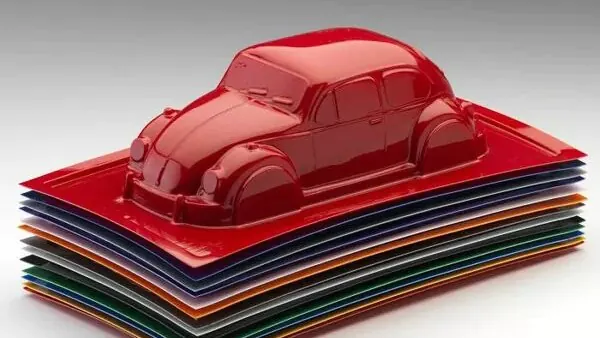
What Properties Decide Whether a Sheet Forms Well?
Melt strength at forming temperature, the width of the softening window, drying behavior, and post-forming shrinkage decide whether a sheet forms cleanly. Tensile and heat-deflection data then tell you whether the formed part will hold up in service.
Hot tensile strength is the property buyers under-weight most. When comparing supplier datasheets, insist that tensile values follow ISO 527-2, the standard tensile test for plastics, because it fixes the specimen geometry and test speed so the numbers describe the same material behavior.1 Heat deflection temperature matters just as much for housings mounted near motors or power electronics: it marks the load-bearing ceiling of the formed wall.2
Moisture is the other quiet variable. Hygroscopic sheet such as ABS, PC, and PA6 absorbs ambient humidity, and forming a wet sheet produces bubbles, streaks, and weak zones that look like processing faults but are storage faults. Drying to the resin maker’s recommendation before forming is part of the material specification, not an optional step.
| Material | Common vacuum forming uses | Verify first | Main forming risk |
|---|---|---|---|
| ABS | Equipment housings, cases, guards, automotive interiors | Impact strength, HDT | Moisture bubbles if not dried |
| PC | Clear guards, protection covers, medical housings | Impact, transparency | High forming temperature, needs drying |
| PC/ABS | Automotive interiors, equipment housings | Blend ratio, surface finish | Narrower window than neat ABS |
| PVC | Trays, packaging, industrial liners | Chemical resistance, cost | Tight heat-stability window |
| HDPE | Industrial trays, equipment liners, storage boxes | Chemical resistance, stress cracking | High shrinkage and warpage |
| PP | Automotive interior parts, trays, boxes | Fatigue life, stiffness | Warpage during cooling |
| PMMA | Clear covers, luminaires, display parts | Optical clarity | Brittleness after forming |
| ASA | Outdoor housings, automotive exterior parts | UV and weathering resistance | Higher cost than ABS |
"Any thermoplastic sheet can be formed with the same oven settings."False
Resins soften across very different temperature ranges and lose melt strength at different rates. Running PC sheet on an ABS window produces excessive sag, webbing between features, and thin corners that fail in service.
"Each grade needs its own verified forming window."True
Heater zones, pre-blow, vacuum timing, and cooling must be tuned to the specific resin and gauge. Documenting that window on the production sheet is what keeps part ten thousand consistent with part one.
Industry references such as the SPE Thermoforming Division publish material-focused case studies if you want to see how these windows are established at production scale.
How Do Thickness and Draw Depth Change Material Choice?
Thicker sheet gives rigidity but deepens the draw and concentrates thinning at corners and sidewalls. As draw ratio increases, materials with higher hot strength — ABS, PC, PC/ABS — hold wall thickness more evenly than semi-crystalline sheet.
The formed wall is never the nominal gauge everywhere. Corners and steep sidewalls thin as the sheet stretches into the mold, and depending on geometry and whether a plug assist is used, critical sections commonly retain somewhere in the 30 to 60 percent range of the starting gauge. That is why experienced designers specify a minimum wall on load-bearing or sealing surfaces rather than a nominal thickness, and why the resin choice is made together with the draw, not after it.
ZetarVac processes sheet from 0.5 to 15 mm and forms parts up to about 2,500 mm long on more than 20 thermoforming machines. That gauge range matters for selection: the same design can be trialed in 3 mm ABS and 6 mm PC/ABS and judged on measured wall distribution before a grade is committed.
Semi-crystalline sheet adds a shrinkage dimension on thick parts. HDPE and PP cool with more mold shrinkage than amorphous resins, so flatness on large panels and hole positions relative to trimmed edges need post-forming data, not datasheet assumptions.
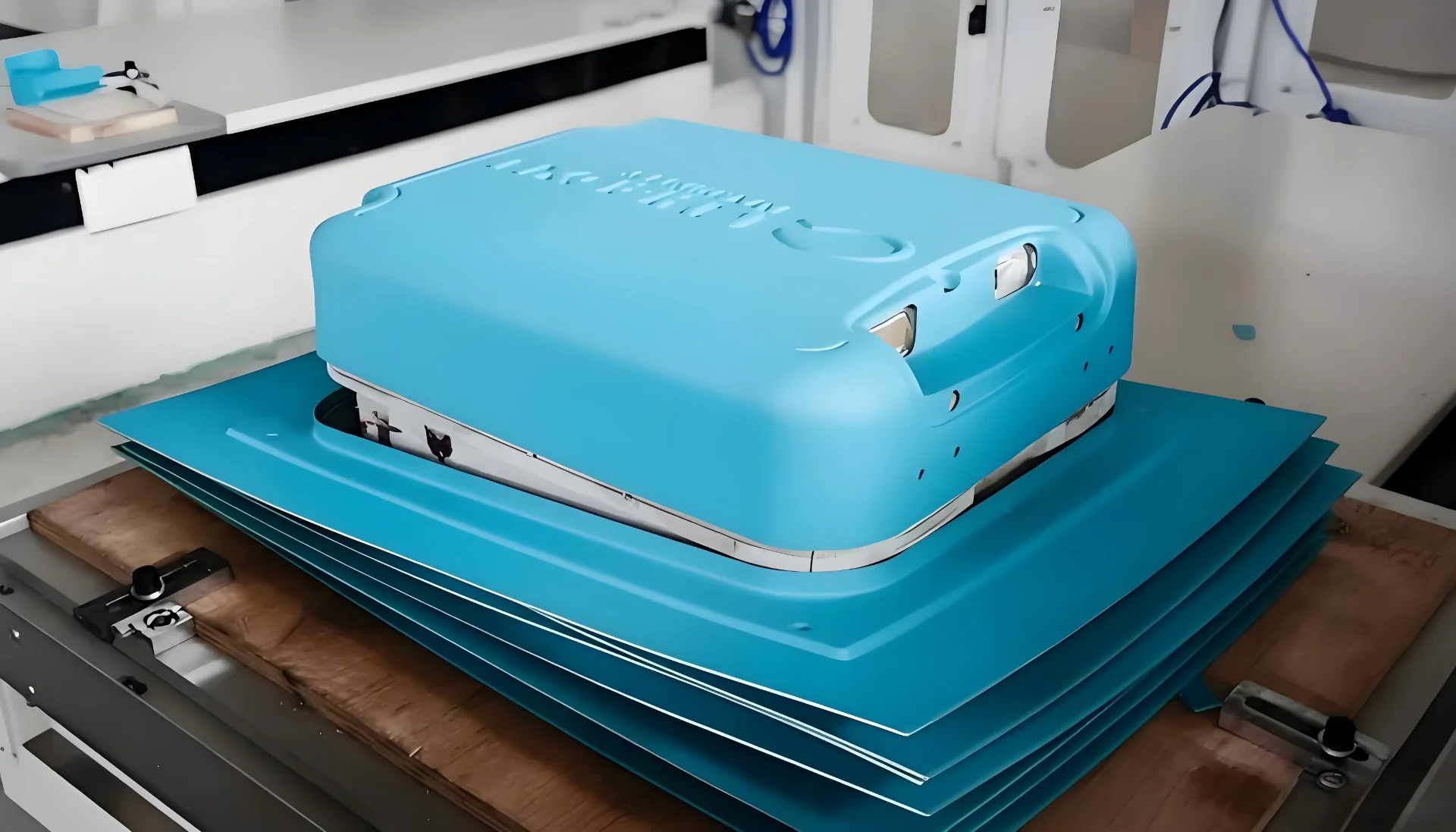
Which Materials Fit Which Applications?
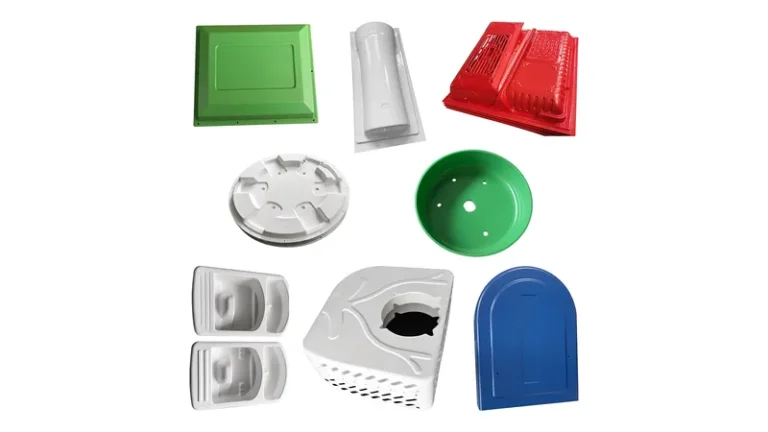
Match the material to the dominant service requirement: housings to ABS or PC/ABS, trays and liners to PVC, HDPE, or PP, clear covers to PC or PMMA, and structural parts to PP/GF or PA6/PA66. Everything else is refinement within those families.
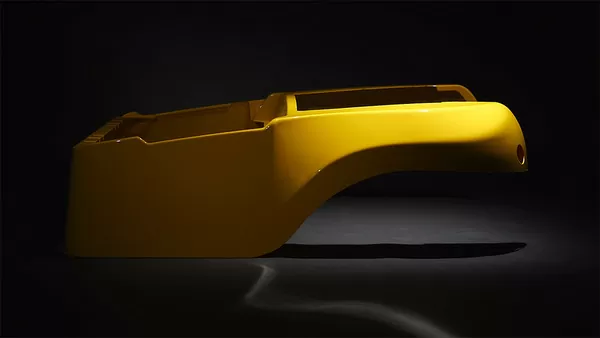
Equipment housings and covers: ABS and PC/ABS are the default for enclosures, machine guards, and cases because they balance impact strength, finish, and forming ease. For housings around electrical equipment, UL 94 flammability classification is what grades the formed material’s burning behavior before it can be used in such assemblies.3 Where a formed cover is part of a protected enclosure, IEC 60529 defines the IP code for dust and water ingress, and that rating has to be proven on the finished assembly rather than inferred from a datasheet.4 Outdoor exposure moves the choice to ASA or UV-stabilized PC.
Trays, liners, and logistics parts: PVC, HDPE, and PP carry most tray and liner work on cost, chemical resistance, and stiffness. For trays and packaging intended to touch food, EU regulation 10/2011 governs which plastic compositions are permitted, so declarations of compliance need checking before the tray design is frozen. A formed ABS seedling tray shows how application and material interact: multi-cavity layouts with custom cell geometry only form repeatably when the resin’s hot strength carries uniform walls into every cell.
Clear covers and display parts: PC and PMMA serve when the part has to be seen through. ISO 13468 specifies how total luminous transmittance of transparent plastics is measured, which is what lets you compare a clear PC guard and an acrylic display cover on a number instead of by eye.5 Formed PMMA display covers with custom curved geometry are a standard retail application where clarity and form stability compete.
Structural and special parts: Glass-filled PP/GF and PA6/PA66 handle industrial structural loads, POM serves precision industrial parts, and TPE, TPU, and TPV supply soft liners, seals, and flexible protection parts formed over rigid substrates.
ZetarVac’s material library spans PVC, ABS, HDPE, LDPE, PP, PC, PMMA, PA6/PA66, POM, TPE, TPU, TPV, PC/ABS, ASA, and PP/GF, produced across more than 45 lines with a reference monthly capacity of roughly 100,000 to 200,000 pieces. A library this broad shifts selection from a datasheet shortlist to a forming trial decision.
Where formed parts end up in service — from enclosures to logistics trays — is mapped in more detail in our article on what plastic vacuum forming is used for.

What Should You Validate Before Committing to a Grade?
Validate the grade on the actual production sheet lot: form trial parts on a production machine, check dimensions after full cooling, and confirm every flammability, ingress-protection, transparency, or food-contact requirement the application carries.
Sheet lots vary more than buyers expect. Regrind percentage, moisture at packing, and gauge distribution across the web all drift within one specification, and thermoforming amplifies each of them because the sheet spends minutes at forming temperature. A certificate of analysis per lot, a documented drying step, and a formability coupon keep the input side honest before the machine sees the sheet.
"A first article that passes proves the run will pass."False
Sheet lots vary in regrind content, moisture, and gauge distribution even within one specification. A single perfect first article says nothing about lot twelve, and unverified lots are where warped housings and rejected trays appear.
"Incoming lot checks protect production stability."True
A short incoming routine — gauge scan, moisture verification, and a formability coupon — flags drift before it becomes a pallet of rejects. Stable thermoforming is a lot-control discipline as much as a machine-setting discipline.
Which Selection Mistakes Cause the Most Rejects?
The costliest mistakes are specifying nominal thickness instead of required stiffness, locking tolerances tighter than the process holds, and ignoring post-forming shrinkage in tool design. Each surfaces only after tooling is cut, when changes are expensive.
Tolerance deserves its own note. Outline dimensions on a formed part follow the trimming operation, and with 5-axis CNC trimming the cut outline tracks the forming tool accurately, so edge positions are controllable. Wall thickness, by contrast, varies with draw and is process-inherent; specifying a tight wall band on a deep corner is a rejection clause waiting to happen.
"Thicker sheet always makes a stronger formed part."False
Strength follows the material left in the critical section, and deep draws strip wall from corners regardless of starting gauge. A 6 mm part drawn carelessly can be weaker where it counts than a 4 mm part with a controlled draw.
"Design draw ratio and grade together with thickness."True
Match the resin’s hot strength to the part’s draw, then choose the gauge that meets stiffness after thinning. That sequence produces parts that pass impact and load tests with margin instead of passing on paper.
FAQ
Can the same material run for prototypes and production volumes?
Yes, and it should. Forming the prototype in the production grade and gauge means the trial data — wall distribution, shrinkage, distortion — carry over directly instead of being invalidated when the material changes at scale-up.
What sheet thickness does heavy-gauge vacuum forming cover?
Heavy-gauge work generally starts around 0.5 mm and extends to 15 mm on capable thermoforming machines, with forming lengths up to about 2,500 mm. The practical ceiling for a part is set by gauge availability in the chosen resin as much as by machine capacity.
Which material should I choose for an outdoor housing?
ASA or UV-stabilized PC, depending on color and finish requirements. ABS is not an outdoor grade; its appearance degrades under UV in exposed service, which is why outdoor equipment covers are specified in ASA or protected PC from the start.
Do clear materials form differently from opaque ones?
Yes. PC and PMMA need tighter temperature control because overheating degrades optical quality, and the sheet surface must be protected throughout handling. Clarity is verified against a measured transmittance target, not just by eye.
How do I compare two candidate materials objectively?
Run the same forming trial on both grades and compare tensile, heat-deflection, and impact data measured on the formed walls, not on virgin sheet datasheets. Formed-property comparison reflects thinning and orientation, which is where real parts differ.
When you are ready to go deeper on process settings, tooling options, and material behavior, explore the vacuum forming guide or see how a China vacuum forming manufacturer structures material selection from prototype through production.
-
ISO 527-2: The standard tensile test for plastics, fixing specimen geometry and test conditions so tensile data from different suppliers are comparable. ↩
-
HDT (heat deflection temperature): The temperature at which a plastic specimen deflects a defined amount under a specified flexural load, indicating service-temperature capability. ↩
-
UL 94: A flammability standard grading how plastic materials burn, commonly required for formed electrical equipment housings and covers. ↩
-
IP code: The ingress-protection rating defined by IEC 60529, classifying an enclosure’s protection against dust and water on the finished assembly. ↩
-
Total luminous transmittance: The fraction of visible light a transparent plastic transmits, measured per ISO 13468 to compare clear formed parts objectively. ↩