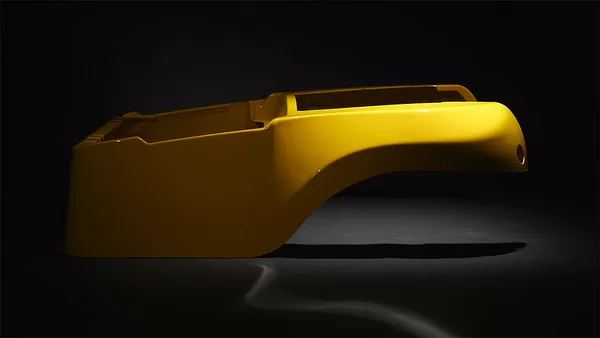
A thermoforming machine turns a flat plastic sheet into a three-dimensional part by heating the sheet until it softens, pressing it against a mould, and pulling it tight with vacuum. In heavy-gauge work — the segment covering equipment housings, machine enclosures, trays, and structural covers — the machine is less a single unit than a line of stations: loading, heating, forming, cooling, and trimming. Each station has its own process window, and each one can ruin the part in a different way. This guide explains what the machine actually does, the parameters that matter, how common materials behave, and which checks prove a formed part is ready for production.
- A thermoforming machine is a heated-sheet forming system: sheet loading, infrared heating, mould table, vacuum and pressure, cooling, and downstream trimming.
- Heavy-gauge machines commonly process sheet from 0.5 to 15 mm, with forming lengths up to roughly 2,500 mm on large-format equipment.
- Sheet temperature uniformity, not raw vacuum power, decides wall distribution, warp, and repeatability.
- Material choice (ABS, PC, HDPE, PP, PMMA, PC/ABS) sets the heating window, cycle time, and final part performance.
- Equipment housings and covers usually carry flammability and ingress-protection requirements such as UL 94 and IEC 60529.
- Five-axis CNC trimming keeps the cut outline consistent with the formed geometry.
What Is a Thermoforming Machine?
A thermoforming machine heats a thermoplastic sheet to forming temperature, draws it against a mould using vacuum — and in some configurations air pressure — holds it until it sets, then releases a shell that is trimmed to its final outline. Machines range from compact single-station units for prototyping to large industrial lines forming sheets several metres long. The underlying process is covered step by step in our vacuum forming guide.
Heavy-gauge machines differ from thin-gauge roll-fed lines mainly in sheet handling and cycle time. Instead of a continuous web, the machine processes individual cut sheets, clamped in a frame and moved through the oven on a shuttle or rotary carrier. That single-sheet discipline is what allows wall thicknesses up to 15 mm and forming lengths of about 2,500 mm. It also means the operator controls the variables a feeder would hide: sheet lot, oven dwell, and mould temperature.
How a Heavy-Gauge Thermoforming Machine Works, Station by Station
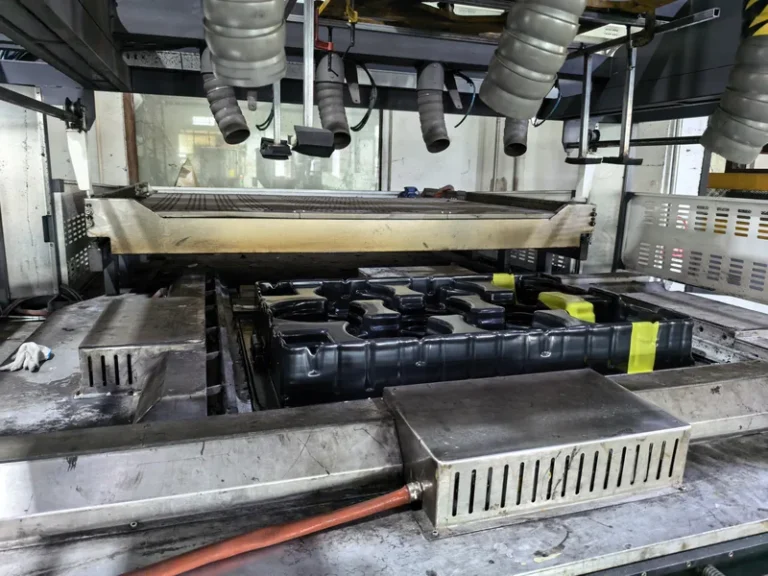
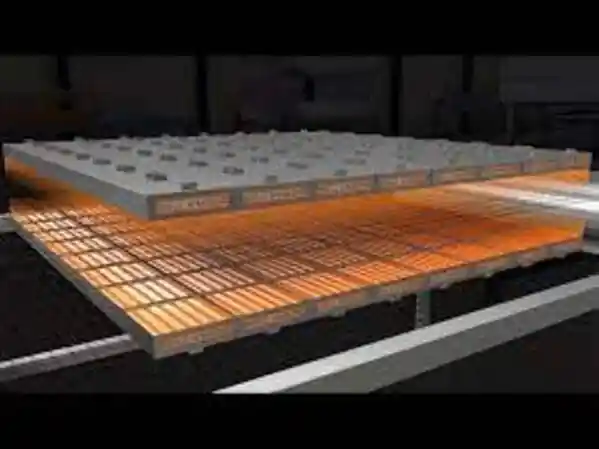
Heating is the most sensitive station. Ceramic and infrared elements warm the sheet from both sides on most heavy-gauge machines, and sheet-surface temperature — not heater setting — is what operators log. Amorphous materials such as ABS, PC, and PMMA offer a wide, forgiving window; semi-crystalline PP and HDPE pass from stiff to saggy quickly, so oven dwell must be tighter. Experienced crews judge readiness partly by sag, but a probe check at several sheet positions is what makes the process repeatable. The Vicat softening temperature gives a useful reference point for where a sheet starts to soften under load1.
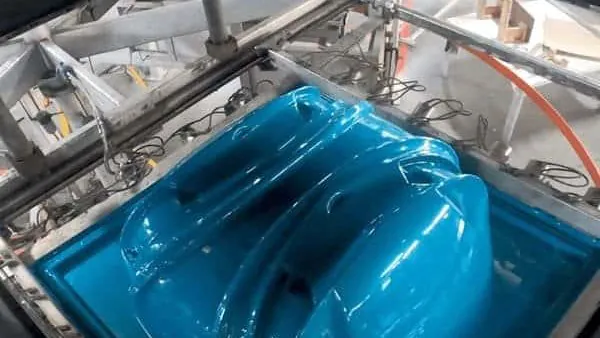
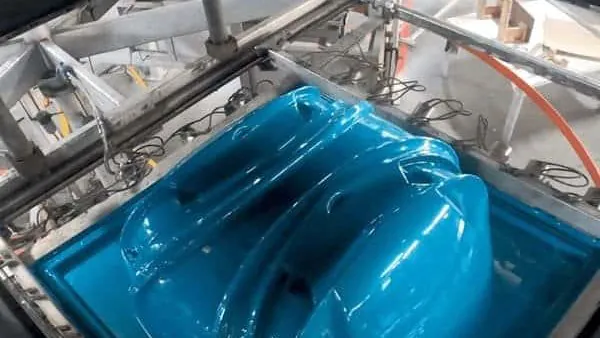
Forming follows immediately. The clamped, softened sheet is sealed against the mould rim and vacuum is applied. Industrial systems typically pull the mould cavity 0.08–0.095 MPa below atmospheric; the last few hundredths of a bar are where pump sizing and seal quality show up. Fine detail demands either faster evacuation, a plug assist that pre-stretches the sheet, or pressure forming, which adds air pressure on the opposite side to push the sheet into texture and tight radii. Vacuum alone reproduces the mould surface only on the side the sheet touches.
"Stronger vacuum always fixes poor wall distribution."False
Vacuum transfers the sheet to the mould; it cannot move material that has already frozen or was never stretched evenly. If the sheet enters the forming station hot at the centre and cool at the corners, corners thin out or web no matter how large the pump is. Correct the heating profile first.
"Sheet temperature uniformity is the main lever for wall distribution."True
When the sheet leaves the oven within a narrow band across its full area, vacuum pulls it down evenly and thickness follows the tool geometry predictably. That is why disciplined shops log sheet temperature per zone, not just heater settings.
Cooling decides cycle time and warp. Fans, mist, and temperature-controlled moulds bring the shell below its deflection point before release. Pulling a part too hot saves seconds and pays them back as distortion; moulds for amorphous materials commonly run warm to reduce internal stress, while semi-crystalline materials need faster heat removal. Uniform cooling across the whole part matters more than fast cooling on one side.
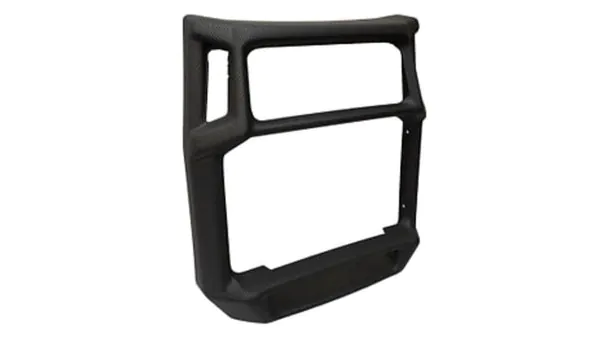
Trimming is a station of its own. Formed shells carry flange and web material that must be removed to reach the final outline. Five-axis CNC routers follow the forming tool geometry, so cut-outs, mounting holes, and edge radii stay consistent across the batch. Three-axis trimming handles flat flanges; deep-draw housings need the fifth axis to keep the cutter normal to curved surfaces.
ZetarVac runs more than 20 vacuum forming and thermoforming machines with a dedicated five-axis CNC trimming centre, processing sheet from 0.5 to 15 mm with forming lengths up to about 2,500 mm. For a project team, that means a housing can move from prototype to volume on the same process base rather than changing methods mid-way.
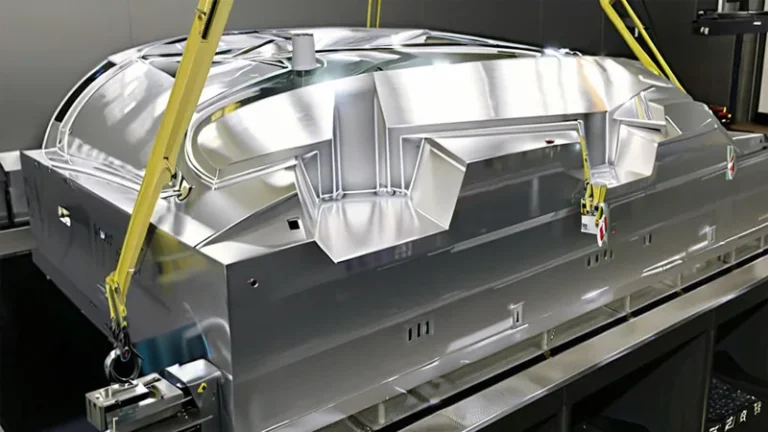
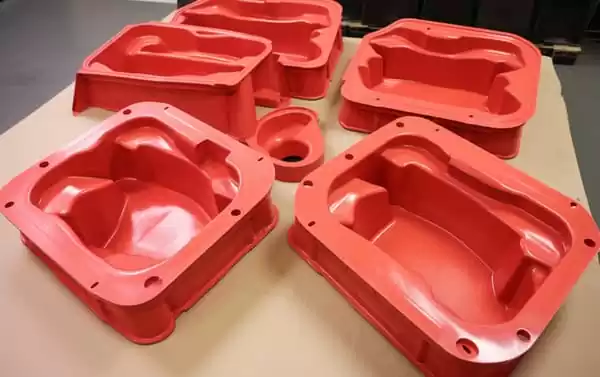
Tooling closes the loop. Most heavy-gauge tools are machined aluminium with vacuum channels and vent holes sized to the sheet thickness; how those cavities and vents are arranged directly controls detail reproduction and cooling speed. Our article on thermoforming mold cavities explains that design in depth.
What Sheet Sizes and Thicknesses Can a Thermoforming Machine Handle?
Most heavy-gauge machines process sheet from about 0.5 to 15 mm, and large-format machines form parts up to roughly 2,500 mm long. The practical limit for a specific part is set by clamp frame size, oven zone layout, and how evenly such a large sheet can be heated.
Thickness drives everything downstream. Sheet above roughly 6 mm needs longer oven dwell, warmer moulds, and deeper vacuum channels, and every extra millimetre lengthens the cycle. Deep draws multiply the effect: as draw ratio increases, corners thin and the process window narrows, so draft angles and generous radii are cheaper insurance than rework.
Tolerances deserve explicit expectations. A formed part has a naturally non-uniform wall, so tolerances belong on functional features — mounting holes, sealing flanges, mating edges — rather than across the whole surface. Large complex parts illustrate the point: our PC medical equipment housing work combines curved surfaces with custom cut-outs and mounting holes, and the inspection plan targets those machined features, not the freeform shell.
"Passing the first article means the production run will hold tolerance."False
A first article is one part from one sheet lot under one oven state. Sheet gauge drift, heater ageing, and ambient conditions all move the process afterwards. Without a locked window and periodic re-checks, a later lot can sit outside the envelope part one met.
"Batch stability comes from a locked process window, not a lucky first part."True
Repeatability needs controlled sheet lots, logged zone temperatures, and fixed vacuum and cool times, with first-article geometry validating the tool rather than the process. That is what separates a machine making samples from one making production parts.
Which Materials Work Best on a Thermoforming Machine?
ABS, HDPE, PP, PC, and PMMA cover most heavy-gauge forming work, with PC/ABS, ASA, and glass-filled grades for more demanding housings and structural parts. The right choice balances forming window, service temperature, impact, and appearance rather than optimising a single property.
| Material | Typical formed parts | Forming behaviour | Watch-outs |
|---|---|---|---|
| ABS | Equipment housings, guards, automotive interior parts | Wide, forgiving heating window; good detail | Modest heat resistance near hot components |
| PC | Clear guards, protection covers, automotive parts | High impact and heat resistance | Needs dry sheet and higher forming temperature |
| PMMA | Display covers, luminaires, retail displays | Excellent optical clarity | Brittle edges; controlled trimming required |
| HDPE | Industrial trays, liners, storage boxes | Good chemical resistance; economical | Higher shrink; warpage control needed |
| PP | Trays, boxes, equipment liners, interior parts | Strong chemical resistance; hinge behaviour | Narrow sag window; tight oven control |
| PC/ABS, ASA | Enclosures, outdoor and automotive parts | Balanced impact, heat, and weathering | ASA preferred for outdoor UV exposure |
Heat resistance should be specified, not assumed. ASTM D648 and ISO 75-2 define the heat deflection temperature of a plastic under flexural load — the property that tells you how close a formed enclosure can sit to a heat source before it starts to relax2. For housings near electronics, that number shapes material selection more than impact data does.
Clear covers add an optical dimension: clarity, haze, and surface finish survive forming only if the sheet, tool, and trim process are chosen together. Our acrylic thermoforming article covers those trade-offs for PMMA parts.
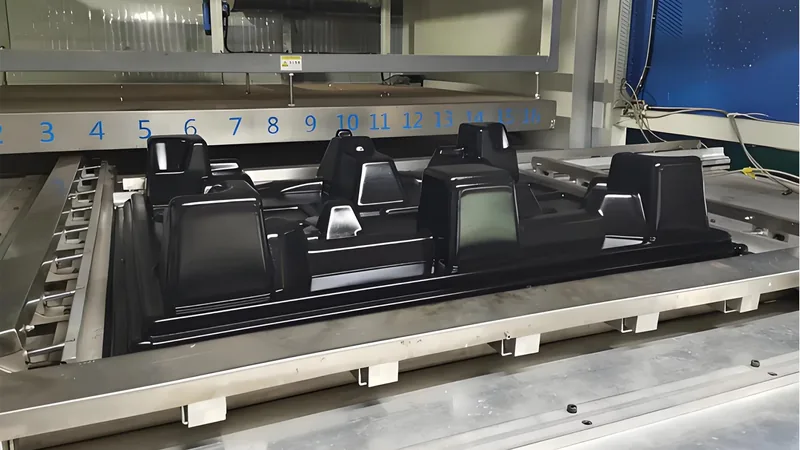
The material library on the ZetarVac floor spans PVC, ABS, HDPE, LDPE, PP, PC, PMMA, PA6/PA66, POM, TPE, TPU, TPV, PC/ABS, ASA, and PP/GF, mapped to applications from equipment housings and trays to automotive interior and outdoor parts. A stocked library matters because substituting a sheet grade late in a project rarely leaves the process window unchanged.
What Quality Checks Validate Parts From a Thermoforming Machine?
Formed parts are validated on three levels: geometry against 3D data, material performance against standard test methods, and, for electrical enclosures, flammability and ingress protection against the standards the application requires. Each level catches failures the others miss.
Geometry checks focus on trimmed features: scanning or fixture measurement of hole positions, sealing flanges, and mating edges, with freeform surfaces compared against CAD for gross deviation. Material checks are equally necessary because forming thins and orients the polymer. ISO 527-2 specifies the tensile test used to characterise plastics, and properties measured on a formed side wall can differ from the flat-sheet certificate — one reason sampling the finished part matters3.
For electrical equipment, two more layers apply. UL 94 defines the flammability classification a plastic must meet before it can be used in many enclosure applications4, and IEC 60529 defines the IP code that grades how well an enclosure keeps out dust and water5. A formed cover reaches its rating only together with gaskets and fixings, so ingress tests run on the assembly, not the bare shell.
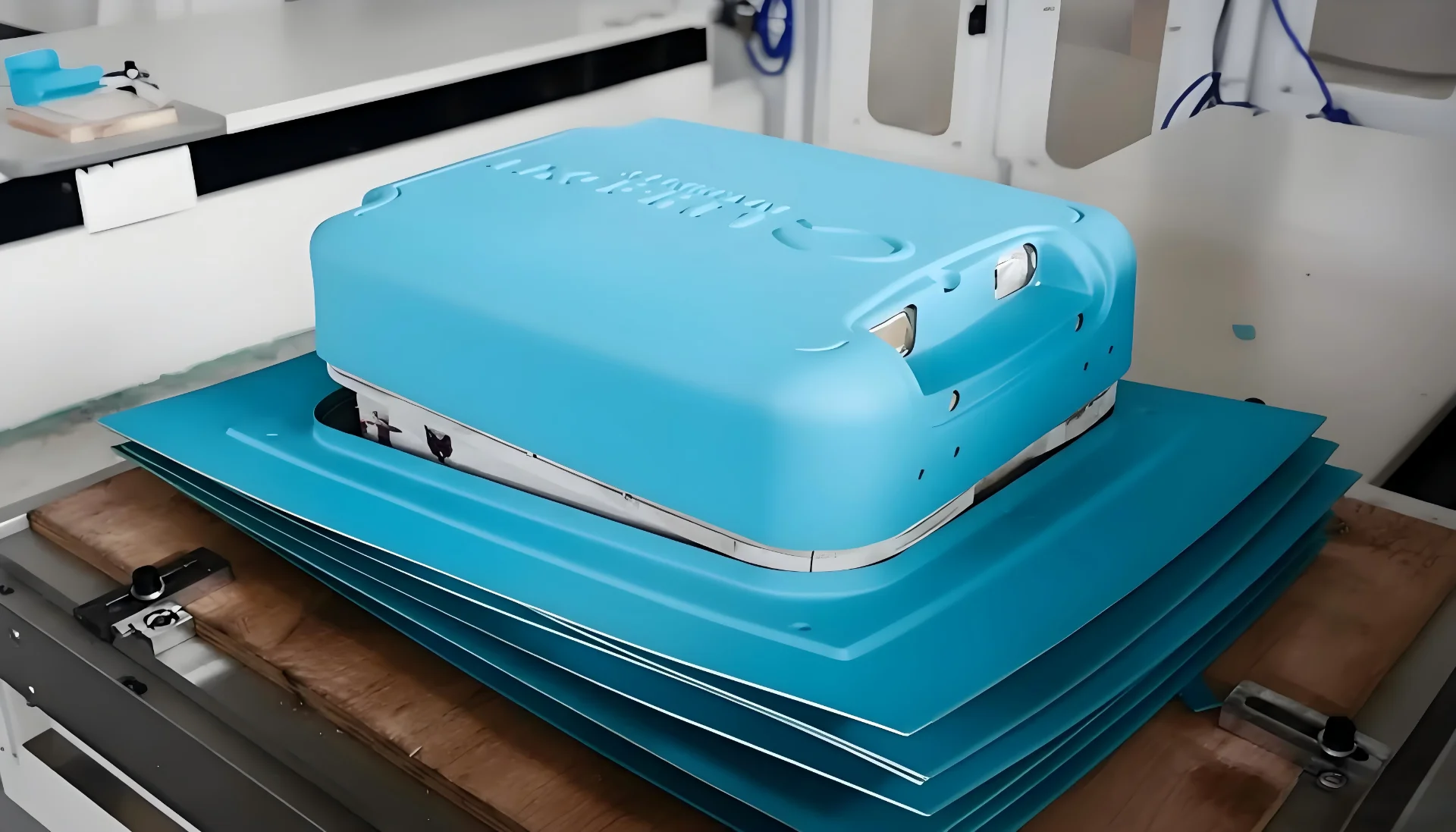
ZetarVac operates 45+ production lines with a reference monthly capacity of about 100,000–200,000 pieces, and supports prototyping, small batch, and large batch production on the same equipment base. For buyers, that means parameters proven on prototype parts carry into volume instead of being rediscovered.
How Do You Choose a Thermoforming Machine for Your Project?
Machine format follows volume and part size. Single-station machines suit prototypes and low volumes; shuttle and rotary lines move heating, forming, and cooling in parallel for repeated production; large-format machines become necessary once parts approach 2,500 mm. Independent references such as the SPE Thermoforming Division publish process guidance on these machine classes when you need a source outside any supplier brochure.
"A bigger forming area automatically means a higher part price."False
Bed size is a fixed machine cost; piece price is driven by material weight, cycle time, and trim complexity. A well-nested multi-cavity tool on a large bed can beat a cramped single-part tool on both cycle time and sheet utilisation.
"Part price follows material, cycle time, and trim strategy more than machine size."True
The levers that move cost are sheet utilisation, heating efficiency, and how much edge material gets machined away. Size only matters when it forces a less efficient tool layout.
Those levers are manageable before the tool is cut, which is why a review of cost control in thermoforming pays off at the design stage, not after the first invoice.
Questions worth asking before you commit: which sheet gauges and formats the machines actually run, how the trimming centre is programmed from the forming tool, what process documentation comes with a production transfer, and how sheet lots are controlled between batches. When the buyer is ready to compare suppliers rather than machines, seeing how a vacuum forming manufacturer in China presents equipment, materials, and cases is a useful checklist baseline.
FAQ
Is a vacuum forming machine the same as a thermoforming machine?
For vacuum processes, yes — vacuum forming is the most common thermoforming method and runs on the same hardware. Pressure forming machines add a pressurised plenum for sharper detail, and twin-sheet lines form two sheets at once for hollow structural parts.
What sheet thickness can a heavy-gauge thermoforming machine process?
Heavy-gauge lines typically run sheet from 0.5 to 15 mm, with large machines forming parts up to about 2,500 mm long. Above roughly 8 mm, heating and cooling dominate the cycle, so part design should justify every extra millimetre.
How much vacuum does the forming step need?
Most industrial systems operate between about 0.08 and 0.095 MPa below atmospheric. The peak figure matters less than evacuation speed and seal quality, because the sheet keeps losing heat while the cavity fills.
What maintenance does a thermoforming tool need?
Aluminium heavy-gauge tools last a long time because forming pressures are low. The practical items are seal edges, vent holes, and surface finish: appearance parts show every mark, so textured and coated tools need more disciplined handling than purely functional ones.
Does every formed part need five-axis trimming?
Not every part, but most housings do. Five-axis trimming keeps the cutter normal to curved surfaces, so deep-draw shells get consistent edges, holes, and cut-outs. Parts with flat flanges can often be trimmed three-axis or sawn.
To keep researching before you talk to anyone, explore the vacuum forming guide and connect machine capability to part design decisions step by step. When you want the manufacturer-side view of the same equipment, see how a China vacuum forming manufacturer presents its machines, materials, and process documentation.
-
Vicat softening temperature: The temperature at which a flat plastic specimen is penetrated to a defined depth under a standard load, indicating where a formed sheet starts to soften. ↩
-
HDT: Heat deflection temperature — the temperature at which a plastic bar deflects a specified amount under flexural load, measured per ASTM D648 or ISO 75-2. ↩
-
ISO 527-2: The part of the ISO 527 standard specifying tensile test conditions for plastics, used to validate thermoformed sheet and formed parts. ↩
-
UL 94: The flammability classification standard for plastic materials, required for many electrical enclosure applications. ↩
-
IP code: The ingress protection rating defined by IEC 60529, grading how well an enclosure resists dust and water. ↩