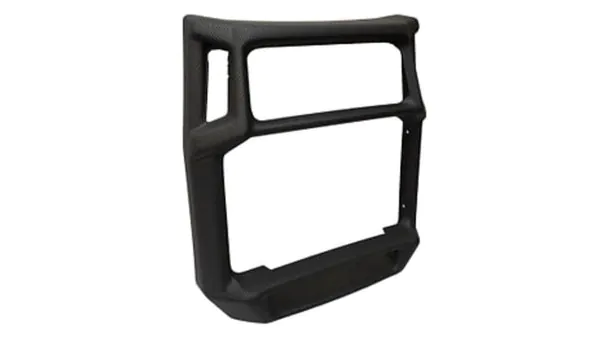
Material selection is the decision that shapes every thermoforming project before a single sheet is heated. The same part geometry can behave completely differently in ABS, PC, or PP: one polymer draws deep detail cleanly, another holds stiffness in hot service, a third warps the moment sheet temperature drifts a few degrees. This guide explains how heavy gauge sheet behaves during vacuum forming, which properties to check before committing to a material, and how to validate a formed part with recognized test standards.
- Material choice defines the forming window: sheet heating range, sag behavior, and achievable draw depth all follow from the polymer, not from the machine.
- Grades matter: a thermoforming-grade sheet is formulated for melt strength and hot strength, and a generic grade of the same polymer can fail on deep draws.
- Sheet gauge drives heating time, wall-thickness distribution, and trimming strategy across the practical 0.5–15 mm range.
- Validate parts against the failures you fear: tensile per ISO 527-2, flexural stiffness per ASTM D790, heat deflection per ISO 75-2, and flammability per UL 94 for enclosures.
- Application signals point to specific materials: ASA and PC/ABS for outdoor and automotive parts, PMMA for clear covers, PP and HDPE for trays and liners.
Why Material Selection Shapes the Whole Thermoforming Process
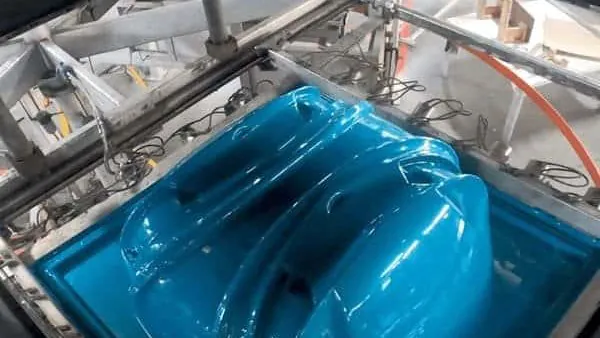
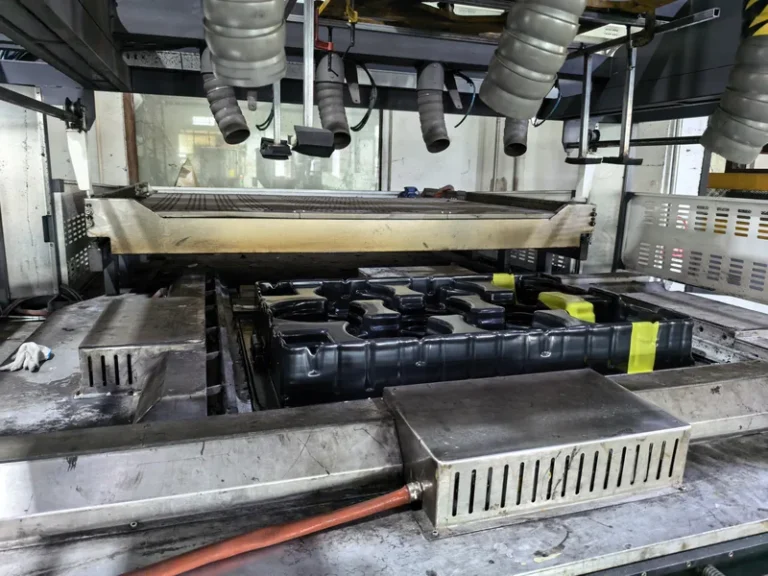
Heavy gauge thermoforming starts from a solid sheet, not a molten shot. The sheet is clamped, heated until it softens and begins to sag, then drawn against a mold — usually by vacuum, sometimes with pressure assistance for sharper detail. Because the material is only heated, never fully melted, its behavior inside the forming window differs from every other plastic conversion route. Room-temperature datasheet values tell you surprisingly little about how a sheet will draw.
Three material characteristics dominate the outcome. First, hot sheet strength: how well the softened sheet carries its own weight while it stretches. Second, the sag and softening range, which sets how wide the heating window is before the sheet marks, tears, or sticks to the mold. Third, post-forming shrinkage and warpage, which decide whether the trimmed part still matches the drawing a day later.
If you are new to the process itself — the machines, the sequence, the tooling — the overview of thermoforming covers that ground first; the rest of this page assumes you know what the machine is doing and focuses on the material riding on it.
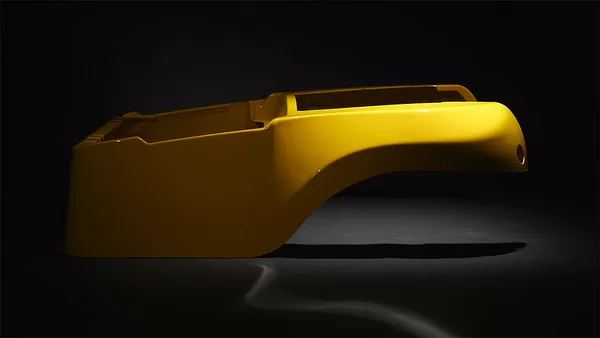
ZetarVac’s thermoforming material library covers fifteen sheet families, from PVC, ABS, and HDPE through PC, PMMA, PA6/PA66, POM, TPE, and PP/GF, mapped to trays, equipment housings, clear covers, and structural industrial parts. For a buyer, that means material selection can be made on engineering fit first, then confirmed against sheet the forming floor already processes every day.
Which Material Properties Matter Before You Commit to a Sheet?
Five properties decide most material outcomes in vacuum forming: hot sheet strength, sag temperature, heat deflection resistance, impact behavior, and post-forming shrinkage. A sheet that cannot carry its own weight at forming temperature thins out at every deep corner; a part whose heat deflection is too low distorts in service. Checking these five before comparing prices removes most forming problems before they reach the mold.
Hot sheet strength and draw ratio: The draw ratio1 — part depth relative to its footprint — describes how hard the sheet will be worked. Deep equipment housings and machine covers demand high-melt-strength grades such as ABS, PC/ABS, or PC; shallow trays and liners tolerate weaker sheets. As a practical rule, the deeper the draw, the more the material grade — not just the polymer type — decides whether corners stay above minimum wall.
Sag behavior and softening point: ISO 306 defines the Vicat softening temperature test2, which indicates the temperature at which a plastic begins to soften under a specified load; for a formed part, it marks where geometry starts to sag. For service conditions, ISO 75-2 specifies the heat deflection temperature (HDT)3 of plastics under flexural load — the standard way to state how hot a formed enclosure or panel can run before it deflects under its duty.
Shrinkage and warpage: Amorphous materials such as ABS, PC, and PMMA typically shrink on the order of 0.4–0.8% after forming, while semi-crystalline PP and HDPE shrink more and directionally as sheet orientation relaxes. These are engineering ranges, not promises — actual values depend on polymer, gauge, tool temperature, and geometry. What is certain: if shrinkage is not designed into the tool, the first trimmed parts will miss the drawing.
Comparing Common Heavy-Gauge Sheet Materials
The table below compresses the decision space for the materials most often formed into enclosures, trays, guards, and covers. Treat it as a shortlist generator rather than a verdict; the forming window and the service environment decide together.
| Material | Typical Formed Applications | Key Selection Property | Forming Behavior Notes |
|---|---|---|---|
| ABS | Equipment housings, cases, guards, automotive interiors | Balanced impact and stiffness | Wide forming window; forgiving on deep draws |
| PC/ABS | Automotive interiors, equipment housings, guards | Impact plus heat resistance | Slightly narrower window than ABS; strong housing material |
| PC | Clear guards, protection covers, automotive parts | Very high impact strength, transparency | Demands tight temperature control; stiffer sag behavior |
| PMMA | Clear covers, luminaires, display parts | Optical clarity and weathering | Crisp detail on shallow draws; brittle in cold service |
| PP | Automotive interiors, trays, boxes, equipment liners | Chemical resistance | Semi-crystalline; larger, directional shrinkage |
| HDPE | Industrial trays, equipment liners, storage boxes | Chemical and wear resistance | Wide sag range; watch warp on flat panels |
| ASA | Outdoor equipment housings, automotive exterior parts | UV and weathering resistance | Handles like ABS; the default for outdoor exposure |
Grade selection is a recognized engineering discipline, not a supplier preference: the SPE Thermoforming Division publishes technical guidance on how material behavior shifts between sheet and formed part, useful as an independent check when comparing datasheets.
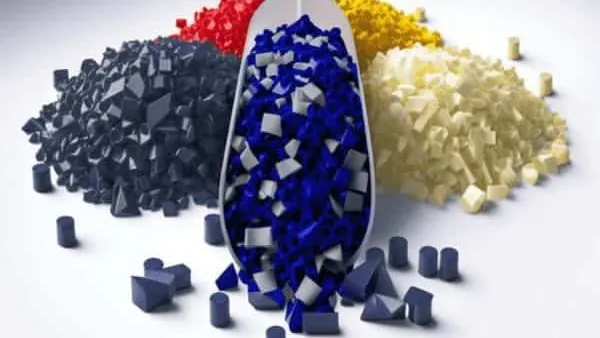
"A thicker sheet always produces a stiffer finished part."False
Stiffness in a formed part comes from geometry — curvature, ribs, flanges — combined with the material’s flexural modulus, not from gauge alone. A curved 4 mm ABS housing shell can outperform a flat 8 mm panel that buckles under load.
"Stiffness is engineered through geometry and material together."True
Formed panels gain most of their rigidity from curvature and formed-in features, which thermoforming produces at no added material cost. Choose the lowest gauge that meets impact and deflection targets, then add shape — you cut sheet cost and heating time simultaneously.
How Do Sheet Gauge and Forming Windows Interact?
Gauge controls heating time, sag behavior, and wall-thickness distribution. Thin sheets reach forming temperature in a few minutes but tear easily on deep draws; heavy sheets need zone-controlled heating and longer cycles but carry structural loads. In production, most heavy gauge thermoforming sits between roughly 1.5 and 10 mm, while capable equipment processes the full 0.5–15 mm range.
Heating is where gauge bites first. Heating time scales with sheet thickness, and thick sheets develop a temperature gradient between faces and core; infrared heaters with zone control exist precisely to keep the core of a 10 mm sheet inside its forming window without scorching the surface. Forming deep draws adds the second effect: material stretched over the mold thins, and corners of deep draws commonly finish 20–40% below nominal gauge depending on material and geometry — which is why minimum wall is specified on the drawing, not assumed.
For the structural end of the range — formed parts that work as load-bearing enclosures, machine components, and large panels — the choices narrow further; our guide to thick gauge thermoforming covers that territory in detail.
ZetarVac processes thermoforming sheet from 0.5 mm to 15 mm, with a maximum forming length of about 2,500 mm, across more than 20 vacuum forming machines. That span lets a product family move from thin packaging trays to meter-scale equipment housings without leaving the process — or re-baselining the material logic.
What Tests Should Validate a Thermoformed Part?
Match the test to the failure you fear. Tensile strength is measured per ISO 527-2, flexural stiffness per ASTM D790, heat deflection per ISO 75-2, and flammability per UL 94; clear parts add transmittance testing per ISO 13468, and food-contact trays require materials compliant with EU Regulation 10/2011. Testing both the incoming sheet and the formed part closes the loop.
ISO 527-2 specifies the tensile test run on thermoformed sheet, and executing it on both incoming sheet and finished parts verifies that forming has not degraded material strength. ASTM D790 defines flexural property testing — the practical stiffness metric for formed panels and enclosure walls, and the number to quote when a cover must span and not sag.
For electrical equipment, UL 94 classifies the flammability of plastic materials, and many formed enclosures and covers must meet a specified rating before they can be built into the end product; UL 746C governs polymeric materials in electrical equipment and is the standard behind formed housing approvals. Where a formed cover must keep out dust and water, IEC 60529 defines the IP code4 — the degrees of protection the enclosure design is claiming, and the figure the customer will audit.
Clarity is testable too: ISO 13468 specifies total luminous transmittance of transparent plastics, so a formed PC or PMMA guard can be accepted on a measured number instead of a visual impression. And for thermoformed trays and packaging that touch food in the EU, Regulation 10/2011 restricts which plastic materials and articles may be used — a constraint that decides the material shortlist before forming performance is even discussed.
"If the first article passes inspection, the material system is production-ready."False
A first article is one sheet from one lot formed one time. Sheet lots vary in moisture, orientation, and additive content, so a passing prototype says nothing about lot-to-lot spread. Parts that pass on day one can drift out of tolerance within the first production week.
"Production readiness is proven across sheet lots, not on a single part."True
Repeat the forming trial on at least two or three independent sheet lots, and re-check critical dimensions only after the parts have fully cooled and stabilized — gauging while the material is still relaxing records numbers that will not survive the week. Add incoming sheet certificates for the properties that matter, and first-article approval becomes a real gate instead of a formality.
From Formed Sheet to Finished Part: Trimming and Tolerance
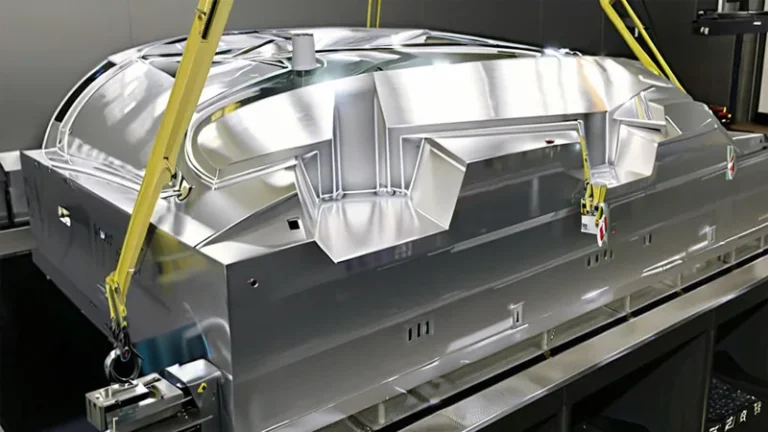
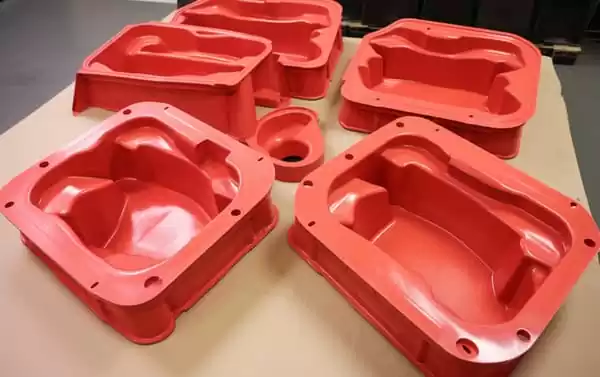
A formed part is not a finished part. Outline, holes, and mounting features all come from trimming, and trimming quality decides whether the housing bolts onto the machine. Heavy gauge work uses 5-axis CNC trimming because formed outlines are three-dimensional: the cutting path follows the forming tool’s geometry, not a flat two-dimensional profile.
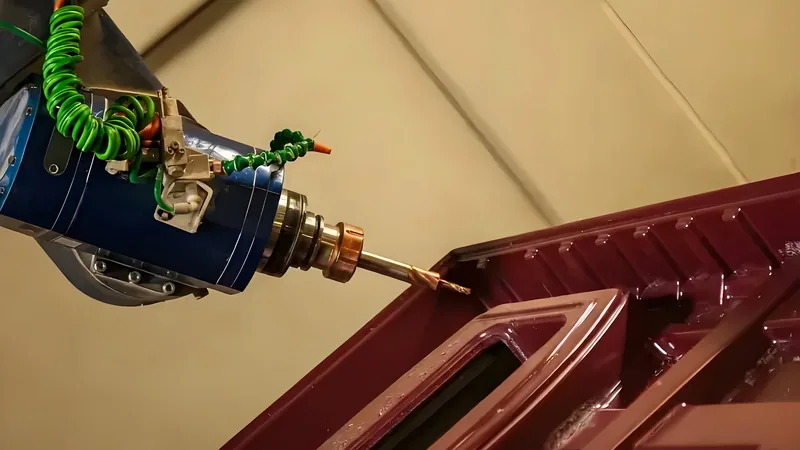
ZetarVac trims formed parts on a 5-axis CNC centre, so the finished outline follows the forming tool directly. Practically, that ties outline accuracy to tool quality rather than to operator re-fixturing — one fewer variable between the mold you approve and the part you receive.
Measure trimmed parts after they stabilize. Post-forming shrinkage keeps relaxing after the part leaves the mold — amorphous sheets settle quickly, semi-crystalline sheets take longer and move directionally — so gauging a housing straight off the trimming table can record dimensions that will drift before the part ever reaches assembly. For parts that assemble tight — enclosure gaskets, automotive interior fits — agree the measurement timing in the drawing or inspection plan, not on the shop floor.
"Any engineering plastic sheet can be swapped onto the same mold without changes."False
Every polymer shrinks at its own rate, so a tool cut for ABS produces undersized PP parts, and semi-crystalline sheets may pull detail differently under the same vacuum. Swapping materials means re-cutting or re-compensating the tool.
"Tooling is material-specific and is signed off together with the material."True
Lock the sheet material, grade, and gauge before tooling is finalized, and treat any later material change as a tooling review, not a purchasing swap. That single discipline prevents the most expensive category of rework in heavy gauge thermoforming.
FAQ: Thermoforming Material Questions
Which thermoforming material is best for outdoor equipment covers?
ASA is the default answer because it resists UV exposure and color fading over years outdoors, and it forms much like ABS. Where impact matters as much as weathering — external machine guards, transport equipment — PC and ASA-capped structures are the usual candidates. Indoor housings rarely need the premium; ABS or PC/ABS covers the requirement at lower cost.
How thick can a vacuum formed part be?
Capable heavy gauge lines process sheet from 0.5 mm up to 15 mm, spanning thin packaging through structural enclosures. Most structural formed parts land between 3 and 8 mm: thick enough for stiffness, thin enough to heat evenly. Beyond that range, cycle time and wall-thickness control start to dominate the design conversation.
Is thermoforming suitable for food-contact packaging and trays?
Yes, provided the sheet is compliant. In the EU, Regulation 10/2011 governs plastic materials intended to contact food, so the material shortlist — typically PP and LDPE grades — is decided by compliance before forming performance enters the discussion. The forming itself is routine; the compliance documentation is the gating item.
ABS or PC for an equipment housing — how do I choose?
Choose ABS when the housing sees indoor temperatures, moderate impact, and cost pressure; it forms the most predictably of any common sheet. Move to PC or PC/ABS when the housing must survive higher impact, higher continuous heat, or an electrical safety requirement, remembering that UL 94 obligations follow the end-product standard, not preference.
Where can I see how these materials behave on the machine?
The most useful next step is seeing how each material behaves through forming, trimming, and inspection part by part. Explore the vacuum forming guide to walk through forming methods and tooling choices, or learn how ZetarVac approaches vacuum forming manufacturing and how our service supports a project from material selection through finished parts — no obligation to take it further than research.
-
Draw ratio: The ratio of formed part depth to its footprint area, describing how far the sheet must stretch during forming. ↩
-
Vicat softening temperature: The temperature at which a plastic softens under a standardized load, defined by ISO 306. ↩
-
Heat deflection temperature (HDT): The temperature at which a plastic specimen deflects a specified amount under flexural load, defined by standards such as ISO 75-2. ↩
-
IP code: The ingress protection classification from IEC 60529 describing an enclosure’s resistance to dust and water. ↩