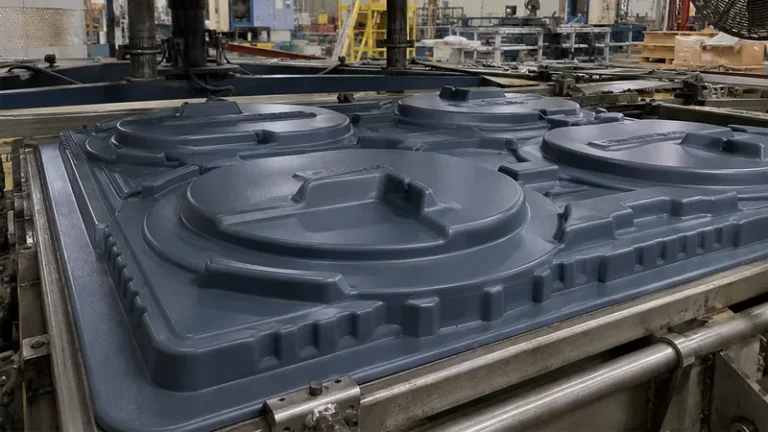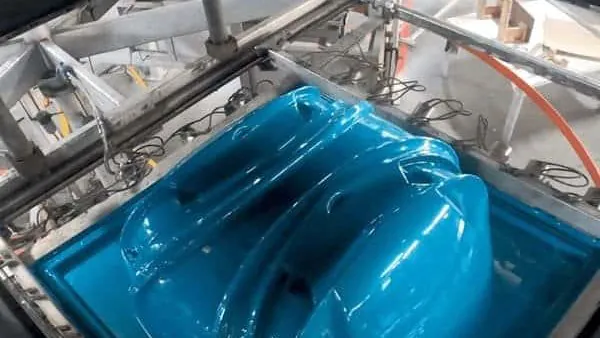
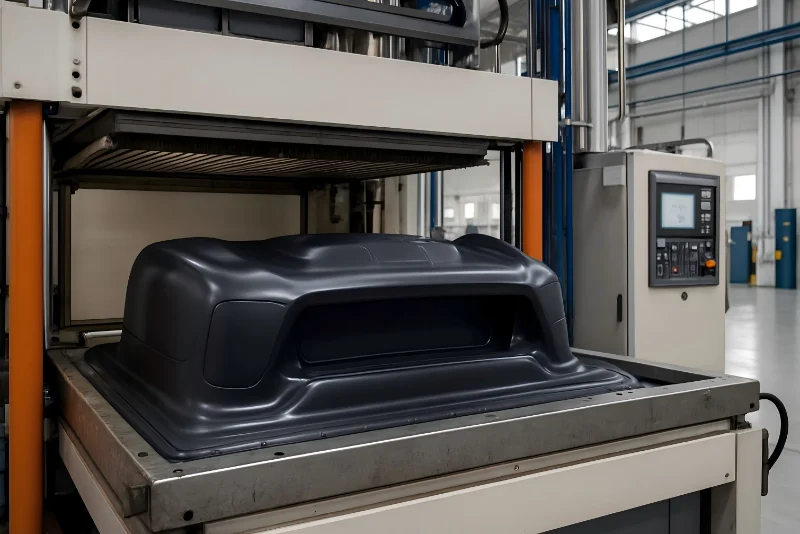
A vacuum forming machine looks simple — a heater bank, a clamping frame, a vacuum system and a moving platen — yet part quality lives inside narrow process windows. When heater zones drift, seals leak or pump oil degrades, the first symptom is usually scrap, not a warning light. This guide walks through the daily checks, service intervals and acceptance criteria that keep heavy-gauge thermoforming equipment forming repeatable parts, shift after shift.
- Most unplanned downtime on a vacuum forming machine traces back to four systems: heaters, the vacuum path, seals and clamping, and machine motion.
- A ten-minute daily check on heater output, vacuum draw-down and seal condition catches most faults before they become scrap sheets.
- Pump oil and filter condition, not running hours alone, should set the service interval for the vacuum system.
- Sheet from 0.5 to 15 mm loads the heating system very differently, so maintenance frequency must follow the material mix you actually run.
- Logged trends — zone temperatures, draw-down time, cycle time — are the only honest proof of machine stability.
- A dated maintenance log also protects part-level compliance such as flammability ratings and enclosure protection classes.
Why Does Vacuum Forming Machine Maintenance Matter?
Because thermoforming accuracy is set by machine condition as much as by the mold. A drifting heater zone, a tired pump or a worn clamping seal changes wall distribution, draw-down speed and cycle time long before a part fails visually.
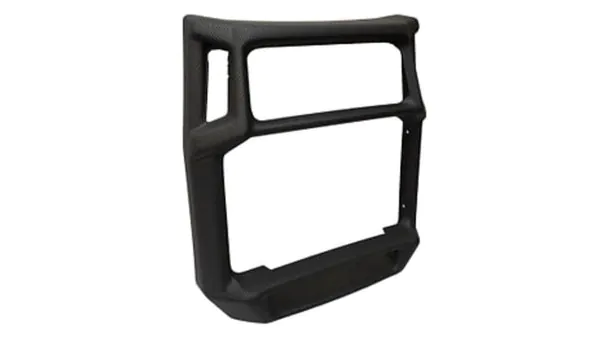
In heavy-gauge thermoforming, parts such as equipment housings, trays and machine covers are trimmed after forming, and the trimmed outline follows the forming tool. If the formed blank itself moves between shifts — thinner corners, warped flanges, uneven sag — no amount of trimming brings it back. Maintenance is therefore not housekeeping; it is the first stage of dimensional control. Everything below assumes a machine running mixed materials and gauges, which is the normal condition in a custom-forming shop.
The plant operates 20+ vacuum forming machines within 45+ total production lines, processing sheet from 0.5 to 15 mm. A fleet and gauge range that wide makes condition-based maintenance the only workable model: one skipped pump service or unnoticed heater fault can idle a line for days and push an entire order queue back with it.
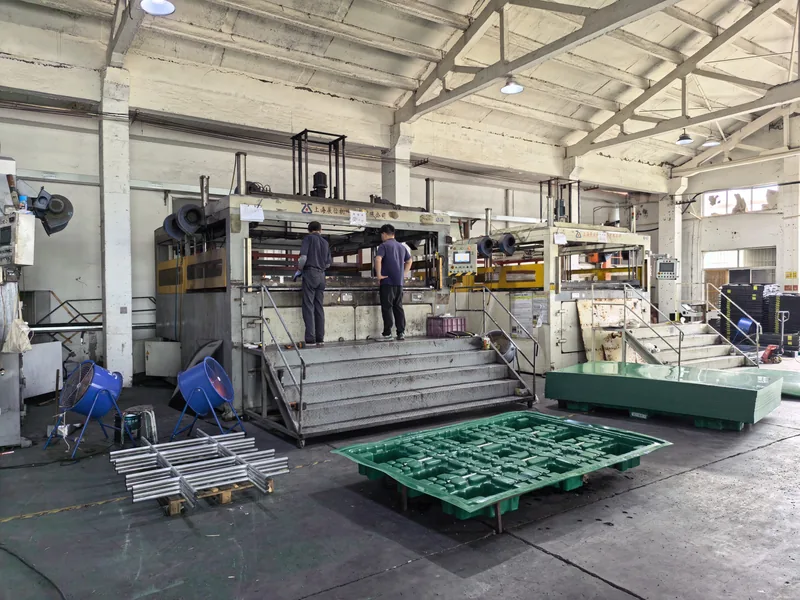
If you are screening suppliers rather than running machines yourself, ask how maintenance is documented. A shop that can show per-machine checklists and trend logs is usually a shop whose parts arrive consistent; the services page gives an overview of what a fully equipped forming operation covers.
What Does a Daily Check on a Vacuum Forming Machine Cover?
Four items: heater output, vacuum draw-down, seal and clamping condition, and safety interlocks. Ten focused minutes at shift start covers all four and prevents most of the faults that would otherwise appear as scrapped sheets in the middle of a run.
Heater zones: walk the bank and look for dark or dead segments, then compare each controller reading with an independent IR spot check on the sheet surface. Record the measured value per zone, not just the setpoint. A zone running visibly cooler than its neighbours will surface later as thin draw on one side of the part.
Vacuum path: with a sheet loaded, time how long the system takes to reach the working vacuum level. Deep-draw heavy gauge work needs the system to pull close to its full achievable vacuum within the baseline time recorded at setup. A draw-down that is visibly slower than last week usually points to a leaking gasket, a tired pump or a clogged filter — not to a process change.
Seals, frame and motion: inspect the clamping gasket for cuts and flat spots, confirm the frame grips the sheet evenly around its perimeter, and grease chains, rails and bearings to the manufacturer’s specification. On machines with water-cooled tooling, verify coolant flow and temperature as well, because a blocked cooling channel changes part distortion as much as any heater fault. Finish with the safety loop — guard switches, emergency stops and heater guards tested rather than assumed.
"A vacuum forming machine only needs attention when parts come out bad."False
By the time sag, webbing or thin corners appear, heater drift or a degrading pump has already been running for days. Sorting scrap after the fact costs far more than a ten-minute daily check, and the same fault quietly stretches delivery times.
"Daily condition checks beat calendar-only servicing."True
A fixed date ignores real operating load: dusty air, thick sheet and long cycles wear pumps and seals faster. A short daily checklist triggers work on condition, so maintenance happens before quality moves instead of after.
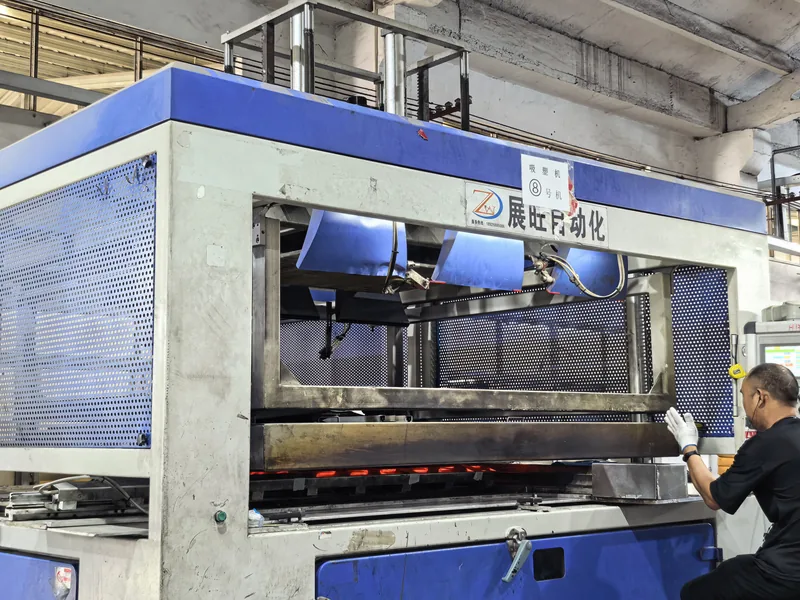
How Often Should the Vacuum Pump and Pneumatics Be Serviced?
For oil-sealed rotary vane pumps, the practical rule is weekly oil inspection and oil changes on condition, with the running-hours baseline taken from the pump manufacturer’s specification and tightened for thermoforming duty. Filters, vacuum valves and clamping pneumatics are inspected on the same cadence.
Oil degrades from moisture and heat. Ambient humidity and the sheet itself carry water into the oil, and degraded oil lowers the achievable vacuum level long before the pump stops working. Check level, colour and emulsion weekly; milky or dark oil means the interval is already too long. A vacuum decay test adds a second layer: pull to working level, isolate the system and watch the fall. More than a small pressure loss per minute usually means leaks at gaskets, valve seats or hose clamps worth hunting the same day.
The pneumatic side is quieter but just as real. Condensate in compressed-air lines corrodes valve internals and slows clamping, so confirm that auto-drains on dryers and filters are actually draining and that lubricators hold oil. Slow clamp movement shows up on the part as uneven sheet grip and, eventually, as slipped edges on wide formats.
"Vacuum pump oil is a fit-and-forget consumable."False
Oil is the only seal between the pump’s moving parts and the vacuum path, and moisture or heat damage lowers the achievable vacuum. Deep-draw heavy gauge parts then lose definition and show slow draw-down or webbing.
"Oil condition, not the calendar, sets the pump interval."True
Weekly level, colour and emulsion checks tell you the real state of the pump. Changing oil on condition keeps the working vacuum band stable instead of hoping the next service date arrives before quality does.
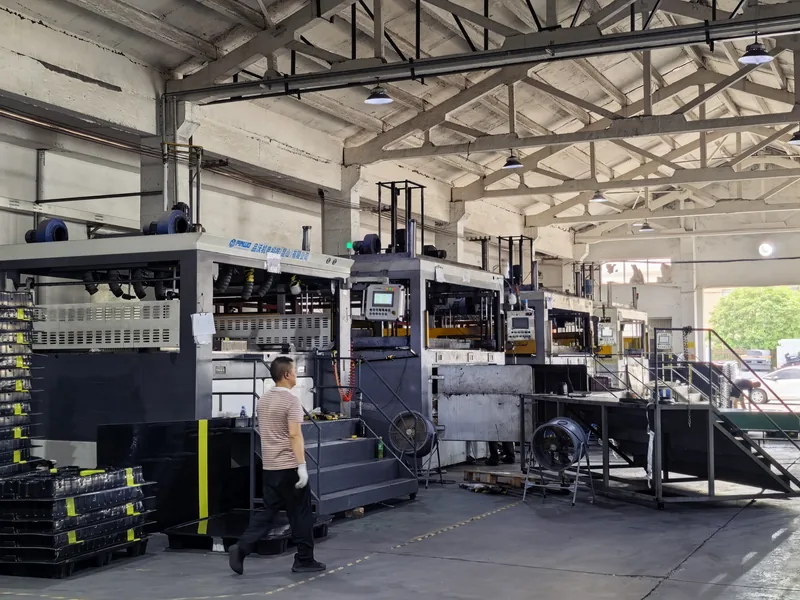
How Do You Calibrate and Maintain the Heating System?
Verify every zone setpoint against an independent measurement — a contact probe or a calibrated IR gun on the sheet surface — and repeat the check after any heater or controller replacement. Working sheet-surface temperatures for common resins fall roughly between 130 and 200 °C, with ABS at the low end of that band and PC near the top.
ISO 306 defines the Vicat softening temperature1, the point where a heated thermoplastic begins to soften and sag under its own weight, and heater calibration is sanity-checked against such values because a sheet heated unevenly past its softening region will not draw evenly. Replace heater elements in matched sets; one new element between aged ones distorts the zone profile in a way no controller can correct. Clean reflectors and insulation on a quarterly rhythm, verify thermocouple placement after any panel work, and log the as-found readings so the drift direction is visible.
Watch the sag profile itself, not only the numbers. A sheet brought to forming temperature should sag uniformly across its width; a lopsided sag curve is the fastest visual indication of unbalanced zones before a single part is formed. On machines where several zones feed one controller group, verify that the group splits power evenly after any element replacement.
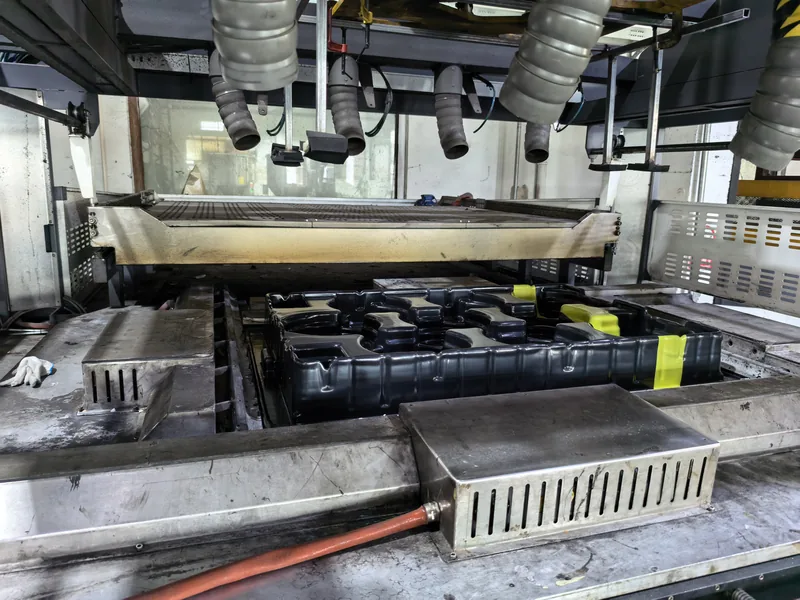
With a maximum forming length of about 2,500 mm, long platens carry many independent heating zones. A single drifting mid-zone produces a defect in the middle of the sheet, away from the edges where eyes naturally look, so zone-by-zone verification is routine maintenance on long machines rather than an optional extra.
Which Tasks Belong on Which Maintenance Schedule?
Frequency should follow three variables: what the machine runs (material and gauge), how long it runs (shifts per day) and what the environment is (dust, humidity, ambient temperature). A machine forming 15 mm PC on two shifts needs a tighter schedule than one forming thin sheet occasionally, even if the two machines are the same model. The table below is a starting framework to adapt, not a universal prescription.
| Task | Interval | What to check | Acceptance criterion |
|---|---|---|---|
| Heater zone scan | Daily | Zone readings vs setpoint; dead or dark segments | Within the band recorded at setup; no dark patches |
| Vacuum draw-down test | Daily | Time to reach working vacuum; hold after isolation | Reaches working level within baseline time; minimal fall-off |
| Pump oil | Weekly | Level, colour, emulsion | Clear oil; no milky layer |
| Seals and clamping frame | Weekly | Gasket cuts, even grip, audible leaks | Uniform clamp; no hiss at rest |
| Motion system | Weekly to monthly | Chains, rails, bearings, lubrication | Smooth platen travel; no stick-slip |
| Full calibration | Quarterly | Independent probes, gauges, thermocouples | Readings agree within stated tolerance |
Whatever intervals you choose, anchor them to observed condition and adjust after the first quarter of data. Treat the table as a floor, not a ceiling.
What Records Prove the Machine Is Stable?
Keep a one-page log per machine per day: date, material and gauge, zone temperatures, time to working vacuum, cycle time and any anomaly. Review the trends weekly; the slope of those lines, not memory, should decide when maintenance is due.
Dimensional confidence comes from first-article checks at every setup plus periodic wall-thickness spot checks with an ultrasonic gauge at corners and other draw-critical areas. Compliance rides on the same records: formed equipment housings are commonly specified against UL 942, the flammability standard that grades how plastic materials burn, and covers sold with an ingress rating depend on IEC 605293, so heater drift that overheats resin or a scored gasket flange becomes a compliance problem rather than a cosmetic one.
Keep sheet batch numbers in the same log entry. When a dimensional complaint arrives months later, matching the part to the machine state and the material batch on that date is what turns a dispute into a five-minute lookup.
"If the first article passes, the machine is stable for months."False
A first article is a snapshot of one sheet batch, one ambient temperature and one heater state. Zones, thermocouples and seals drift continuously, so parts made weeks later can move out of tolerance with no visible event in between.
"Stability is proven by logged trends, not by one good part."True
Zone temperatures, draw-down time and cycle time show where the machine is heading. Flat trends mean stable; sloping trends mean maintenance is due before the next dimensional check fails.
One caution: the log is only useful if anomalies get written down as they happen. Encourage operators to record near-misses — a slow clamp, a soft vacuum reading, a zone that needed a nudge — because those entries are usually the earliest trace of the failures described above.
With reference monthly output of about 100,000–200,000 pieces across the plant, even a single unplanned stop-day consumes a measurable share of capacity. That is why the daily checklist, the pump service records and the trend review work as one loop rather than three separate documents.
FAQ
How often should vacuum pump oil be changed in a thermoforming shop?
Inspect weekly and change on condition, with the running-hours baseline taken from the pump manufacturer’s specification. Shorten the interval for two-shift schedules, humid environments and heavy gauge work, and treat any milky emulsion as an immediate change.
Why do formed parts suddenly show thin corners or webbing?
Thin corners usually mean heater drift — one zone cooler or hotter than its neighbours — while webbing often points to vacuum losses from a leaking gasket or a tired pump. Check zone temperatures and draw-down time first; both are already part of the daily checklist.
Do thick sheets change the maintenance schedule?
Yes. A 15 mm PC or PP sheet carries far more thermal load per cycle than thin stock: longer heat soak, more heat absorbed by reflectors and frame, longer pump runtime. Tighten cleaning and verification intervals accordingly, and remember that structural panels are judged on heat deflection temperature under ISO 75-24, which leaves little margin for heat-starved forming. Ambient temperature matters too — a hot summer shop changes both heater balance and cooling-water behaviour, so the schedule you set in winter deserves a re-check in July.
What spares should a forming shop keep on hand?
Heater elements, thermocouples, clamping gasket stock, pump oil and filters, vacuum valve seals and drive belts. These are the items whose failure stops a machine immediately; holding them turns a multi-day supplier wait into a same-day swap.
To keep exploring the forming side — tooling choices, material behaviour and part design — see the vacuum forming process overview or learn how a China vacuum forming manufacturer runs these maintenance routines across a full machine fleet.
-
Vicat softening temperature: The temperature at which a flat-ended needle penetrates a plastic specimen a set depth under specified load, defined in ISO 306; it indicates where heated sheet begins to soften and sag. ↩
-
UL 94: The flammability standard that classifies how plastic materials burn; it is required for many equipment enclosures and formed covers. ↩
-
IP code: The ingress protection rating defined in IEC 60529, describing how well an enclosure excludes dust and water; rated formed covers depend on undamaged gasket and flange surfaces. ↩
-
HDT: Heat deflection temperature, the temperature at which a standard bar deflects a specified amount under flexural load, defined in ISO 75-2. ↩