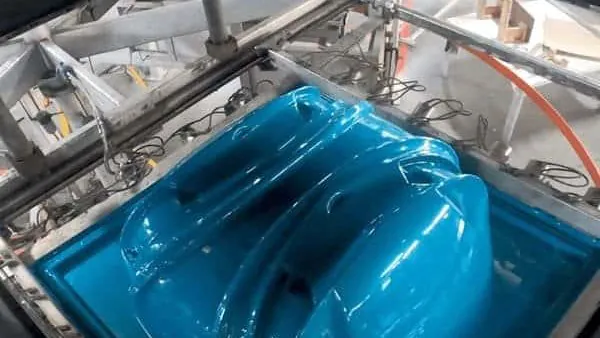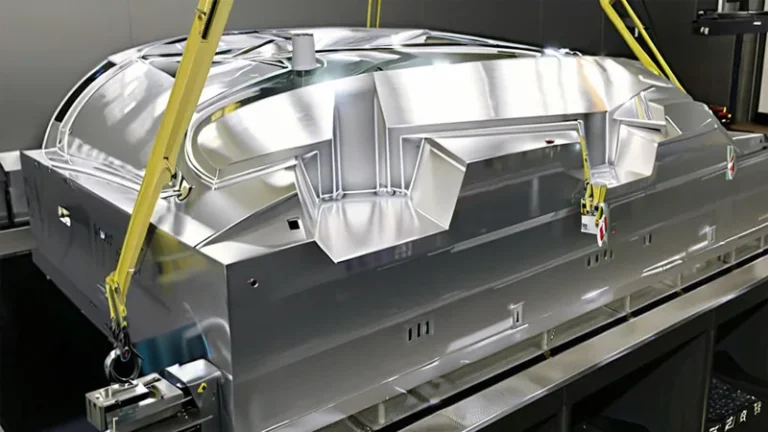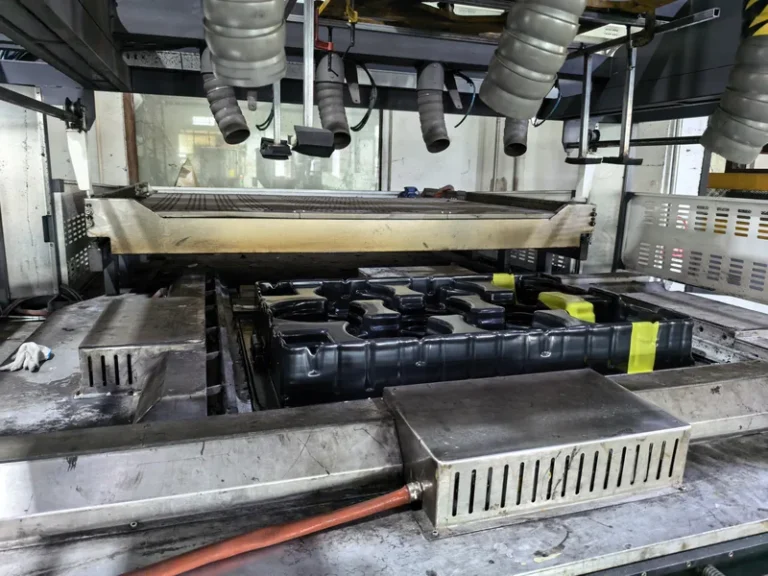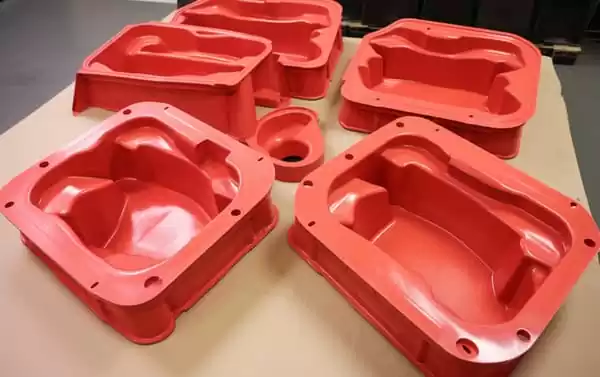
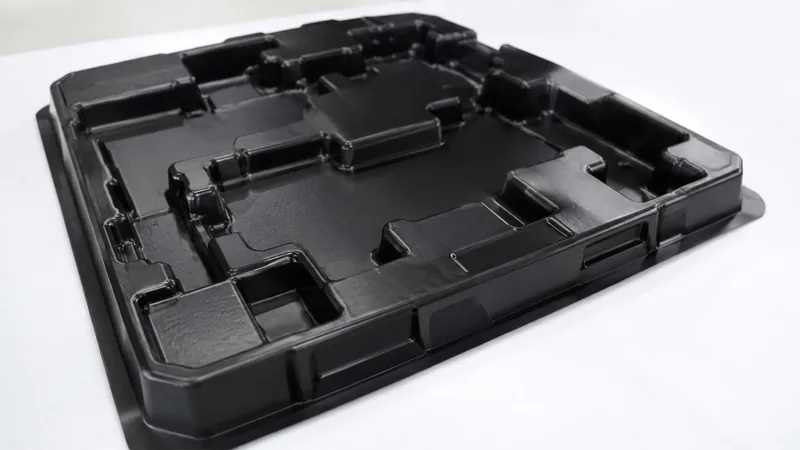
Packaging buyers rarely start the sustainability conversation from a blank page. Drop tests, cleanliness rules, stack strength and unit cost all arrive first. Thermoformed packaging earns its environmental case inside those constraints: it starts from a flat sheet, forms plastic only where the geometry needs it, and keeps the resin identity intact for recycling. This article breaks down where the real environmental gains come from, which material decisions decide the outcome, and which supplier claims deserve a harder look before you commit a packaging program.
- Thermoformed packaging uses less plastic per part because material is placed only where the part geometry needs it.
- Heavy-gauge vacuum forming produces single-material parts, so trim scrap and end-of-life packaging stay in one clean recycling stream.
- Downgauging works only when it is backed by validated sheet data, not by cutting gauge and hoping the drop test survives.
- Resin choice — PP, HDPE, PC, PVC or LDPE — decides recyclability more than the forming process itself.
- Food-contact thermoformed packaging must meet documented migration limits on the finished part, not just a resin certificate.
- Reusable heavy-gauge trays amortize their material footprint over hundreds of handling cycles.
Why Is Thermoformed Packaging Better for the Environment?
Thermoformed packaging is better for the environment because it uses less plastic per part and keeps that plastic in a single, identifiable resin. Vacuum forming shapes a heated sheet only where the design needs material, so a tray carries plastic in its walls instead of in machined-off bulk. Less resin per part, less mixed-material waste and a longer usable life add up to a lower footprint per delivery cycle.
The mechanical reason is material placement. A thermoformed tray is a shell: deep pockets where the product sits, thin webs where nothing needs to sit. Wall thickness follows sheet gauge and draw ratio, so a designer can concentrate thickness in a corner that takes repeated handling and let low-stress surfaces run thinner on the same part. That gradation is hard to justify economically in processes that must fill every cavity of a tool equally.
The process itself runs at moderate energy intensity. Sheet is preheated into a forming window — roughly 120 to 180 °C depending on the resin and heater type — drawn under vacuum or modest air pressure, then cooled against an aluminum or composite tool. There is no high-pressure packing stage and no large machining allowance to cut away. Per-part energy depends on cycle time and heater efficiency, but the physics of shaping a preheated sheet with ambient-pressure air keeps the energy ceiling low.
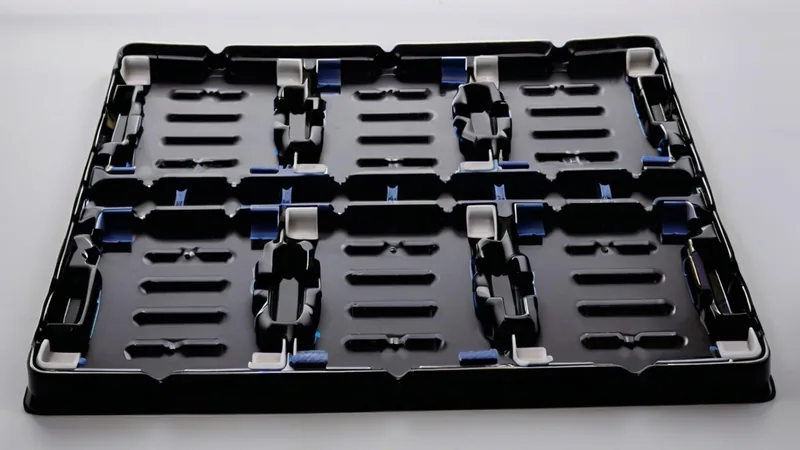
Durability extends the argument. Heavy-gauge packaging is often a returnable asset rather than a single-use consumable: dunnage trays, tote lids and equipment liners survive hundreds of logistics loops before retirement. At end of life, the part is one resin, so it re-enters a recycling stream instead of becoming mixed-material waste. For typical part families and use cases, review thermoformed packaging applications.
Where the Environmental Gains Actually Come From
Material efficiency: The largest lever is resin per part. Downgauging — reducing sheet thickness while keeping the required performance — only works when it is guided by data.1 Sheet suppliers publish tensile properties to ISO 527-2, which specifies the standard tensile test run on thermoformed sheet; comparing candidate materials on that common basis tells you how much gauge you can remove before stiffness or impact margins disappear.2
Heat resistance for reusable parts: Returnable packaging sees sunlit logistics yards, warm production floors and occasional hot washdowns. For those parts, ask for heat deflection data: ISO 75-2 specifies the standard test for the deflection temperature of plastics under flexural load, which predicts when a loaded tray or lid starts to soften rather than deform elastically. A tray that stacks well at room temperature but sags at 70 °C fails environmentally twice — it is replaced early and it wastes the resin invested in it.3
ZetarVac runs more than 20 vacuum forming and thermoforming machines, processing sheet from 0.5 to 15 mm with a maximum forming length of about 2,500 mm. For a packaging program, that means one process covers thin consumer trays through heavy industrial dunnage, and the material-efficiency assumptions you validate on prototypes carry into production volume.
Service life as a multiplier: The environmental math of reusable packaging is simple: resin footprint divided by the number of use cycles. A 4 mm HDPE tray used 300 times beats a thinner single-use alternative on every per-trip metric, provided the design survives the handling reality. That is why wall thickness, corner radii and stacking features deserve engineering attention — they decide whether the reuse loop actually closes.
How Vacuum Forming Reduces Material Waste in Heavy-Gauge Packaging
Vacuum forming reduces waste because the starting sheet is cut close to the developed area of the part, and everything trimmed away is one clean resin. Offcut frames, cavity webs and trim slivers are not mixed waste; they are the same polymer as the part and can be reground or routed to a recycler as a segregated stream. The waste that remains is bounded, visible and priceable.
In heavy-gauge work,4 the trim fraction depends on cavity nesting and part geometry, not on chance. Multi-cavity trays leave webs between pockets; deep-draw parts develop corner thinning that must be balanced with plug assist or heater zone profiling. An experienced molder tunes sheet temperature and vacuum paths so material distributes evenly instead of pooling in flanges that will only be trimmed off. A leaner flange means less resin purchased and less scrap generated.
"Vacuum forming throws away most of the sheet, so it cannot be an efficient packaging process."False
A heavy-gauge part consumes roughly the sheet area its developed surface needs; trim is limited to frames, webs and edges. Treating that bounded fraction as the whole sheet leads buyers to reject a process whose scrap stream is actually single-material and readily reground.
"Trim scrap from single-material thermoformed packaging is one of the easiest plastic streams to recycle."True
The offcuts are one polymer, free of labels and adhesives, and generated at a single point in the plant. That makes a regrind loop or a segregated recycler relationship straightforward — provided the resin itself is a recyclable grade, which is a design decision, not a process one.
Ask any candidate supplier two questions: what share of sheet becomes saleable part weight on your geometry, and where the rest goes. A plant that regrounds its own single-material offcuts into non-critical parts, or segregates them for a licensed recycler, has a closed and auditable loop. Vague answers here usually predict vague claims elsewhere.
Which Materials Make Thermoformed Packaging Recyclable?
PP and HDPE give thermoformed packaging the widest established recycling streams, while PC and PMMA suit long-life reusable parts that rarely enter municipal recycling. PVC trades end-of-life simplicity for low cost and chemical resistance. Because the resin — not the forming process — decides recyclability, lock the material choice before the drawing freezes.
| Material | Typical thermoformed packaging use | End-of-life profile | Design watch-outs |
|---|---|---|---|
| PP | Trays, boxes, equipment liners | Widely recycled stream; strong chemical resistance | Higher shrink; sag control needed on wide sheet |
| HDPE | Industrial trays, totes, liners | Established stream; tough and moisture-proof | Larger thermal shrink; verify stacking at elevated temperature |
| LDPE | Thin-wall packaging parts | Flexible stream; lower stiffness | Poor stiffness over spans; better as liners |
| PVC | Trays, packaging, industrial liners | Cost-effective; recycling access narrower and region-dependent | Confirm grade and local acceptance early |
| PC | Clear guards, protection covers, reusable parts | Very durable; long service life offsets limited recycling | Sensitive to some cleaning chemicals; check stress cracking |
| PMMA | Clear covers, display packaging | Long-life use; clarity restorable by polishing | More brittle than PC; handle edges carefully |
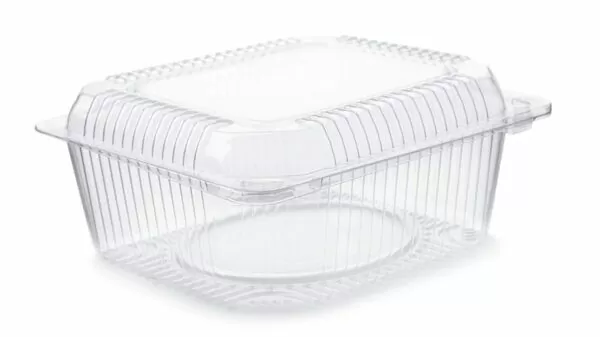
Clarity matters for retail and display packaging, and it should be measured rather than assumed: ISO 13468 specifies the measurement of total luminous transmittance of transparent plastics, giving clear formed parts a laboratory number instead of a visual judgement.5 If a customer specification says transparent, ask which transmittance value and which test method the acceptance is written against.
Construction choices matter as much as resin. A single-material design with minimal ink coverage recycles cleanly; a part with a bonded foam layer, metallized surface or mixed-polymer lamination may carry more performance per gram but loses its route back into a recycling stream at end of life.
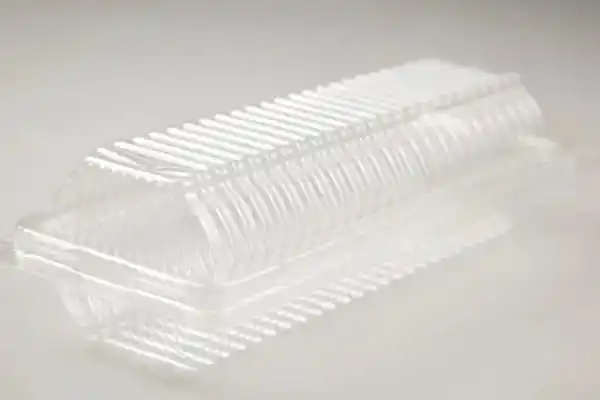
The plant’s material library spans PVC, ABS, HDPE, LDPE, PP, PC, PMMA and other engineering resins, all formable on the same machine base. For an environmental program that is practical leverage: a single-material PP or HDPE design can replace a layered construction without changing suppliers, tooling strategy or quality systems.
Can Thermoformed Packaging Meet Food-Contact and Durability Requirements?
Yes — when the resin grade and the documentation back it. Food-contact thermoformed packaging must comply with EU 10/2011, the European regulation for plastic materials and articles intended to come into contact with food, which sets specific migration limits for the finished article.6 Durability is validated the same way: standardized tests, not visual inspection.
"A food-grade resin certificate is enough to qualify thermoformed packaging for food contact."False
Migration compliance applies to the finished article, so colorants, regrind ratio and forming conditions can all change the result. Qualifying on the resin certificate alone leaves the program exposed the moment an auditor asks for documentation on the finished tray.
"Food-contact thermoformed packaging is qualified by testing the finished part, not the sheet."True
That is how EU 10/2011 is structured. Requesting a declaration of compliance backed by migration data on the actual article is the fastest way to separate documented compliance from marketing language.
For mechanical durability, two tests cover most packaging programs. ASTM D790 specifies the standard test for the flexural properties of plastics, which is how you compare the stiffness of formed panels, tray lids and stacked boxes on a common scale. ISO 6603-2 defines instrumented puncture impact testing of rigid plastics, a practical way to quantify how a tray wall responds to a dropped corner load instead of relying on warehouse anecdotes. For inspection planning, see quality control for thermoformed packaging.
How Should You Judge a Supplier’s Environmental Claims?
Most environmental claims fail on specificity, not on intent. Four checks separate packaging suppliers who can substantiate their numbers from those who repeat them.
Ask for resin, grade and gauge. A sustainable-packaging statement without a polymer, a grade and a sheet thickness is not verifiable. Request the datasheet and the tests behind it — tensile, flexural, heat deflection — so your downgauging and reuse assumptions rest on numbers rather than adjectives.
Ask where trim scrap actually goes. A genuine regrind loop or documented recycler relationship is auditable; a general assurance about waste handling is not. For food-contact programs, confirm that any regrind policy is compatible with migration compliance on the finished article.
Check the trimming path. Trim quality affects both scrap rate and part consistency. A 5-axis CNC trimming centre that follows the forming tool holds the outline without manual refixturing, which keeps finished-part weight — and therefore resin per part — stable across batches.
Model total cycles, not just material. For reusable packaging, ask what the life expectation is based on: material toughness data, wall thickness, corner design and the actual handling chain. A supplier who can walk through that calculation is one whose reuse claims will survive your own logistics data.
Independent background helps here too: the SPE Thermoforming Division publishes technical resources on process fundamentals, useful for benchmarking what a supplier tells you.
ZetarVac trims formed parts on a 5-axis CNC centre whose outline follows the forming tool, and supports prototyping through small and large batch production at a reference monthly capacity of about 100,000–200,000 pieces. For packaging programs, that means the material assumptions proven on first articles are the same ones running at volume — no process switch between validation and production.

FAQ
Is thermoformed packaging actually recyclable?
It depends on the resin and the construction, not the process. Single-material PP or HDPE thermoformed parts fit established recycling streams; PVC and heavily decorated or laminated parts are less straightforward. Specify one polymer, minimal ink coverage and no bonded layers if recyclability is the priority.
Does heavy-gauge thermoforming use a lot of energy?
Less than most buyers expect. The process heats sheet into a forming window and shapes it with vacuum or modest air pressure, without high-pressure packing or heavy machining allowances. Energy per part is driven by heater efficiency and cycle time, both of which improve with good nesting density and heater zone control.
Can thermoformed trays include recycled content?
Often yes, with limits. Regrind from clean, single-material offcuts is commonly blended into non-critical or non-food-contact packaging parts. Food-contact and medical-adjacent packaging usually restricts regrind, because migration compliance must be demonstrated on the finished article with the exact production recipe.
How thick and how large can thermoformed packaging be?
Heavy-gauge vacuum forming commonly handles sheet from 0.5 to 15 mm and can form parts up to about 2,500 mm long, depending on the machine and tool. That range covers thin retail trays through full-size industrial dunnage in a single process.
Where should I start when evaluating thermoformed packaging?
Start with the part, not the promise: define a resin shortlist, a gauge range and the tests that matter — stiffness, impact, heat exposure or food-contact compliance — then pressure-test supplier claims against them. To keep researching before you compare suppliers, explore the vacuum forming guide to see how heavy-gauge packaging moves from sheet specification to trimmed parts, or learn how a China vacuum forming manufacturer organizes sheet sourcing, tooling and 5-axis trimming for packaging programs.
-
Downgauging: Downgauging is the deliberate reduction of sheet or wall thickness while maintaining required mechanical performance, done to cut resin use and cost per part. ↩
-
ISO 527-2: ISO 527-2 specifies the tensile test method for plastics, including rigid thermoformed sheet, and is the common basis for comparing sheet stiffness and strength data. ↩
-
HDT: HDT stands for heat deflection temperature, the temperature at which a plastic specimen deflects a defined amount under flexural load, measured per ISO 75-2. ↩
-
Heavy gauge: Heavy gauge refers to thermoforming with thick sheet — commonly above about 1.5 mm — used for durable, structural or reusable parts such as industrial packaging. ↩
-
ISO 13468: ISO 13468 specifies the measurement of total luminous transmittance of transparent plastics, the standard metric for comparing clear formed parts. ↩
-
EU 10/2011: EU 10/2011 is the European regulation on plastic materials and articles intended to come into contact with food, setting specific migration limits. ↩